


Download the article in pdf format
Publication date: 01.04.2022
DOI: 10.51871/2782-6570_2022_01_01_5
UDC 612.816; 796.034.6
FEATURES OF FUNCTIONAL STATE OF THE NEUROMUSCULAR SYSTEM IN ELITE FEMALE ATHLETES OF DIFFERENT SPORTS
S.M. Abutalimova, S.V. Nopin, Yu.V. Koryagina
FSBI “North-Caucasian Federal Research-Clinical Center of the Federal Medical and Biological Agency”, Essentuki, Russia
Annotation. The purpose of this study was to examine and compare parameters of the neuromuscular system’s functional state of female athletes with different direction of the training process. The study involved 41 female athletes specialized in weightlifting, track-and-field, triathlon, biathlon, rhythmic gymnastics. We have discovered higher values of the motor response (area, amplitude) in athletes, who train speed, power and endurance (track-and-field, weightlifting, biathlon, triathlon); higher values of nerve conduction velocity along the motor fibers of the peroneal nerve in athletes specialized in the speed-power direction (track-and-field, weightlifting); lower values of residual latency in athletes of complex coordination sports. Therefore, as a result of the conducted research, we revealed features of the neuromuscular system in female athletes engaged in different sports.
Keywords: neuromuscular system, stimulation electroneuromyography, female athletes, sexual dimorphism.
Introduction. Typical features of the neuromuscular system’s (NMS) functioning form within the process of the long-term sports training [1-3]. It is known, that physiological processes related to the adaptation of an athlete’s NS to regular physical loads contributes to high results in sports [4-6]. Moreover, direction of the training process and the specificity of loads influence the functional state of an athlete’s NMS. Currently, the biggest part of conducted studies dedicated to an evaluation of the NMS work was carried out in male athletes [7-8]. This study’s relevance is due to not only research of the NMS work parameters in female athletes, but also to the identification of correlations between the training process’s direction and motor response indicator when conducting stimulation electroneuromyography.
The purpose of the study was to examine and compare parameters of the neuromuscular system’s functional state of female athletes with different direction of the training process.
Methods and organization. The study involved 41 female athletes specialized in weightlifting (7 people), track-and-field (middle-distance sprinters, 13 people), triathlon (6 people), biathlon (6 people), rhythmic gymnastics (9 people). Average age of the athletes is 21.4±4.1 years. It was carried out with the stimulation electroneuromyography method on the 4-channel hardware and software complex Neuro-MVP (Neurosoft, Ivanovo). We registered motor response from the extensor digitorum brevis muscle, innervated by the n. Peroneus. Following parameters of the motor response were analyzed: latency, residual latency, amplitude, surface, motor response duration, nerve conduction velocity (NCV). The data statistical processing was carried out with the Mann-Whitney U-test in the Statistica 13.0 software.
Results and discussion. The latency examination in the “Tarsus” stimulation point on the right revealed a significant difference (р⩽0.04) in parameters between track-and-field (3.7±0.5 ms) and triathlon (4.3±0.7 ms) athletes. In other stimulation points, latency values of track-and-field female athletes (“Head of fibula” – 10.8±1.0 ms, р⩽0.03; “Popliteal fossa” – 12.4±0.9 ms, р⩽0.03) and gymnasts (“Head of fibula” – 11.2±1.0 ms, р⩽0.008; “Popliteal fossa” – 13.6±1.5 ms, р⩽0.01) (fig. 1).
Latency parameters in the “Tarsus” stimulation point on the left is lower in weightlifters (3.3±0.8 ms) than in track-and-field (3.9±0.3 ms, р⩽0.04), triathlon (4.6±1.1 ms, р⩽0.02), and biathlon athletes (4.8±1.4 ms, р⩽0.01). Moreover, latency values of biathlon athletes (4.8±1.4 ms) were significantly different from parameters in gymnasts (3.6±0.5 ms, р⩽0.01) and track-and-field athletes (3.9±0.3 ms, р⩽0.04). In the “Head of fibula” stimulation point, latency parameters in track-and-field athletes (9.4±1.1 ms) were also lower compared with those in track-and-field (10.7±0.9 ms, р⩽0.03), rhythmic gymnastics (11.2±0.8 ms, р⩽0.02) and biathlon (11.4±2.0 ms, р⩽0.05) athletes. In the “Popliteal fossa” stimulation point, latency values in weightlifters (10.8±1.0 ms) were significantly different from those in track-and-field (12.1±0.7 ms, р⩽0.02), triathlon (12.9±0.8 ms, р⩽0.005), biathlon athletes (13.4±2.2 ms, р⩽0.01) and gymnasts (13.2±1.3 ms, р⩽0.01) (fig. 2).
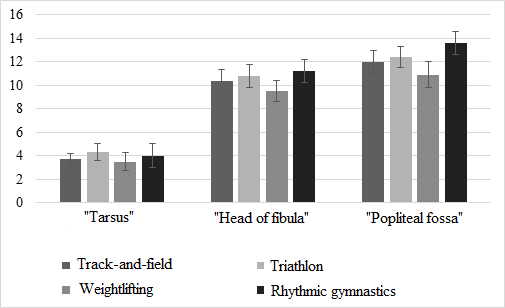
Fig. 1. Motor response latency parameters on the right in female athletes specialized in track-and-field, weightlifting, triathlon, rhythmic gymnastics
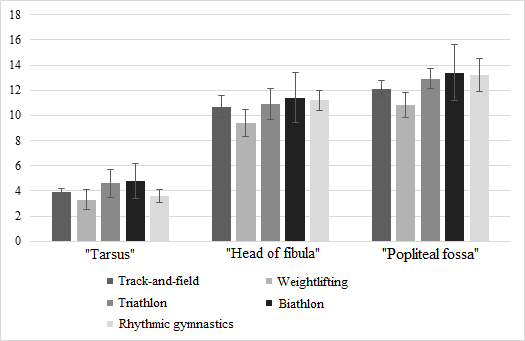
Fig. 2. Motor response latency parameters on the left in female athletes specialized in track-and-field, weightlifting, triathlon, biathlon, rhythmic gymnastics
Parameters of residual latency on the right is significantly different between athletes of track-and-field (2.3±0.4 ms) and triathlon (3.0±0.7 ms, р⩽0.03). We also revealed differences on the left side when comparing the group of triathlon athletes (3.0±0.6 ms) with groups of weightlifters (2.0±0.7 ms, р⩽0.02) and gymnasts (20±0.5 ms, р⩽0.01). Residual latency parameters were also different in track-and-field athletes (2.6±0.4 ms) and gymnasts (2.0±0.5 ms, р⩽0.02) (fig. 3).
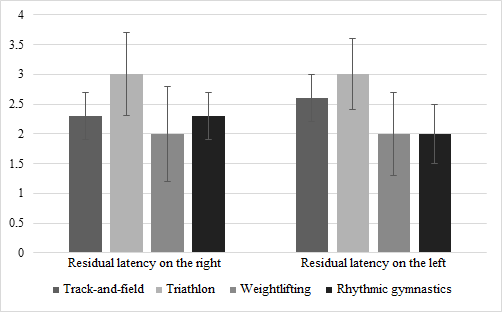
Fig. 3. Residual latency parameters in female athletes specialized in track-and-field, weightlifting, triathlon, rhythmic gymnastics
Analysis of electromyography (EMG) data has demonstrated that values of the motor response amplitude in female athletes specialized in rhythmic gymnastics are lower than in female athletes of other sports. For example, in the “Tarsus” stimulation point on the right the motor response amplitude in gymnasts amounted to 3.8±1.0 mV, in track-and-field athletes – to 6.5±2.6 mV (р⩽0.002), in weightlifters – to 6.2±1.8 mV (р⩽0.02), in biathlon athletes – to 6.4±1.6 mV (р⩽0.003). In the “Head of fibula” stimulation point on the right, amplitude parameters in gymnasts (3.1±1.1 mV) were also lower than those in track-and field athletes (6.7±2.8 mV, р⩽0.003), weightlifters (6.2±2.1 mV, р⩽0.02), triathlon (5.3±1.5 mV, р⩽0.01) and biathlon (5.3±2.6 mV, р⩽0.03) athletes. The same data were received when stimulating the peroneal nerve in the “Poplietal fossa” point on the right. The motor response amplitude in gymnasts (2.7±0.9 mV) were significantly different from the parameters in track-and-field athletes (6.7±2.8 mV, р⩽0.0002), triathlon athletes (5.4±1.9 mV, р⩽0.008), weightlifters (7.3±2.2 mV, р⩽0.003) and biathlon athletes (5.8±1.1 mV, р⩽0.002) (fig. 4).
When stimulating the peroneal nerve in the “Tarsus” point on the left, the motor response amplitude in athletes specialized in track-and-field (6.9±2.0 mV) was higher than in triathlon athletes (4.1±1.4 mV, р⩽0.01) and gymnasts (4.6±1.7 mV, р⩽0.008). In the “Head of fibula” point, amplitude parameters of track-and-field athletes (6.5±2.4 mV) are also higher than in gymnasts (4.1±1.3 mV, р⩽0.03). When stimulating the peroneal nerve in the “Popliteal fossa” point, we discovered that amplitude parameters in gymnasts (3.7±1.4 mV) are significantly different from those in track-and-field (6.7±2.1 mV, р⩽0.001) and triathlon athletes (5.0±0.5 mV, р⩽0.03) (fig. 5).
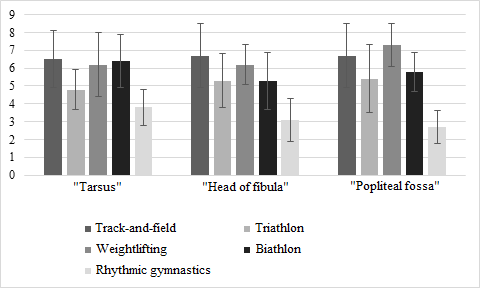
Fig. 4. Motor response amplitude parameters on the right in female athletes specialized in track-and-field, triathlon, weightlifting, biathlon, rhythmic gymnastics
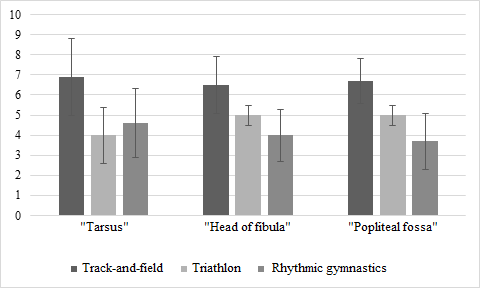
Fig. 5. Motor response amplitude parameters on the left in female athletes specialized in track-and-field, triathlon, rhythmic gymnastics
Motor response duration in gymnasts is higher than in weightlifters in the “Tarsus” point on the right (weightlifters – 5.6±1.0 ms, gymnasts – 6.7±0.8 ms, р⩽0.03), the “Head of fibula” point on the right (weightlifters – 6.2±1.0 ms, gymnasts – 7.3±1.1 ms, р⩽0.02), and the “Head of fibula point on the left (weightlifters – 6.3±0.8 ms, gymnasts – 7.1±0.7 ms, р⩽0.007) (fig. 6).
In the “Tarsus” stimulation point on the right, the motor response area in track-and-field athletes (20.7±7.7 mV×ms) is higher than in gymnasts (14.0±4.1 mV×ms, р⩽0.03). We also found significant differences between indicators of triathlon (14.3±6.5 mV×ms) and biathlon athletes (21.3±6.5 mV×ms, р⩽0.04). In the “Head of fibula” point on the right, these parameters in track-and-field athletes (22.3±9.1 mV×ms) are higher than in gymnasts (11.8±4.9 mV×ms, р⩽0.01). Values of the motor response area in gymnasts (7.1±3.9 mV×ms) are significantly different from the same parameters in track-and-field athletes (22.6±8.7 mV×ms, р⩽0.0002), triathlon athletes (17.3±5.1 mV×ms, р⩽0.005), weightlifters (21.1±6.7 mV×ms, р⩽0.003) and biathlon athletes (19.8±4.8 mV×ms, р⩽0.003) (fig. 7).
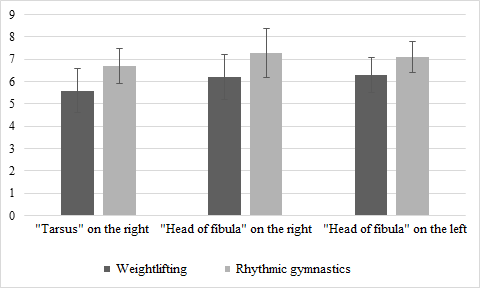
Fig. 6. Motor response duration parameters in female athletes specialized in weightlifting and rhythmic gymnastics
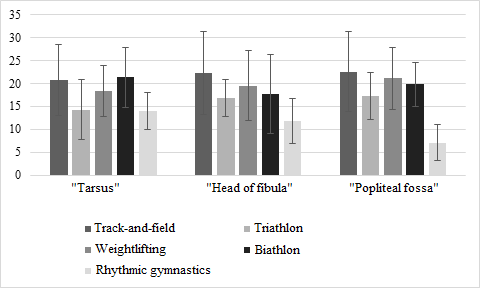
Fig. 7. Parameters of motor response area on the right in female athletes specialized in track-and-field, triathlon, weightlifting, biathlon, rhythmic gymnastics
In the “Tarsus” stimulating point on the left, parameters of motor response area in track-and-field athletes (21.6±6.5 mV×ms) are higher than in triathlon athletes (12.9±5.4 mV×ms, р⩽0.02), weightlifters (16.5±5.6 mV×ms, р⩽0.03) and gymnasts (15.9±4.1 mV×ms, р⩽0.04). In the “Popliteal fossa” point on the left, values of motor response area were also different in female athletes specialized in track-and-field (22.3±7.9 mV×ms) and rhythmic gymnastics (11.7±6.5 mV×ms, р⩽0.006) (fig. 8).
When stimulating the peroneal nerve in the “Head of fibula” point on the right, the nerve conduction velocity is higher in weightlifters (55.8±4.5 m/s) compared to track-and-field athletes (50.1±3.4 m/s, р⩽0.008) and gymnasts (47.6±2.0 m/s, р⩽0.003). We also identified lower values of the nerve conduction velocity in gymnasts (41.6±12.9 m/s) compared to track-and-field athletes (59.4±7.4 m/s, р⩽0.001), weightlifters (62.1±9.0 m/s, р⩽0.001) and biathlon athletes (61,.5±4.2 m/s, р⩽0.002) when stimulating the peroneal nerve on the “Popliteal fossa” point on the right (fig. 9).
The nerve conduction velocity when stimulating the peroneal nerve in the “Head of fibula” point on the left is lower in gymnasts (45.7±2.7 m/s) compared to track-and-field athletes (50.8±3.1 m/s, р⩽0.003), triathlon athletes (53.6±5.8 m/s, р⩽0.01) and weightlifters (53.7±5.2 m/s, р⩽0.01). We identified significantly higher values in the “Popliteal fossa” point in female athletes specialized in weightlifting (66±6.6 m/s) compared to the data from biathlon (47.8±7.6 m/s, р⩽0.003) and triathlon athletes (46.7±6.9 m/s, р⩽0.01). Velocity parameters are also higher in track-and-field athletes than in biathlon (47.8±7.6 m/s, р⩽0.01) and triathlon athletes (46.7±6.9 m/s, р⩽0.008) (fig. 10).
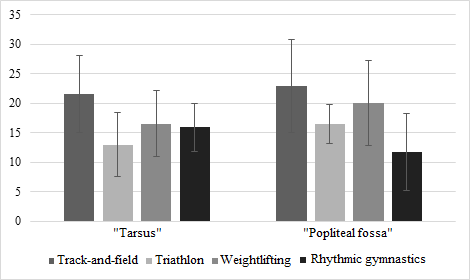
Fig. 8. Motor response area parameters in female athletes specialized in track-and-field, triathlon, weightlifting, rhythmic gymnastics
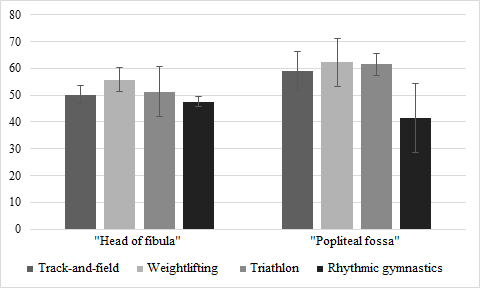
Fig. 9. Nerve conduction velocity parameters on the right in female athletes specialized in track-and-field, weightlifting, biathlon, rhythmic gymnastics
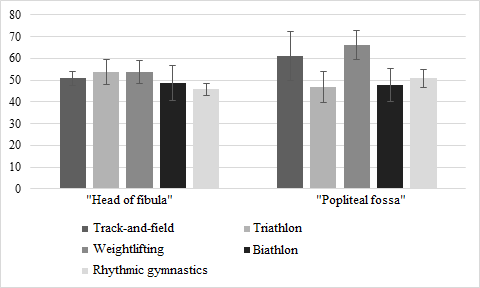
Fig 10. Nerve conduction velocity parameters on the left in female athletes specialized in track-and-field, triathlon, weightlifting, biathlon, rhythmic gymnastics
The data obtained as a result revealed that parameters of the neuromuscular transmission are different in female athletes of different specialization. Moreover, motor response parameters are higher in athletes training speed, power and endurance (track-and-field, weightlifting, biathlon, triathlon) than in athletes of complex coordination sports (rhythmic gymnastics. We have found higher values of the nerve conduction velocity in track-and-field athletes and weightlifters compared to triathlon and biathlon athletes. Meanwhile, gymnasts have lower values than triathlon and biathlon athletes.
Conclusion. Therefore, as a result of the conducted study, we have discovered features of the neuromuscular transmission parameters in female athletes of different sports. The highest values of motor response were registered in athletes training speed-power qualities and endurance. Meanwhile, higher nerve conduction velocity was identified in athletes following the speed-power direction of the training process, lower values were found in athletes of complex coordination sports.
REFERENCES
- Zamchij T.P., Koryagina Yu.V. Morphological, functional and psychological features of male and female athletes of power sports from the position of sexual dimorphism. Therapeutic Physical Culture and Sports Medicine, 2011, no. 7(91), pp. 18–26. (in Russ.)
- Popova I.E., Sysoev A.V. Neuromuscular apparatus and segmental composition of the limbs of qualified divers. Scientific Notes of the P.F. Lesgaft University, 2020, no. 9(187), pp. 293–297. (in Russ.)
- Bashkin V. M. Study of changes in the functional state of the neuromuscular apparatus of athletes during various training periods. Scientific Notes of the P.F. Lesgaft University, 2009, no. 3, pp. 3–6. (in Russ.)
- Akopyan A.O., Kulagina L.A., Domuladzhanova O.V., Kremlev U.N. Functionality of the neuromuscular apparatus of elite female boxers. Theory and Practice of Physical Culture, 2021, no. 1, pp. 88–89. (in Russ.)
- Koryagina Yu.V., Roguleva L.G. The use of electroneuromyography in sports medicine. Modern Issues of Biomedicine, 2018, vol. 2, no. 12, pp. 31–43. (in Russ.)
- Nopin S.V., Koryagina Yu.V. Physiological and biomechanical control of the functional state of the motor system of athletes. Essentuki: FSBI NCFRCC FMBA of Russia, 2021. – 176 p. (in Russ.)
- Mikhajlova E.A., Povareshchenkova Yu.A. Changes in the parameters of the neuromuscular status of athletes during the competitive season. Pedagogical-Psychological and Biomedical Problems of Physical Culture and Sports, 2010, no. 2(15), pp. 73–77. (in Russ.)
- Rumyantseva E.R., Tarasova E.V. Features of adaptation of the neuromuscular apparatus of badminton players to asymmetric loads in the training process. Man. Sport. Medicine, 2020, vol. 20, no. 4, pp. 69–75. (in Russ.)
INFORMATION ABOUT THE AUTHORS:
Sabina Malikovna Abutalimova – Researcher of the Center for Biomedical Technologies, FSBI “North Caucasian Federal Research-Clinical Center of the Federal Medical and Biological Agency”, Essentuki, e-mail:
Sergej Victorovich Nopin – Candidate of Technical Sciences, Lead Researcher of the Center for Biomedical Technologies, FSBI “North-Caucasian Federal Research-Clinical Center of Federal Medical and Biological Agency”, Essentuki, e-mail:
Yulia Vladislavovna Koryagina – Doctor of Biological Sciences, Professor, Head of the Center for Biomedical Technologies, FSBI “North-Caucasian Federal Research-Clinical Center of Federal Medical and Biological Agency”, Essentuki, e-mail:
For citation: Abutalimova S.M., Nopin S.V., Koryagina Yu.V. Features of functional state of the neuromuscular system in elite female athletes of different sports. Russian Journal of Sports Science: Medicine, Physiology, Training, 2022, vol. 1, no. 1. DOI: 10.51871/2782-6570_2022_01_01_5