


Download the article in pdf format
Publication date: 01.04.2022
DOI: 10.51871/2782-6570_2022_01_01_1
UDC 796.071; 616-003.96
FEATURES OF URGENT ADAPTATION TO HIGH-ALTITUDE CONDITIONS IN ATHLETES WITH DIFFERENT LEVEL OF PHYSICAL CONDITION
A.V. Grebenyuk1,2, V.F. Reps3, A.N. Mozhelskij3
1Pyatigorsk State University, Pyatigorsk, Russia
2Regional Scientific and Sports Center of the North-Caucasian Federal District, Pyatigorsk, Russia
3Pyatigorsk Research Institute of Balneology – the branch of the Federal State Budgetary Institution "North-Caucasian Federal Research and Clinical Center of the Federal Medical and Biological Agency" in Pyatigorsk, Russia
Annotation. The aim of the work was to identify the features of physiological adaptation to hypobaric hypoxia in mountaineers with different experience of climbing 5000 m mountains. The study involved 24 mountaineers aged 24 to 46 years, regularly engaged in mountaineering. They were divided into two groups: 9 people – athletes (mountaineering for at least 5 years) and 15 people – "beginners" (mountaineering from three months to a year). We assessed the saturation level and pulse at different heights of step-by-step adaptation when climbing Mount Kazbek (5033 m). The duration of the expedition was 10 days. The differences in the adaptation strategy between mountaineers with different levels of condition for physical loads in high-altitude conditions is that the level of blood saturation in experienced athletes is maintained at an altitude of 3600 m above sea level with a lower pulse value than in athletes with less climbing experience, which indicates the presence of functional reserves formed during training.
Keywords: step-by-step adaptation to high altitude, hypoxia, alpine region, mountaineers.
Introduction. Increase of functional reserves of an athlete’s body to hypoxia is significant not only for the arrangement of climbing training, but also when planning training for athletes, their better acclimatization to competitions in conditions of hypobaric hypoxia. Many international competitions take place in middle-altitude conditions. For example, the 1968 Olympics took place in Mexico City, located at an altitude of 2240 m above sea level (ASL), the ski tournament at the 2022 Olympics in Beijing took place at an altitude of 1800 m ASL. One of the prerequisites of successful performance in these conditions are the formation of adaptation’s functional reserves of an athlete’s body to physical loads, including conditions of lowered partial oxygen pressure at these altitudes. It was noted earlier that the respiratory (increase of respiratory volume and rapid breathing due to the stimulation of arterial chemoreceptors) and cardiovascular (rapid heartbeats) systems response to hypoxia according to the hyperbolic curve, in dependence to partial oxygen pressure in the blood
(PaO2) [1].
The aim of the study was to examine the physiological adaptation to hypobaric hypoxia in mountaineers with different climbing experience on the 5000 m mountains.
Methods and organization. The study included 24 mountaineers aged 24 to 46 years, who climb regularly. According to the study’s design, we divided them into two groups: 9 people – athletes (mountaineering for at least 5 years) and 15 people – "beginners" (mountaineering from three months to a year). When climbing on Mount Kazbek – 5033 m ASL (Georgia), we conducted the saturation (blood oxygen saturation – SpO2, %) and pulse rate analysis in seated participants with the “Armed YX302” fingertip pulse oxymeter (“Medical equipment”, Russia) at 500 m ASL, 1500 m ASL, 3000 m ASL and 3600 m ASL (before and after the ascension). The expedition took 10 days: first three days – moving from Gergeti village (Georgia) to the altitude of 3000 m ASL (one night stay at 500 m, 1500 m, two stays and one acclimatization day at 3000 m); the 5th day – moving to the “Meteostation” summit camp at 3600 m ASL; the 6th day of acclimatization – ascent to 4000 m ASL, then descent to 3600 m ASL and one night stay; the 7th day – ascent to 4200 m ASL, descent and one stay at 3600 m ASL; the 8th day – ascent to the mountain’s top at 5033 m ASL, descent and one stay at 3600 m ASL; the 9th day – descent from the summit camp to Gergeti village, one stay at 500 m ASL; the 10th day – departure.
The statistical data processing was conducted with the R software package [2], using the non-parametric criterion (the Mann-Whitney U-test) for intergroup comparison. Differences between groups are deemed as statistically significant if p<0.05. The indicators are presented in medians (Me) and quartiles (Q25-Q75), the correlation between indicators in groups was calculated using the Spearman correlation coefficient. The imaging was made in the R programming language [2] with the ggplot2[3], aplpack[4] и GGally[5] software packages.
Results and discussion. The analysis of the degree of formed physical adaptation when climbing Kazbek in mountaineers with different physical condition revealed that at 500 m ASL the saturation level was not different in both groups. However, the saturation level in athletes with less mountaineering experience (“beginners”) was supported by an increase in pulse rate (fig. 1). Schemes below also show great distribution range of this indicator’s values in the group.

Fig. 1. Saturation level and pulse rate at different stages of the step-by-step adaptation to hypoxia – 500 m ASL.
Note: nonparametric – Me(95%CI) – median (red dot), 95% – confidence interval (red lines directed towards different sides from the dot); normal – M(95%CI), mean value (black bold line), 95% – confidence interval (black fine lines)
This tendency remains when climbing to 1500 m ASL (fig. 2). We have also identified an extension in range of individual responses of the cardiovascular system (the pulse rate at this altitude) in the group of experienced athletes.

Fig. 2. Saturation level and pulse rate at different stages of the step-by-step adaptation to hypoxia – 1500 m ASL.
Note: nonparametric – Me(95%CI) – median (red dot), 95% – confidence interval (red lines directed towards different sides from the dot); normal – M(95%CI), mean value (black bold line), 95% – confidence interval (black fine lines)
During the process of the step-by-step adaptation at 3000 m ASL (fig. 3), we have registered a tendency of increasing blood saturation (not significant) in experienced athletes (not significant, р=0.678) with relatively low pulse rate (р=0.011), which indicates a presence of functional reserves, formed during the training process.

Fig. 3. Saturation level and pulse rate at different stages of the step-by-step adaptation to hypoxia – 3000 m ASL.
Note: nonparametric – Me(95%CI) – median (red dot), 95% – confidence interval (red lines directed towards different sides from the dot); normal – M(95%CI), mean value (black bold line), 95% – confidence interval (black fine lines)
The same adaptation mechanism, but in a more pronounced form, is preserved at higher altitudes (the summit camp before and after the ascension – 3600 m ASL, fig. 4, 5).

Fig. 4. Saturation level and pulse rate at different stages of the step-by-step adaptation to hypoxia – 3500 m ASL.
Note: nonparametric – Me(95%CI) – median (red dot), 95% – confidence interval (red lines directed towards different sides from the dot); normal – M(95%CI), mean value (black bold line), 95% – confidence interval (black fine lines)

Fig. 5. Changes in saturation and pulse rate at 3600 m ASL after the ascension
Note: nonparametric – Me(95%CI) – median (red dot), 95% – confidence interval (red lines directed towards different sides from the dot); normal – M(95%CI), mean value (black bold line), 95% – confidence interval (black fine lines)
It is important to note the preservation of these physiological adaptation strategies in experienced athletes after the ascension. However, we have registered a greater variation of individual responses of physiological systems (the width of it is shown on fig. 5, blue color). It can be interpreted as individual metabolic reactions, generated during training, and the specificity of the biochemical enzymatic “profile” of each athlete. Therefore, we have learned that the hypoxic preconditioning contributes to an increase of tolerance to acute hypoxia conditions, which is shown through the less pronounced degree of hemoglobin desaturation and lowered heart rate [6].
It should be pointed out that in case of the ascension the acute (urgent) adaptation effect is implemented mainly at the expense of the cardiovascular system. Figure 6 shows that there is an inverted correlation between the saturation and pulse, and its absolute values increase when climbing under hypobaric hypoxia conditions (from r=-0.1 at 500 m ASL to r=-0.5 at 3600 m ASL). Important is the fact that after the ascension this correlation is much higher (r=-0.8), i.e. the pulse is even higher with lowered blood saturation. When analyzing values of the coefficient correlation between these indicators, we can assume the high degree of physiological connection between them in conditions of the urgent adaptation to hypoxia.
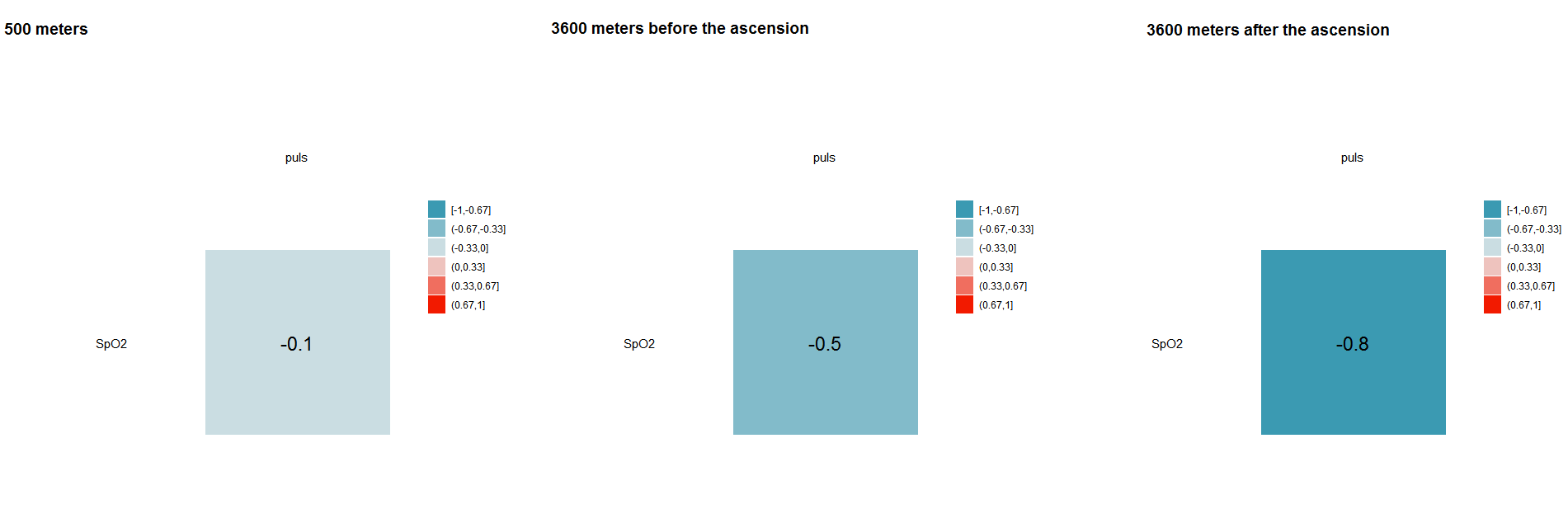
Fig. 6. The Spearman correlation coefficient between saturation indicators and pulse at different stages of the urgent adaptation to hypoxia in high-altitude conditions of 500 m ASL (S=2600.7, p=0.543), 3600 m ASL before the ascension (S=3524.4, p=0.007) and 3600 m ASL after the ascension (the summit camp) (S=4090.6, p<0.001)
After the ascension, the blood saturation level, according to the medians of the whole group, decreases (fig. 7). It indicates an urgent adaptation phenomenon called the “oxygen debt”, where there is a need to recover oxygen in tissues (in myoglobin).

Fig. 7. Dynamics of the saturation and pulse rate (median (Me) values) during the formation of adaptation to hypoxia when ascending Mount Kazbek (5033 m ASL)
Similar changes of the cardiorespiratory system were noted in other works studying adaptation to the high-altitude hypoxia [7-8].
In the study by Yu.V. Koryagina [8], when analyzing urgent adaptation processes in conditions of the one-day expedition to the Elbrus region (2380 m ASL in the Dzhily-Su area), it was revealed that athletes without mountaineering experience also have lowered saturation with a simultaneous increase of heart rate and tone activation of the sympathetic nervous system, but to a greater extent than in the “beginner” group of our study – the athletes, mountaineering for a year and attending regular weekly training sessions according to the developed program for the interval hypoxic training when preparing to ascend in high-altitude conditions.
The experimental works have revealed that preservation of oxygen content in arterial blood in case of hypoxic submaximal loads can be done at the expense of stimulating hypoxic factors (HIF – hypoxia-inducible factor), increased erythropoietin and changes in the hemoglobin oxygen affinity [9-10].
Conclusion. Therefore, we have identified differences in a degree of forming adaptation to hypobaric hypoxia between two mountaineer groups at an altitude of 3600 m ASL. Athletes with less experience have signs of hypobaric hypoxia: lowered blood saturation, increased pulse rate. In the experienced athletes (more than 5 years), the saturation is supported by other physiological mechanisms. The suggested algorhythm of the step-by-step adaptation to hypoxia for 10 days can be used when arranging programs of active tourism, e.g. when ascending to Elbrus.
Mechanisms of forming the long-term adaptation to hypoxia in high-altitude conditions among athletes of different qualification requires further research and appropriate biomedical support.
REFERENCES
- Black C.P., Tenney S.M. Oxygen transport during progressive hypoxia in high-altitude and sea-level waterfowl. Respir Physiol, 1980, no. 39(2), pp. 217-239. DOI: 10.1016/0034-5687(80)90046-8.
2. R Core Team. R: A language and environment for statistical computing. R Foundation for Statistical Computing, Vienna, Austria 2021. Available at: https://www.R-project.org/ (accessed 14.03.2022) - Wickham H. ggplot2: Elegant Graphics for Data Analysis. Springer-Verlag New York, 2016. 213 p.
- Wolf H. aplpack: Another Plot Package (version 190512). 2019. Available at: https://cran.r-project.org/package=aplpack (accessed 14.03.2022).
- Schloerke B., Cook D., Larmarange J., Briatte F., Marbach M., Thoen E., Elberg A., Crowley J. GGally: Extension to 'ggplot2'. R package version 2.1.2. 2021. Available at: https://CRAN.R-project.org/package=GGally (accessed 14.03.2022).
6. Glazachev O.S., Bobyleva O.V. Dynamics of autonomic reactivity and resistance to acute dosed hypoxia in the course of interval hypoxic training. Human Physiology, 2007, no. 2, pp. 81–89. - Reps V.F., Grebenyuk A.V. Technologies for increasing the functional adaptation of athletes in conditions of high-altitude hypoxia. Physiological Journal, 2012, vol. 58, no. 4, pp. 78–84.
- Koryagina Yu.V., Ter-Akopov G.N., Roguleva L.G., Nopin S.V. Mountain tourism: effects of urgent adaptation of the cardiovascular and respiratory systems of the human body (the Dzhily-Su area in the Elbrus region). Resort Medicine, 2019, no. 1, pp. 54–57.
- Boggs D.F., Kilgore D.L., Lacefield S. Correlation between convection requirement and carotid body responses to hypoxia and hemoglobin affinity: comparison between two rat strains. J Comp Physiol B, 2021, no. 191(6), pp. 1031–1045. DOI: 10.1007/s00360-021-01377-7.
- Stewart G.M., Chase S., Cross T.J., Wheatley-Guy C.M., Joyner M.J., Curry T., Lehrer-Graiwer J., Dufu K., Vlahakis N.E., Johnson B.D. Effects of an allosteric hemoglobin affinity modulator on arterial blood gases and cardiopulmonary responses during normoxic and hypoxic low-intensity exercise. J Appl Physiol (1985), 2020, no. 128(6), pp. 1467–1476. DOI: 10.1152/japplphyiol.00185.2019.
INFORMATION ABOUT THE AUTHORS:
Aleksandr Viktorovich Grebenyuk – Associate Professor of the Department of Physical Culture and Sports, Pyatigorsk State University, Pyatigorsk, Director of the Regional Scientific and Sports Center of the North-Caucasian Federal District, Pyatigorsk, e-mail:
Valentina Fedorovna Reps – Doctor of Biological Sciences, Associate Professor, Leading Researcher of the Department for Studying the Mechanisms of the Action of Physical Factors, Pyatigorsk Research Institute of Balneology – the branch of the Federal State Budgetary Institution "North-Caucasian Federal Research and Clinical Center of the Federal Medical and Biological Agency" in Pyatigorsk, e-mail:
Andrej Nikolaevich Mozhel’skij – Head of the Sector of Mathematical Modeling and Statistical pProcessing, Pyatigorsk Research Institute of Balneology – the branch of the Federal State Budgetary Institution "North-Caucasian Federal Research and Clinical Center of the Federal Medical and Biological Agency" in Pyatigorsk, e-mail:
For citation: Grebenyuk A.V., Reps V.F., Mozhelskij A.N. Features of urgent adaptation to high-altitude conditions in athletes with different level of physical condition. Russian Journal of Sports Science: Medicine, Physiology, Training, 2022, vol. 1, no. 1. DOI: 10.51871/2782-6570_2022_01_01_1