


Download the article in pdf format
Publication date: 01.12.2022
DOI: 10.51871/2782-6570_2022_01_04_2
UDC 612.24; 612.59
FEATURES OF THE RESPIRATORY SYSTEM FUNCTION IN YOUNG PEOPLE FROM DIFFERENT REGIONS OF RUSSIA
E.A. Klokotova1, V.N. Pushkina2,3
1Northern (Arctic) Federal University named after M.V. Lomonosov, Arkhangelsk, Russia
2Moscow City University, Moscow, Russia
3Moscow State University of Sport and Tourism, Moscow, Russia
Annotation. The purpose of this study is to examine features of the respiratory system function in young people from different regions of Russia. The study involved 110 boys and 114 girls of working age who were divided in 4 groups: 1 group – boys from European North of Russia (n=50), 2 group – boys from the Central Russia (n=60), 3 group – girls from the European North (n=51), 4 group – girls from the Central Russia (n=63). The study on the external respiration function was made with spirography methods during winter in healthy people who live constantly in their region. The higher indicators of lung capacity and respiratory volume were found in boys and girls from the Central Russia compared to students from the North. The discovered differences between 1 and 2, 3 and 4 groups show that during winter, young people from the Central Russia, without taking into account gender differences, have the respiratory system that is on higher level of adaptive reserves. It is possible that lower results obtained from the test subjects who live in the European North are connected to the time of examination according to the external respiration indicators. During winter, negative temperature behavior is registered in the European North regions. The external respiration system of people from the North, as a response to low temperature effect, is described with activation of defense mechanisms, in our case – a significant decrease in the respiratory volume.
Keywords: external respiration, European North, Central Russia, spirography.
Introduction. The studies of many authors prove that health depends significantly on climate and geographical conditions of the environment [1-2]. Living in conditionally unfavorable climate conditions negatively influences physiological and morphological processes that occur in a human body, provoking stress of compensatory and adaptive mechanisms. Russia is considered as one of the coldest countries in the world. Many territories are unfavorable for constant residence, and they include the European North conditions [3].
The external respiration system, due to its location, primarily suffers from negative environmental factors, in the northern region in particular – from negative temperatures. It is shown that respiratory diseases take the first place in the northern regions of Russia [4-7]. Special attention must be paid to health of children and youth as an important component of our country’s well-being and preservation of working-age population.
Therefore, the purpose of our study is and examination of features of the respiratory system function in young people from different regions of Russia.
Methods and organization. We have examined 110 boys and 114 girls of working age who were divided in following groups: 1 group – boys from European North of Russia (n=50), 2 group – boys from the Central Russia (n=60), 3 group – girls from the European North (n=51), 4 group – girls from the Central Russia (n=63). The study was carried out during December-February with healthy people: 1 group (age – 20.72±1.8 years) and 2 group (age – 18.54±1.3 years), 3 group (age – 20.54±1.7 years) and 4 group (age – 18.74±1.2 years), who constantly live in their region. All test subjects were healthy, included in the main medical group, did not have chronic diseases and were not under regular check-up of cardiologist or pulmonologist. In order to define the functional ability of the external respiration system we used the Spiro-Spectrum spirometer (SSP TU64-1-2267-77) made by Neurosoft. At the beginning, we measured anthropometric indicators (body length and mass) according to generally accepted methods. According to these indicators, there were no statistically significant differences between boys and girls: 1 group: body length – 180.10±7.21 cm, body mass – 71.11±1.62 kg; 2 group: body length – 178.73±7.0 cm, body mass – 69.56±1.93 kg; 3 group: body length – 164.96±5.51 cm, body mass – 56.72±4.92 kg; 4 group: body length – 166.11±4.90 cm, body mass – 57.10±3.12 kg.
The results were processed with the STATISTICA 11.0 software package. The normality of distribution was checked according to the Shapiro-Wilk test (n≤50). We have found that the parameters do not obey the law of normal distribution. The statistically significant differences between the indicators were identified with the Mann-Whitney test with the Bonferroni correction. The significance level – p<0.05-0.001.
Results and discussion. One of the most simple and informative indicators is lung capacity (LC) which is directly dependent on body length and mass, gender, strength of respiratory muscles, bronchi patency and fitness. The conducted analysis of external respiration parameters has revealed that the LC indicator in young boys and girls from the Central Russia was significantly higher by 11% (р<0.01) (fig. 1) and 7% (р<0.05) (fig 2) respectively compared to people from the North. It is known that the LC shows the functional state as well as aerobic capabilities of the external respiration system [8], the lower LC in northern youth may indicate a decrease in these parameters.
It is also known that the LV includes following volume characteristics: inspiratory reserve volume (IRV), expiratory reserve volume (ERV) and respiratory volume (RV). When comparing the IRV and ERV, we have found that there were no significant differences between young boys from the North and young boys from the Central Russia. The same dynamics are found in the girls’ group. These parameters were within the age standard in all groups.
However, during the analysis of results, we have discovered that there are significant dynamics in the RV indicators. Thus, the RV values in residents of the Central Russia are substantially higher, regardless of gender characteristics. The RV values in young men from the Central Russia is higher by 26% compared to young boys from the European North. The girls have the same, though the less pronounced dynamics – the RV indicator was higher by 19% (р<0.001).
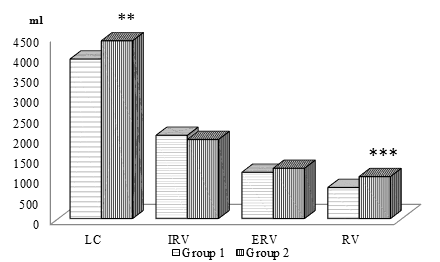
Fig. 1. External respiration indicators in young boys from different regions of Russia
Note: differences between the indicators of young boys from different regions: * – р≤0.05; ** – р≤0.01; *** – р≤0.001
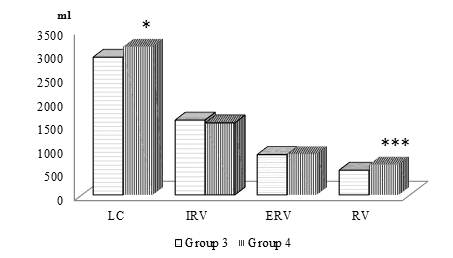
Fig. 2. External respiration indicators in young girls from different regions of Russia
Note: differences between the indicators of young girls from different regions: * – р≤0.05; ** – р≤0.01; *** – р≤0.001
The study of children of different age from the Khanty-Mansijsk Autonomous Okrug – Yugra demonstrated that all 9-11-year old children have the RV average values that are up to more than 2 times higher than the age norm, which may indicate an increased number of functioning alveoli [9]. Moreover, according to the data from other studies, among people who constantly live in low temperature conditions, a decreased RV indicator may be an adaptive mechanism due to the reflex decrease in the inhale depth to optimize function of the respiratory system. This process is related to limitations in the inhale depth and automatic increase of the respiration rate. It strengthens rarefication of breathe air in the respiratory departments which contributes to temperature stabilization in alveoli. Stimulation if decrease in the RV among northern population may occur due to the growth of bronchial resistance/inhibiting action of the respiratory muscles [10].
Conclusion. Therefore, the conducted comparative analysis in the external respiration indicators among the European North and Central Russia residents indicates a higher level of adaptive reserves of the respiration system in young people from the Central Russia, regardless gender characteristics. The substantial increase of LV reserves occurs due to more significant RV indicators identified among students living in more southern regions. These differences are possibly related to the examination time (February), when the significant temperature decrease occurs in the European North regions, while higher temperatures are typical for the Central Russia. It is the cold factor that the external respiration of the northern population reflectively reacts to, automatically activating defense mechanisms that provide preservation of the internal homeostasis but also cause stress of the respiratory system [2, 8, 11].
REFERENCES
- Grigor’eva E.A. Climatic conditions of the Far East as a factor in the development of respiratory diseases. Regional problems, 2017, vol. 20, no. 4, pp. 79-85. (in Russ.)
- Pushkina V.N., Gernet I.N., Fedorova E.Yu., Gernet M.S. Assessment of the adaptive capabilities of the external respiration system in students who came to study in Russia from East Asia. Materials of the All-Russian Scientific and Practical Conference with international participation “Aghadzhanyan readings”. Moscow, April 16-18, 2020. pp. 183-185. (in Russ.)
- Lugovaya E.A., Aver’yanova I.V. Assessing tension coefficient of body adaptation reserves under chronic exposure to factors existing in Polar Regions. Health Risk Analysis, 2020, no. 2, pp. 101-109. DOI: 10.21668/health.risk/2020.2.11 (in Russ.)
- Grishin O.V., Ustyuzhaninova N.V. Breathing in the North. Function. Structure. Reserves. Pathology. Novosibirsk, 2006. pp. 45-50. (in Russ.)
- Andronov S.V., Lobanov A.A., Popov A.I., Emel’yanov A.V. the prevalence of respiratory symptoms among residents of the Russian Far North. Clinical medicine, 2017, vol. 95, no. 3, pp. 260-263. (in Russ.)
- Muzakaeva H.S. On gender-based differences of respiratory volume. Izvestiya Chechenskogo gosudarstvennogo universiteta, 2019, no. 3 (15), pp. 64-68. (in Russ.)
- Shishkin G.S., Grishin O.V., Ustyuzhaninova N.V., Gultyaeva V.V., Umantseva N.D. Pulmonological risk and its correlation with respiratory diseases in students in Novosibirsk. Bulletin of Physiology and Pathology of Respiration, 2004, no. 19, pp. 17-21. (in Russ.)
- Gudkov A.B., Popova O.N., External human respiration in the European North. 2nd edition, revised and supplemented. Arkhangelsk: Northern State Medical University, 2012. 251 p. (in Russ.)
- Kon’kova K.S., Kon’kov V.Z., Mal’kov O.A. Indicators of external respiration of boys aged 9-11 years with different levels of motor activity in the conditions of the north. Modern Issues of Biomedicine, 2022, vol. 6, no. 3. DOI: 10.51871/2588-0500_2022_06_03_10 (in Russ.)
- Shishkin G.S., Ustyuzhaninova N.V. Respiration at low temperatures conditions. Bulletin of Physiology and Pathology of Respiration, 2013, no. 50, pp. 9-15. (in Russ.)
- Maksimova T.A. Comparative analysis of the indicators of the functional state of students of the special medical group living in the conditions of the extreme North. International Journal of Applied and Fundamental Research, 2018, no. 1, pp. 104-108. (in Russ.)
INFORMATION ABOUT THE AUTHORS:
Ekaterina Aleksandrovna Klokotova – Expert in Educational and Methodological Work, Northern (Arctic) Federal University named after M.V. Lomonosov, Arkhangelsk, e-mail:
Valentina Nikolaevna Pushkina – Doctor of Biological Sciences, Professor, Professor of the Department of Adaptology and Sports Training of the Institute of Natural Sciences and Sports Technologies, Moscow City University; Leading Researcher of the Department of Project and Scientific Activities, Moscow State University of Sport and Tourism, Moscow, e-mail:
For citation: Klokotova E.A., Pushkina V.N. Features of the respiratory system function in young people from different regions of Russia. Russian Journal of Sports Science: Medicine, Physiology, Training, 2022, vol. 1, no. 4. DOI: 10.51871/2782-6570_2022_01_04_2