


Download the article in pdf format
Publication date: 01.06.2023
DOI: 10.24412/2782-6570-2023_02_02_2
UDC 376.2
RISK FACTORS LEADING TO KNEE JOINT INJURIES IN BASKETBALL: A LITERATURE REVIEW
K.M. Gimadieva1, N.V. Lunina1,2
1Russian State University of Physical Culture, Sports, Youth and Tourism, Moscow, Russia
2FSBI “North-Caucasian Federal Research and Clinical Center of the Federal Medical and Biological Agency”, Essentuki, Russia
Annotation. The article presents an overview of Russian and foreign studies that consider risk factors for injuries of the ligament system of the knee joint in basketball players.
The results of a theoretical analysis of literary sources showed that anterior cruciate ligament rupture is the most common knee injury in an athlete, regardless of age or sports specialization. A high percentage of traumatization of the ligaments in the knee joint is explained by the specifics of activity in basketball: the movements typical of this sport, the pace of their implementation, the emotional load and involvement of the player during the training and competitive processes, the anatomical and physiological features of basketball players that are taken into account in sports selection. The data obtained made it possible to identify the main risk factors for traumatization of the ligament system of the knee joint in basketball players and determine the main directions for the prevention and rehabilitation of this type of injury.
Keywords: ligament system, knee joint, injury, basketball players, risk factors, prevention, rehabilitation.
Introduction. Basketball has long been one of the most popular team sports in Russia, which is developing rapidly every year. The Russian Men's Basketball Championship has been held since 1992 [1-2]. The structure of Russian men's basketball includes the following professional divisions: VTB United League – 12 clubs (8 Russian); Russian Basketball Super League 1 – 16 clubs; Russian Basketball Super League 2 – 12 clubs.
According to regulations, every club officially registered with the Russian Basketball Federation (RFB) is required to have a youth squad taking part in the Children's and Youth Basketball League (CYBL) championship, which determines the increasing number of young people engaged in professional basketball [1-3]. The transition from youth basketball to professional level, associated with increased physical and emotional stress of the training and competition process and a number of other factors, is often accompanied by an increase in injuries, Injuries are also a common cause of interruptions in sporting activities [4-6].
According to experts, approximately 17% of athletes participating in the training and competition process injure the knee joint during the season [6]. Taking into account the complexity and long-term rehabilitation after knee ligament system injuries, when restoring the athleticperformance of basketball players, it is necessary to consider the specifics of these injuries [6-7], as well as risk factors for the prevention of re-traumatization of athletes.
The purpose of the study: a theoretical analysis of risk factors leading to ligament injuries of the knee joints in basketball.
Methods and organization. We used the method of content analysis of research papers of Russian and foreign authors, presented in peer-reviewed scientific journals, Russian and foreign databases. A total of 30 sources were analyzed and 26 were selected.
Results and discussion. According to data on injury rate in different sports, basketball is one of the ten most injury-prone team contact sports (fig. 1). Injury rate in this sport is very high and varied due to the specific movements of athletes during training and matches.
The ankle, knee, wrist and shoulder joints are more susceptible to injuries, and the lumbar spine is often affected. The relevance of the research results is due to the high frequency of injuries of the knee joint, both in young and professional basketball players. Young players are at risk, especially during the period of transition to a professional team, when the load on the musculoskeletal system increases, often accompanied with little to no adaptation and lack of injury prevention measures [6-7].
Specificity of motor actions in basketball consists of realizing strong angular accelerations with a change in movement, tempo, combined with constant various jumps occurring in constant contact with the opponent, creating an extreme load on the knee joint and making it vulnerable to damage, macro and micro injuries [8].
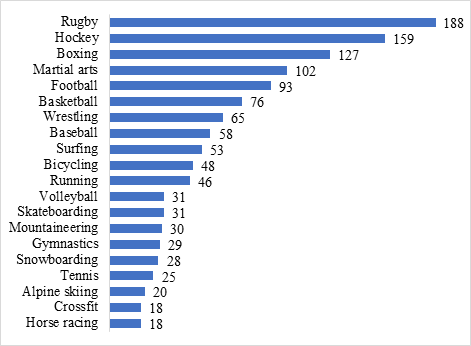
Fig. 1. Injury rate for every 1000 athletes in different sports (American Sports Data Press Release, 2003)
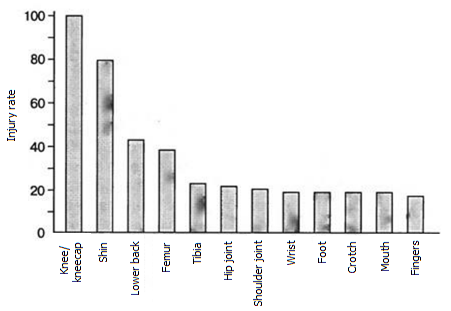
Fig. 2. Location of injuries typical for basketball [12]
Detailed statistics on basketball injuries (fig. 2) show the following distribution of joint injuries of the total number: the ankle joint – 30% and the knee joint – 18%. Of the 80% of injuries, 28% are ligamentous injuries, 21% are muscle injuries, 18% are bruises and 12% are tendinopathy [9-11].
Although the ankle joint accounts for the largest percentage of injuries in basketball, knee injuries are considered to be much more serious and complicated due to the length of recovery time. The recovery time from an ankle injury is easier and quicker, with an average of 4-8 weeks. The rehabilitation period for injuries to the knee joint can last up to a year. In some cases, after a serious knee injury, up to 8% of all players end their career [13-15].
The recovery time after a ligament injury in the knee joint is mostly defined by anatomic and physiological features.
The stability of the knee joint is due to the ligaments around it that hold the bones in position as they bend and straighten the knee. Compared to the hip joint, which is quite stable, the knee joint lacks the “depth” to maintain joint congruence during maximum amplitude movements and the ligament system of the knee joint is highly stressed to maintain it [16-19].
The collateral ligaments along the lateral surfaces of the knee joint (tibia and fibula) are elastically stretched when the knee joint is extended and loosen when it is flexed.
Tears of the tibial collateral ligaments and anterior cruciate ligaments can be caused by blows to the side of the knee [19-20], by maximal extension of the knee joint, by sudden thrusts when performing exercises with a overextended knee, such as deadlifts, forward bending with the barbell on the back, etc. Besides, anterior cruciate ligament is often torn as a result of the femur sliding backwards in relation to the tibia, which may be caused by running backwards (back to front) or kicking the hip. It is also injured when one player falls on other player lying and facing the ground, causing involuntary overextension of the knee joint.
One of the most common reasons for an early end of a basketball player’s career is the knee joint’s injury, mostly the anterior cruciate ligament ruptures with instability of the knee joint [22-24]
Two groups of risk factors are attributed with the injury: disruption of the ligament system of the knee joint and overexposure to the traumatic factor.
The main factors for the protection and prevention of knee injuries in athletes include: sufficient elasticity of the ligaments and joint tissues; adequate blood supply to the ligaments and joint tissues; the degree of development of the joint-strengthening muscles. Effective adaptation of the knee joint to physical loads is important for athletes.
A variety of damaging factors contribute to injury to the knee joint. In athletes participating in team sports, the following are distinguished: impaired biomechanics of the joint’s movement; reduced level of the joint’s fitness to perform a given amount of physical loads; mechanical impact made on the joint; congenital features of the joint’s structure; effect of congenital connective tissue diseases (e.g. connective tissue dysplasia). These factors are not a reason for excluding a child from the sport. However, it will significantly increase the risk of musculoskeletal injuries. This issue is particularly relevant for young basketball players, since the selection criteria is a tall and asthenic body type, typical of athletes with connective tissue dysplasia [25-26].
Conclusion. High rate of the ligament injury in the knee joint in basketball is due to specificity of motor actions: fast and sudden movements on the court, significant number of contact movements with other players and different jumps (vertical, horizontal). During sports selection, morphological, anatomical and physiological features are taken into account as risk factors for injuries in basketball: tall stature, asthenic body type, often caused by dysplasia, which further increases the risk of musculoskeletal injuries. At the same time, the possibility of injury is greatly increased by high physical and emotional stress when levels of competition are changed, in the team due to the increased responsibility, tempo and complexity of the training process.
The literature analysis has formed a theoretical foundation of the role and significance of paying attention to main risks factors of the knee joint in basketball. In future, it would serve as a basis for developing methodological guidelines, comprehensive prevention and recovery measures for treating the knee joint’s injury in basketball players.
REFERENCES
- Nesmeyanov A.A., Shabrov A.V., Ovchinnikov V.P. Basketball and Piterbasket: medical, psychological and pedagogical aspects: a textbook. St. Petersburg: R-KOPI LLC, 2020. 344 p. (in Russ.)
- Physical culture and sports in the educational space: innovations and development prospects: a collection of materials of the All-Russian Scientific and Practical Conference “Herzen Readings”: in 2 volumes. Vol 2. St. Petersburg: Publishing house of the Herzen University, 2020. 412 p. (in Russ.)
- Nesmeyanov A.A., Ovchinnikov V.P., Khuchinskij T. Basketball and Piterbasket in the physical education of a child. Monograph. St. Petersburg: “R-KOPI” LLC, 2021. 308 p. (in Russ.)
- Orlan I.V. Modern sports games. Volgograd: Volgograd State Academy of Physical Culture, 2014. 51 p. (in Russ.)
- Razumets E.I. Psychological diagnosis and correction in the process of recovery of elite athletes after injuries of the musculoskeletal system: an author’s dissertation. Moscow, 2022. 159 p. (in Russ.)
- Matveev D.V., Bolotov D.A. Injuries of the knee joint in basketball and other sports. “Jumper's knee”. The Manual Therapy Journal, 2010, no. 4, pp. 59-68. (in Russ.)
- Physical culture and healthy lifestyle of students: a textbook. Moscow: Publishing house of the MSUCE “Soyuz”, 2000. 250 p. (in Russ.)
- Astanin M. V. Individual physical fitness of elite basketball players. Sports science bulletin, 2010, no. 3, p. 19. (in Russ.)
- Loseva E.A., Chernov S.V. Physiological portrait of sports injuries in basketball. Student Science: materials of the Interregional Scientific Conference, 2019, pp. 160-163. (in Russ.)
- Kozhevnikova O.A., Zavilskij D.V. Analysis of the structure and level of injuries in team sports. Injuries in team sports among athletes of Nizhny Tagil. Eurasian Scientific Association, 2021, no. 3-2, pp. 147-149. (in Russ.)
- Shagalova A. A. Injury prevention in basketball. Science, Technology and Education, 2021, no. 6 (81), pp. 58-61. (in Russ.)
- Vysochin Yu.V. Specific injuries of athletes: a study guide. St.Petersburg: The Lesgaft National State University of Physical Education, Sport and Health, 1980. 43 p. (in Russ.)
- Dorontsev A.V., Zinchuk N.A., Ermolina N.V., Yaroshinskaya A.P. Evaluation of the amplitude exercises use for the sports injuries prevention in basketball. Pedagogico-Psychological and Medico-Biological problems of Physical Culture and Sports, 2020, vol. 15, no. 3, pp. 24-28. (in Russ.)
- Potapov D.A. Injury prevention in basketball. In the World of Scientific Discoveries: Materials of the XXI International Scientific and Practical Conference. Moscow: “Pero”, 2016, pp. 17-20. (in Russ.)
- Shikhov A.V., Semyonov G.I. Medical and pedagogical aspects of sports injuries: a study guide. Ekaterinburg: Publishing House of the Ural University, 2020. 128 p. (in Russ.)
- Klimovitskij V.G., Tyazhelov A.A., Goncharova L.D., Rami T.M. Features of a structure and function of a knee joint: the biomechanical analysis of its dynamic stability. Ukrainian medical almanac, 2011, vol. 14, no. 2, pp. 94-97. (in Russ.)
- Blyum Yu.E. Features of the correction of musculo-articular imbalance of the musculoskeletal system in athletes of game sports (tennis): an author’s dissertation. Moscow, 2009. 125 p. (in Russ.)
- Savel’eva L.V., Varakuta E.Yu., Grigor’eva L.A. et al. Functional anatomy of the musculoskeletal system: a study guide. 2nd Tomsk: the SibSMU Publishing House, 2016. 81 p. (in Russ.)
- Grigor’ev A.P. Drobysheva I.V., Moroga D.F., Krikun E.N. A Successful case of rehabilitation of a badminton player after the combined rupture of both cruciate ligaments and the medial collateral ligament of the knee joint. Sport. Medicine. 2022, vol. 22, no. 2, pp. 164-171. (in Russ.)
- Mazur A.I., Pirogova L.A., Velitchenko N.P.
Injuries of the distal extremities in athletes in the aspect of medical rehabilitation. Modern Approach in Treatment, Rehabilitation and Recovery in Sanatorium Conditions: materials of the International Scientific and Practical Conference dedicated to the 20th anniversary of the OAO “Belagrozdravnitsa”, branch of the “Radon” sanatorium, Grodno, November 14th, 2013. pp. 229-235. (in Russ.) - Fedulova D.V., Serova N.B. Diagnosis of cruciate ligament injuries of the knee joint. Innovative Technologies in Physical Education, Sports and Physical Rehabilitation: materials of the II International Scientific and Practical Conference. 2016. pp. 317-325. (in Russ.)
- Tsvetkova V.O., Pushkareva I.N. Prevention of knee joint injuries in basketball players aged 9-11. Scientific and Methodological Foundations for the Formation of Physical and Mental Health of Children and Youth: materials of the International Scientific and Practical Conference. Ekaterinburg, 2021. p. 469. (in Russ.)
- Zdanovich O.S., Bartova S.V. Prevention of injuries of the musculoskeletal system in basketball classes. Sport and Sports Medicine: materials of the II International Scientific and Practical Conference. 2021. pp. 66-69. (in Russ.)
- Orlan I.V., Burov A.V. Lean approaches to the selection of young basketball players to the training groups of youth sports schools. Physical Education and Sports Training, 2021, no. 3, pp. 44-54. (in Russ.)
- Matveev S.V., Uspenskij A.K., Uspenskaya Yu.K. Morphofunctional criteria for the selection of young basketball players. SPORTMED-2018:
abstract collection of the XIII International Scientific Conference on the issues of current state and development prospects of medicine in elite sports. Moscow, 2018. pp. 75-77. (in Russ.) - Galimullin I.V., Mozhaev E.L., Konovalov I.E. Analysis of the most promising criteria for the selection of young basketball players at the training stage in the training group. Science Almanac, 2019, no. 4-3, pp. 43-46. (in Russ.)
INFORMATION ABOUT THE AUTHORS:
Kamilya Marselevna Gimadieva – Bachelor of the Department of Physical Rehabilitation, Massage and Health-Improving Physical Culture named after I.M. Sarkizov-Serazini, Russian State University of Physical Culture, Sports, Youth and Tourism, Moscow.
Natal’ya Vladimirovna Lunina – Candidate of Biological Sciences, Associate Professor, Associate Professor of the Department of Physical Rehabilitation, Massage and Health-Improving Physical Culture named after I.M. Sarkizov-Serazini, Russian State University of Physical Culture, Sports, Youth and Tourism, Moscow; Senior Researcher of the Center of Biomedical Technologies, FSBI “North-Caucasian Federal Research-Clinical Center of Federal Medical and Biological Agency”, Essentuki, e-mail:
For citation: Gimadieva K.M., Lunina N.V. Risk factors leading to knee joint injuries in basketball: a literature review. Russian Journal of Sports Science: Medicine, Physiology, Training, 2023, vol. 2, no. 2. DOI: 10.24412/2782-6570-2023_02_02_2