


Download the article in pdf format
Publication date: 01.06.2023
DOI: 10.24412/2782-6570-2023_02_02_6
UDC 376.22
EFFICIENCY OF THERAPEUTIC PHYSICAL CULTURE FOR CHILDREN AGED 5-7 WITH SPASTIC DIPLEGIA
Ya.G. Yavorskij1, K.S. Skoryukova1, N.V. Lunina1,2
1Russian State University of Physical Culture, Sports, Youth and Tourism, Moscow, Russia
2FSBI “North-Caucasian Federal Research and Clinical Center of the Federal Medical and Biological Agency”, Essentuki, Russia
Annotation. The article presents the results of the therapeutic physical culture (TPC) used in children aged 5-7 years with spastic diplegia of cerebral palsy. The effectiveness of TPC is represented by an increase in the range of motion in all joints according to goniometry, a decrease in spasticity according to the Ashworth scale and an increase in muscle strength according to the Lovett scale in the affected lower limb. The data obtained can be used in the development of physical rehabilitation programs for spastic diplegia of cerebral palsy and in the work of specialists in adaptive physical culture with this contingent.
Keywords: spastic diplegia, cerebral palsy, therapeutic physical culture.
Introduction. Infantile cerebral palsy is a condition caused by brain damage sustained during the perinatal or the newborn period [1]. This disease is the most common cause of disability in childhood [2].
Cerebral palsy is one of the most severe diseases of the central nervous system, which manifests itself in combined motor, speech and mental disorders of varying severity. The structures of the brain that regulate voluntary movements, speech and other cortical functions are most affected [3].
The disease is characterized by a wide variety of clinical signs, associated symptoms, severity of motor impairment, degrees of compensation, and the causes of the disorder, which pose complex problems for the formation and development of life skills [2, 4, 5].
The purpose of this study: to assess efficiency of therapeutic physical culture for children aged 5-7 with spastic diplegia.
Methods and organization. The study included children aged 5-7 (n=7) with spastic diplegia of cerebral palsy. The research took place in the Regional Children Hospital (Yaroslavl), the Department of Speech Pathology and Neurological Rehabilitation.
Goniometry was used to assess the range of motion in the affected lower limbs and mobility in the hip, knee and ankle joints was studied. Flexion and extension amplitude in the studied joints were examined and the results were recorded in degrees.
The degree of muscle spasticity in the affected lower limb was evaluated with the Ashworth scale. Muscle strength of the affected limb was assessed with the Lovett scale. The results were statistically processed; arithmetic mean and standard deviation were calculated. Significance of changes in the investigated indices of parametric methods was assessed with the Student’s t-test if p≤0.05. The data were checked for normality of the distribution using the Shapiro-Wilk test.
To correct motor disorders, children aged 5-7 years with spastic diplegia underwent a course of rehabilitation measures with therapeutic physical culture (TPC), consisting of 3 periods: introductory, main, final, with total duration of at least 21 days.
The morning hygiene exercises were carried out daily and individually for 10-15 minutes under the supervision of a child's parents. The therapeutic gymnastics sessions included calisthenics for all muscle groups, breathing exercises of static and dynamic nature, as well as special exercises, which included stretching, relaxation, and coordination exercises. During the classes, the calisthenic exercises for large and small muscle groups were alternated by day. Additional equipment could also be used. As adaptation to physical activity was made, calisthenic and special exercises were used to increase muscle volume and strength as well as to teach the young patients household and self-care skills. Massage was aimed at relaxing the spastic muscles. Independent outdoor sessions were carried out at weekends with parents for 1-1.5 hours in game form. They were aimed at build and improvement of walking.
Results and discussion. After the course of recovery measures with TPC exercises for children aged 5-7 years with spastic diplegia, dynamics of goniometry indices in the affected lower limb’s joints has changed (table):
- in the hip joint at flexion it was 4.26%, changing from 110.3±1.4° to 115±1.4°, at extension – from 11±0.7° to 14.2±0.5° with dynamics of 29.1%;
- in the knee joint at flexion it was 2.65%, changing from 147.2±0.72° to 151.1±0.66°, at extension – from 3.01±1.84° to 4.99±1.88° with dynamics of 65.4%;
- in the ankle joint at flexion it was 11.6%, changing from 22.4±0.85° to 25.0±1.22°, at extension – from 13.8±0.42° to 15.3±0.6° with dynamics of 10.87%.
We believe that the use of special exercises (correcting the main defect, stretching, relaxation exercises, positional therapy), therapeutic massage and therapeutic swimming contributed to the increase in the mobility of all joints of the affected limb.
The dynamics of muscle strength and spasticity after a course of rehabilitation measures for 5-7-year-old children with spastic diplegia, as assessed by specialized scales, are shown in the figure below.
Table
Results of goniometry of the affected lower limb joints during rehabilitation measures for 5-7-year-old children with spastic diplegia, °, X±σ
|
Lower limb joints |
Function |
Indices |
P≤ |
|
|
Before |
After |
|||
|
Hip joint |
Flexion |
110.3±1.4 |
115±1.4 |
0.05 |
|
Extension |
11.0±0.7 |
14.2±0.5 |
0.05 |
|
|
Knee joint |
Flexion |
147.2±0.72 |
151.1±0.66 |
0.05 |
|
Extension |
3.01±1.84 |
4.99±1.88 |
0.05 |
|
|
Ankle joint |
Flexion |
22.4±0.85 |
25.0±1.22 |
0.05 |
|
Extension |
13.8±0.42 |
15.3±0.6 |
0.05 |
|
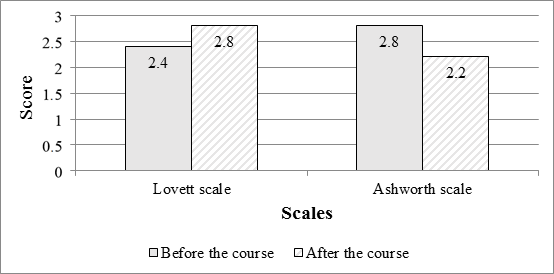
Fig. Dynamics of muscle strength (Lovett Scale) and spasticity (Ashworth Scale) after a course of rehabilitation measures for 5-7-year-old children with spastic diplegia
Muscle strength accessed with the Lovett scale in the examined group significantly increased after the course by 58.82% (at p≥0.05), from 2.43±0.98, corresponding to an intermediate level of strength development to 3.86±0.9, corresponding to satisfactory muscle strength.
Muscle spasticity examined with the Ashworth scale decreased by 53.85% (at p≥0.05) from 2.79±0.99 corresponding to an insignificant increase in muscle tone to 1.29±0.7 points, corresponding to a slight increase in muscle tone.
Conclusion. As a result of the course of rehabilitation measures with therapeutic physical culture, according to goniometry parameters the range of motion in all joints of the affected lower limb increased, muscle spasticity reduced and muscle strength increased, indicating the effectiveness of therapeutic physical culture for children aged 5-7 with spastic diplegia.
REFERENCES
- Badalyan L.O., Zhurba L.T. Children's cerebral palsy. Kyiv: Slovo, 2009. 156 p. (in Russ.)
- Babina G.V., Golovchits L.A., Krotkova A.V., Miklyaeva N.V., Chumakova I.V., Lyubimova M.M., Kirillova L.I., Komova N.S., Romusik M.N., Osetrova A.A. Garagozova A.E. Preschool education of children with special educational needs: a study guide. Moscow: Moscow Pedagogical State University, 2019. 288 p. (in Russ.)
- Minenkova I.N., Radygina V.V., Yakubovskaya E.A. Fundamentals of methodology for corrective and developmental work: a study guide. Minsk: Belarusian State Pedagogical University, 2013. pp. 71-91. (in Russ.)
- Lunina N.V., Korneev A.S. Assessment of motor functions of primary school children with spastic diplegia of cerebral palsy. Russian Journal of Sports Science: Medicine, Physiology, Training, 2022, vol. 1, no. 1. DOI: 10.51871/2782-6570_2022_01_01_6.
- Lunina N.V., Skoryukova K.S. Application of game biocontrolled mechanotherapy in the restoration of motor functions of the upper limb in hemiparetic form of childhood cerebral palsy. Modern Issues of Biomedicine, 2023, vol. 7, no. 1. DOI: 10.51871/2588-0500_2022_07_01_19. (in Russ.)
INFORMATION ABOUT THE AUTHORS:
Yaroslav Grigor’evich Yavorskij – Bachelor of the Department of Physical Rehabilitation, Massage and Health-Improving Physical Culture named after I.M. Sarkizov-Serazini, Russian State University of Physical Culture, Sports, Youth and Tourism, Moscow.
Ksenia Sergeevna Skoryukova – Master’s Student of the Department of Physical Rehabilitation, Massage and Health-Improving Physical Culture named after I.M. Sarkizov-Serazini, Russian State University of Physical Culture, Sports, Youth and Tourism, Moscow.
Natal’ya Vladimirovna Lunina – Candidate of Biological Sciences, Associate Professor, Associate Professor of the Department of Physical Rehabilitation, Massage and Health-Improving Physical Culture named after I.M. Sarkizov-Serazini, Russian State University of Physical Culture, Sports, Youth and Tourism, Moscow; Senior Researcher of the Center of Biomedical Technologies, FSBI “North-Caucasian Federal Research-Clinical Center of Federal Medical and Biological Agency”, Essentuki, e-mail:
For citation: Yavorskij Ya.G., Skoryukova K.S., Lunina N.V. Efficiency of therapeutic physical culture for children aged 5-7 with spastic diplegia. Russian Journal of Sports Science: Medicine, Physiology, Training, 2023, vol. 2, no. 2. DOI: 10.24412/2782-6570-2023_02_02_6