


Download the article in pdf format
Publication date: 01.09.2023
DOI: 10.24412/2782-6570-2023_02_03_7
UDC 616.8-009.18
CORRECTION OF KYPHOTIC POSTURE DISORDER IN PRIMARY SCHOOL CHILDREN BY MEANS OF PHYSICAL REHABILITATION IN THE CONDITIONS OF FITNESS CENTER
A.P. Tikhomirova1, N.V. Lunina1,2
1Russian State University of Physical Culture, Sports, Youth and Tourism, Moscow, Russia
2FSBI “North-Caucasian Federal Research and Clinical Center of the Federal Medical and Biological Agency”, Essentuki, Russia
Annotation. The article reflects the results of the correction of kyphotic posture disorder in primary school children in a fitness center by means of physical rehabilitation. The results significantly improved (p<0.5) in terms of static endurance of the neck muscles by 65.8%, the abdominal muscles – by 69.8%, the back muscles – by 60.1%, spinal mobility improved by 60%, visual posture diagnosis – by 165.4%, the number of points scored increased from 2.6±1 to 6.9±0.9 points (p<0.5). The revealed positive dynamics of the studied indices reflect a pronounced corrective effect of the application of physical rehabilitation means implemented in a fitness center for primary school children with kyphotic posture disorders.
Keywords: posture disorders, posture correction, children, primary school age, physical rehabilitation, fitness center.
Introduction. Kyphotic posture disorder in primary school age is one of the main disorders of the musculoskeletal system, formation of which has a great number of factors [1-2]. The pathological process has a trend for progression, having a negative effect on almost all systems of a growing body [3], worsening health [4], school performance and adaptation. Systematic application of various means, forms and methods of physical culture and recreational nature convincingly proves the effectiveness of their use for various disorders of the musculoskeletal system regardless of the age of the participants [3, 5]. Moreover, the need of long-term correction of present disorders in case of a limited set of special corrective means causes monotony and lowered motivation for regular workout. It is especially relevant for primary school age, in which game activity plays an important role in the development of a growing body, when higher cortical structures regulating motivational and volitional behavior are still unformed. Conditions of modern fitness centers allow to expand a field of application of recovery measures for a comprehensive impact on a body, supporting interest of those involved to a long-term recovery process, combining a personal approach and modern arrangement of corrective measures, taking into account present disorders.
The objective – to evaluate effectiveness of using physical rehabilitation measures for primary school children with kyphotic posture disorder in a fitness center.
Methods and organization. The study took place in the Medical Department of the Kimberly Fitness and Recreation Center (Moscow) during October 2022 – March 2023. It included 10 primary school children with posture disorders, who visit the center.
Strength endurance of the stabilizing muscles that elongate the spine was identified with motor tests [6] according to the anatomical location of the following muscle groups: neck, back, abdominal muscles while holding them contracted for a while in a lying position. The spinal mobility (flexibility) was assessed with a “trunk tilt towards” motor test while standing, arms down with fixation of the distance (in cm) from the fingertips to the support on which the test subject was standing. Assessment of the visual posture diagnosis (VPD) was done comprehensively according to a sum of points received after a series of tests: anthropometric measurement of symmetry of location of body members forming cervical and scapular regions (right, left); calculation of the ankle-brachial index; identification of the correctness of the posture of the sagittal plane by the number of points where the back touches the vertical support. The best result was 8 points, showing that the posture is maximally correct. The statistical data processing was made with the Statistica 13 software package, we calculated mean arithmetic values and standard deviation of received indices, significance of differences was evaluated with the Wilcoxon signed-rank test (p>0.05). Distribution normalcy of the examined data was identified with the Kolgomorov-Smirnov test.
Results and discussion. In the preliminary testing of the studied group, we have identified lowered values of examined parameters (table): weak strength endurance of the stabilizing muscles, poorly formed posture.
Table
The preliminary testing results in primary school children with kyphotic posture disorder, Х±σ
|
Index |
Result |
|
|
Quantitative criteria |
Qualitative criteria |
|
|
Strength endurance of the neck muscles, s |
64.1±9.7 |
Weak muscle endurance |
|
Strength endurance of the |
19.2±3.6 |
Weak muscle endurance |
|
Strength endurance of the back muscles, s |
24.8±6.8 |
Weak muscle endurance |
|
Spine mobility, cm |
-0.5±2.6 |
Insufficient spinal mobility |
|
Visual poster diagnosis, points |
2.6±1 |
Poorly formed posture |
Following physical rehabilitation measures were applied in the fitness center for the correction of revealed disorders of the musculoskeletal system: therapeutic gymnastics (TG) classes 4 times a week for 40 minutes; therapeutic massage of the back, pectoral and abdominal muscles 3 times a week for 40 minutes; therapeutic swimming 3 times a week for 40 minutes; hydrokinesiotherapy 3 times a week for 30 minutes; gymnastics with a ball 3 times a week for 45 minutes. Among physiotherapeutic measures, the following ones were used: paraffin ozokerite applications on the thoracic spine, 7 treatments every other day, 20 min; pearl baths, 7 treatments every other day, 15 min, water temperature – 35°; mineral baths, 7 treatments every other day, 15 min, water temperature – 35°; peloid therapy,applications on the thoracic spine, 8 treatments every other day, 15 minutes. The course took 5 weeks.
At home, under the parents’ supervision, morning hygienic gymnastics, a set of special correcting exercises and unloading positions learned earlier at the therapeutic gymnastics classes were applied (fig. 1, 2).
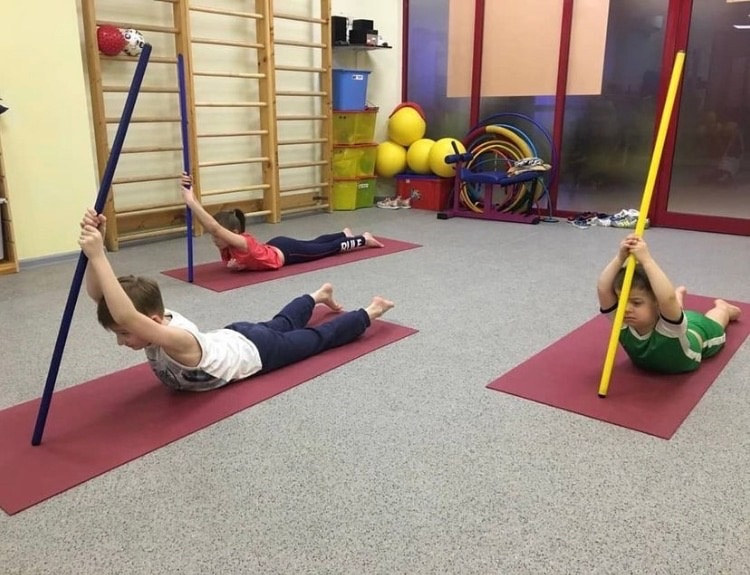
Fig. 1. Example of special corrective exercises for kyphotic posture (lying on the stomach)
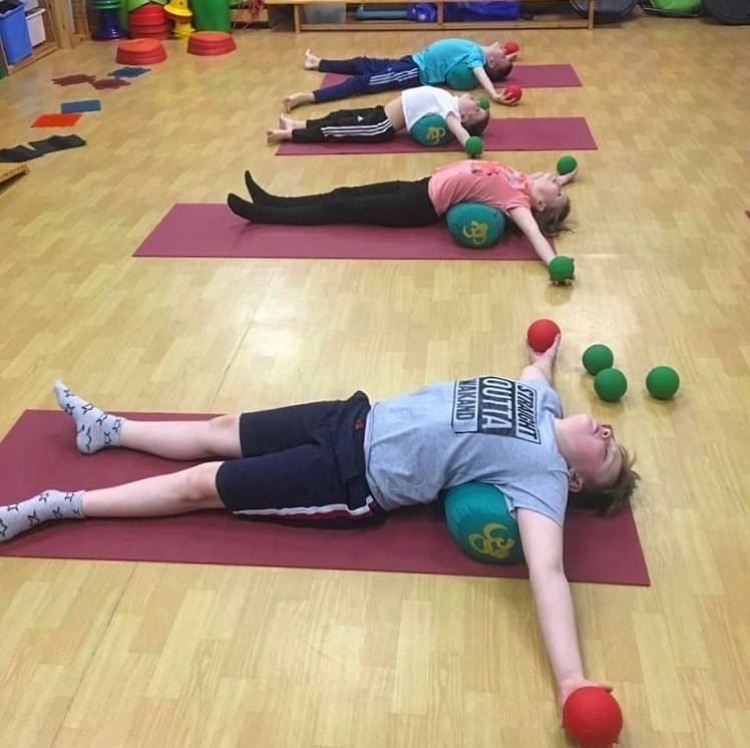
Fig. 2. Example of special corrective exercises for kyphotic posture (lying on the back)
After the course, strength endurance of the stabilizing muscles has significantly improved. Indices of static endurance have substantially improved as well after the contraction test (р<0.5): for the neck muscles – by 65.8% (from 64.1±9.7 to 106.3±11.5 s), the abdominal muscles – by 69.8% (from 19.2±3.6 to 32.6±5.9 s), the back muscles – by 60.1% (from 24.8±6.8 to 39.7±5.6 s). The spinal mobility has improved by 60% (from -0.5±2.6 to 3±2.3 cm) (р<0.5). The visual posture diagnostic results have also improved by 165.4%, a number of points scored has increased from 2.6±1 to 6.9±0.9 points (р<0.5).
Conclusion. Improving dynamics of strength endurance, spinal mobility and visual posture diagnosis in primary school children with kyphotic disorder reflect a pronounced corrective effect of the physical rehabilitation measures applied in the fitness center.
Conflict of interest. The authors declare no conflict of interest.
REFERENCES
- Kudryashova Yu.A., Saburova S.S., Berdichevskaya E.M., Polovnikova M.G., Kudryashov E.A. Role of functional and morphological asymmetries in the formation of posture disorders and their consideration in the organization of physical therapy classes. Physical culture, sport – science and practice, 2020, no. 1, pp. 73-79. (in Russ.)
- Zakrevskij L.A. Neurotrophic processes and pathogenesis of idiopathic scoliosis. Topical issues of treatment and prevention of spine diseases. Kazan: University Publishing House, 2005. pp. 86-87. (in Russ.)
- Lunina N.V., Gubskaya K.D. Correction of scoliotic deformities in elite gymnasts. Modern Issues of Biomedicine, 2022, vol. 6, no. 4. DOI: 10.51871/2588-0500_2022_06_04_28. (in Russ.)
- Zinyankov N.N., Boldyrev S.Yu., Zinyankov N.T., Bartashevich V.V. To the question about the prevalence of infringements of a bearing among
Kuban Scientific Medical Bulletin, 2008, no. 8, pp. 91-92. (in Russ.) - Chernitsyna N.V. Correction and prevention of background disorders in children of senior preschool age by means of fitball gymnastics. International Journal of Experimental Education, 2018, no. 11, pp. 29-34. (in Russ.)
- Lovejko I.D., Fonarev M.I. Therapeutic physical culture for spine diseases in children. Leningrad: Meditsina, 1988. 144 p. (in Russ.)
INFORMATION ABOUT THE AUTHORS:
Aleksandra Pavlovna Tikhomirova – Bachelor of the Department of Physical Rehabilitation, Massage and Health-Improving Physical Culture named after I.M. Sarkizov-Serazini, Russian State University of Physical Culture, Sports, Youth and Tourism, Moscow, e-mail:
Natal’ya Vladimirovna Lunina – Candidate of Biological Sciences, Associate Professor, Associate Professor of the Department of Physical Rehabilitation, Massage and Health-Improving Physical Culture named after I.M. Sarkizov-Serazini, Russian State University of Physical Culture, Sports, Youth and Tourism, Moscow; Senior Researcher of the Center for Biomedical Technologies, FSBI “North-Caucasian Federal Research-Clinical Center of Federal Medical and Biological Agency”, Essentuki, e-mail:
For citation: Tikhomirova A.P., Lunina N.V. Correction of kyphotic posture disorder in primary school children by means of physical rehabilitation in the conditions of fitness center. Russian Journal of Sports Science: Medicine, Physiology, Training, 2023, vol. 2, no. 3. DOI: 10.24412/2782-6570-2023_02_03_7