


Download the article in pdf format
Publication date: 01.12.2023
DOI: 10.24412/2782-6570-2023_02_04_6
UDC 577.112.389
ON THE SAFETY OF MELDONIUM (MILDRONATE®) FOR ATHLETES: A SCOPING REVIEW
A.B. Miroshnikov, A.V. Meshtel
Russian University of Sports “GTSOLIFK”, Moscow, Russia
Annotation. Meldonium (Mildronate®) is a pharmaceutical substance approved in Russia for the treatment of cerebral and myocardial ischemia and has been on the WADA List of banned substances since January 2016. Objective of the study: to review the available literature on the safety of meldonium for athletes. This study was conducted in accordance with the PRISMA-ScR statement. Literature search was conducted in the PubMed, MedNar, Epistemonikos, Lilacs, Cochrane Library and ResearchGate databases. The time frame of the search was not set, but the last search was done on 12.09.2023. A total of 514 mentions were identified. Only 2 randomized controlled trials and 5 reviews met the inclusion criteria. At present, we cannot claim that meldonium is a relatively safe remedy for athletes.
Keywords: meldonium, mildronate, doping in sports, anti-doping.
Introduction. Meldonium is a substance included in the medicinal product Mildronate®, which is marketed in the Eastern Europe, in particular in Azerbaijan, Belarus, Georgia, Kazakhstan, Kyrgyzstan, Moldova, Ukraine, Uzbekistan and Russia. It is used to treat ischemic diseases of the brain and heart [1-2]. After 13 medalists (in 15 out of 21 sports) at the Baku 2015 European Games were found to have meldonium in their samples, the World Anti-Doping Agency (WADA) included meldonium in the List of banned substances since January 1, 2016 [3]. According to WADA, in order to be included in this list, the substance must meet two of three criteria:
- Medical or other scientific data, pharmacological effect or experiment evidencing that the substance or method, separately or combined with other substances and methods, may increase or enhance athletic performance.
- Medical or other scientific data, pharmacological effect or experiment giving proof that use of the substance/method has a real or potential risk for an athlete’s health.
- Use of the substance/method goes against the essence of sport, as it is described in the introduction to the World Anti-Doping Code.
Since there are no well-designed randomized controlled trials (RCTs) conducted on athletes, we may assume that meldonium does not enhance their performance [4] and probably decreases it [5]. Regarding the side effects of Mildronate®, Jardin [6] calls it pseudo-placebo (placebo with possible side effects), since the carnitine deficit is associated with fatigue and muscle weakness. There are clinical and experimental evidence that carnitine has cardioprotective effects for patients with cardiomyopathy, angina and heart attack [7-8]. Given the decreased availability of adenosine triphosphate (ATP) as an energy carrier due to reduced carnitine levels, Mildronate® may contribute to cellular damage and reduced cardiac function in heart failure and heart attack [6], as well as during exercise in athletes, since fatty acids are the predominant source of cardiac fuel in this case [9]. According to the analysis of the problem situation, data of modern scientific literature and requests of sports medicine physicians, the aim of the study was established.
Aim of the study – to carry out a research of available literature on the safety of meldonium for athletes.
Methods and organization. The study took place at the Sports Medicine Department, the Russian University of Sports “GTSOLIFK”. It was conducted in accordance with the statement of Preferred Reporting Items for Systematic reviews and Meta-Analyses extension for Scoping Reviews (PRISMA-ScR) [10]. The study protocol was created before the search and did not change neither during the procedure nor after it. Before the search we agreed that the review will include RCTs, non-RCTs and any reviews on side effects of meldonium. The literature search was done in the PubMed, MedNar, Epistemonikos, Lilacs, СochraneLibrary и ResearchGate databases. The following keywords were used: “Meldonium AND Mildronate AND (toxicological OR safety)”. In order to improve the topic’s coverage we also searched grey literature in the Google Scholar database. Then, in order to find potentially relevant studies that were omitted by the electronic search, we also did a manual reference search in the found studies. Time frames were not set, however the last search date was 12.09.2023.
In order for the study to be included, it must meet the inclusion criteria of the PICOS system [11]. P (Population) – men and women older than 18 years; I (Intervention) – meldonium (Mildronate®) intake; C (Comparison) – comparison with the control group or before the intervention; O (Outcomes) – the studies examined meldonium (Mildronate®) safety; S (Study) – any reviews, systematic reviews and meta-analyses, RCTs and non-RCTs, which examined meldonuim (Mildronate®) safety. Initially, authors of the review (A.V. Meshtel, A.B. Miroshnikov) simultaneously and independently checked titles, abstracts and, if needed, full text of the articles from the database records in accordance with the inclusion criteria. Then the authors in the same manner extracted the needed articles. The language barrier was not set. Since the data in all studies were descriptive, no statistical analysis was applied.
Results and discussion. 514 mentions were found in total. Then all the data were exported, and any duplicates or articles that did not correspond with the inclusion criteria were manually deleted. The figure below illustrates the PRISMA scheme of the research selection process for the review. Only 2 RCTs [12-13] and 5 reviews met with the inclusion criteria [4, 6, 14-16] (tables 1, 2).
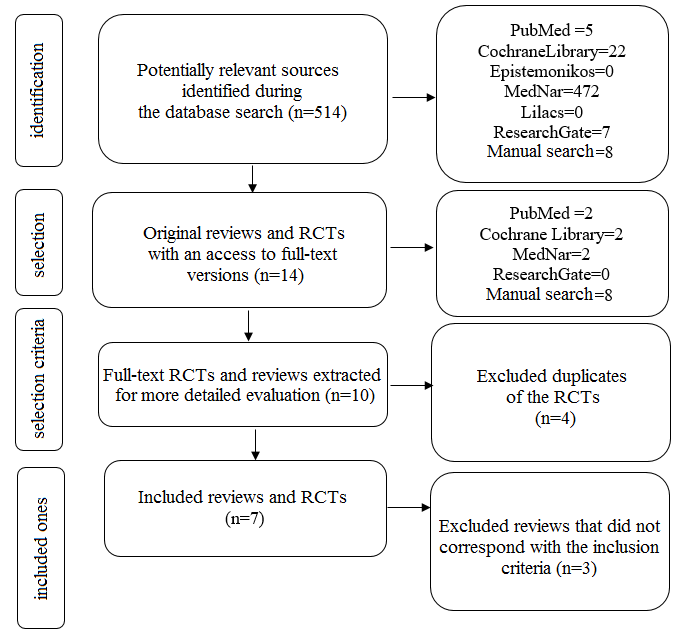
Fig. The PRISMA scheme
Table 1
Main findings of studies and reviews on the meldonium’s safety
|
Authors, year |
Design |
Main findings |
Financing/ |
|
Zhu et al, 2013 [12] |
RCT |
Mildronate® injection is as effective and safe as the cinepazide injection for treating acute ischemic stroke. |
Ge-Lin Biopharmaceutical Co. Ltd., Shenyang, China. |
|
Zhao et al, 2016 [13] |
RCT |
The drug is safe and is well tolerated at a dose of 250 to 750 mg. |
Major Production of New Medicine. |
|
Jargin, 2019 [6] |
SR |
Given the decreased availability of adenosine triphosphate (ATP) as an energy carrier due to reduced carnitine levels, Mildronate® may contribute to cellular damage and reduced cardiac function in heart failure and heart attack. |
--------- |
|
Berlato et al, 2020 [15] |
SR |
Currently there are no reports on cases of acute or chronic meldonium intoxication. There are rare side effects, including allergic reactions (skin redness and itching, hives, rash and/or angioedema), dyspepsia, tachycardia and change (increase/decrease) in the blood pressure. |
None |
Note: RCT – randomized controlled trial; SR – scoping review; BP – blood pressure
Table 2
Main findings of reviews on the meldonium’s safety
|
Authors, year |
Design |
Main findings |
Financing/ |
|
Heuberger et al, 2022 [4] |
SR |
Burning in stomach or digestive tract, muscle spasms, dizziness, discomfort caused by stress, depression, sedative effect and/or drowsiness, fast heartbeat, visual disorders, anorexia and compulsive overeating. |
None |
|
Adami et al, 2022 [14] |
SR |
Following side effects were found in athletes: allergic reaction (skin redness and itching, hives, rash and/or angioedema); dyspepsia; tachycardia; increase/decrease in the blood pressure. |
None |
|
Arduini et al, 2016 [16] |
SR |
WADA decided to add meldonium into the List of banned substances not because of some insignificant effect that enhances the performance of healthy athletes, but because of the real danger that it has for an extremely engaged athlete, which can overdose them and decrease level of intracellular carnitine to its pathological values. |
None |
Note: SR – scoping review; BP – blood pressure
According to two RCTs [12-13], Mildronate® injections are safe and well tolerated at doses ranging from 250 to 750 mg. However, these studies were sponsored by pharmaceutical companies, and this fact does not allow us to make final conclusions on the meldonium safety [17-18].
Jargin [6] insists, that there are no relatable evidences that meldonium is an effecitve way to improve athletic results and that its injection is safe for healthy people. Moreover, the author suggests to solve this issue in experiments protected from conflicts of interest.
It is well-known that people with carnitine deficit are sensitive to pro-drugs that have pivalic acid, since it is a remedy able to cause carnitine deficit (like meldonium), which leads to lethal disorders of heart rate [19]. Oral meldonium intake for healthy participants (500 mg two times a day) for 4 weeks leads to significant reduction of the carnitine level by 18% [20]. A recent study on rats showed that any phenotype with carnitine deficit may be subject to a number of side effects in case of strong adrenergic stress [21]. Therefore, according to Arduini and Zammit [16], if meldonium has effects that are not attributed to the designated use, we must be thankful for the fact that it was not injected in such high doses that would cause harm to athletes who continued to use it. Another aspect of the meldonium pharmacological properties, according to the same two authors [16], is the inhibition of carnitine acetyltransferase (CAT) activity – an enzyme that reversely transfers the acetilylic part of acetyl coenzyme A on carnitine in mitochondria and peroxiomes. Thanks to its ability to buffer the mitochondrial acetyl coenzyme A levels, CAT plays an important role in intermediary metabolism and muscle bioenergetics. As it was expected, on the example of rats the decreased CAT activity in muscles leads to muscle fatigue and intolerance to exercise [5]. The review’s authors assume that this is the strongest argument [16] against using meldonium as a remedy for enhancing performance, especially when such inhibiting CAT activity is combined with carnitine depletion.
Heuberger and his colleagues [4], while finding similarities with trimetazidine [22], identify following side effects of meldonium: “Burning in stomach or digestive tract, muscle spasms, dizziness, discomfort caused by stress, depression, sedative effect and/or drowsiness, fast heartbeat, visual disorders, anorexia and compulsive overeating”. According to the review by Adami et al [14], it were athletes who reported rare side effects after meldonium, including allergic reactions (skin redness and itching, hives, rash and/or angioedema), dyspepsia, tachycardia and changes (increase/decrease) in the blood pressure. The data is confirmed by Berlato and his colleagues [15], adding that there are currently no reports on cases of acute or chronic meldonium intoxication.
Conclusion. At present, it is said that meldonium is a relatively safe remedy for patients who need anti-ischemic therapy. However there are no evidence that it can be applied to enhance performance, or that its application is safe for healthy people. Despite the fact that meldonium is popular in sports, there is no systematic scientific basis, as well as RCTs conducted with elite athletes and published in peer-reviewed journals proving that meldonium does indeed enhance performance of athletes and it is safe to use. This is the reason why we should take measures to prevent meldonium overdose and identify athletes that can risk their health by trying to artificially enhance their performance. In this field, additional RCTs are necessary.
Conflict of interest. The authors declare conflict of interest.
Author contributions. Concept, research design and text writing – A.B. Miroshnikov; collection of material – A.V. Meshtel, A.B. Miroshnikov; editing – A.V. Meshtel.
REFERENCES
- Greenblatt H.K., Greenblatt D.J. Meldonium (Mildronate): A Performance-Enhancing Drug? Clin Pharmacol Drug Dev, 2016, vol. 5, no. 3, pp. 167-169. DOI: 10.1002/cpdd.264.
- Schobersberger W., Dünnwald T., Gmeiner G., Blank C. Story behind meldonium-from pharmacology to performance enhancement: a narrative review. Br J Sports Med, 2017, vol. 51, no. 1, pp. 22-25. DOI: 10.1136/bjsports-2016-096357.
- Stuart M., Schneider C., Steinbach K. Meldonium use by athletes at the Baku 2015 European games: table 1. Br J Sports Med, 2016, vol. 50, no. 11, pp. 694-698. DOI: 10.1136/bjsports-2015-095906.
- Heuberger J.A.A.C., Henning A., Cohen A.F., Kayser B. Dealing with doping. A plea for better science, governance and education. Br J Clin Pharmacol, 2022, vol 88, no. 2, pp. 566-578. DOI: 10.1111/bcp.14998.
- Seiler S.E., Koves T.R., Gooding J.R., Wong K.E., Stevens R.D., Ilkayeva O.R., Wittmann A.H., DeBalsi K.L., Davies M.N., Lindeboom L. et al. Carnitine Acetyltransferase Mitigates Metabolic Inertia and Muscle Fatigue during Exercise. Cell Metab, 2015, vol. 22, no. 1, pp. 65-76. DOI: 10.1016/j.cmet.2015.06.003.
- Jargin S.V. Drugs and dietary supplements with unproven effects in research and practice. Complement. Med. Res, 2019, vol. 10, pp. 27-37. DOI: 10.5455/jcmr.10.5455/jcmr.20181223075028.
- DiNicolantonio J.J., Lavie C.J., Fares H., Menezes A.R., O'Keefe J.H. L-carnitine in the secondary prevention of cardiovascular disease: systematic review and meta-analysis. Mayo Clin Proc, 2013, vol. 88, no. 6, pp. 544-551. DOI: 10.1016/j.mayocp.2013.02.007.
- Shang R., Sun Z., Li H. Effective dosing of L-carnitine in the secondary prevention of cardiovascular disease: a systematic review and meta-analysis. BMC Cardiovasc Disord, 2014, vol. 14, p. 88. DOI: 10.1186/1471-2261-14-88.
- Murashige D., Jang C., Neinast M., Edwards J.J., Cowan A., Hyman M.C., Rabinowitz J.D., Frankel D.S., Arany Z. Comprehensive quantification of fuel use by the failing and nonfailing human heart. Science, 2020, vol. 370, no. 6514, pp. 364-368. DOI: 10.1126/science.abc8861.
- Tricco A.C., Lillie E., Zarin W., O'Brien K.K., Colquhoun H., Levac D., Moher D., Peters M.D.J., Horsley T., Weeks L. et al. PRISMA Extension for Scoping Reviews (PRISMA-ScR): Checklist and Ann Intern Med, 2018, vol. 169, no. 7, pp. 467-473. DOI: 10.7326/M18-0850.
- Samson D., Schoelles K.M. Chapter 2: medical tests guidance (2) developing the topic and structuring systematic reviews of medical tests: utility of PICOTS, analytic frameworks, decision trees, and other frameworks. J Gen Intern Med, 2012, vol. 27, pp. 11-19. DOI: 10.1007/s11606-012-2007-7.
- Zhu Y., Zhang G., Zhao J., Li D., Yan X., Liu J., Liu X., Zhao H., Xia J., Zhang X., Li Z. et al. Efficacy and safety of mildronate for acute ischemic stroke: a randomized, double-blind, active-controlled phase II multicenter trial. Clin Drug Investig, 2013, vol. 33, no. 10, pp. 755-760. DOI: 10.1007/s40261-013-0121-x.
- Zhao Z., Chen J., Peng W., Wang X., Chen Z., Tang H., Liang Y., Ma Z., Chen J., Chen X. et al. Single- and Multiple-dose Pharmacokinetic, Safety and Tolerability Study of Mildronate Injection in Healthy Chinese Subjects Pharmacokinetic of Mildronate Injection. Drug Res (Stuttg), 2016, vol. 66, no. 5, pp. 251-256. DOI: 10.1055/s-0035-1569297.
- Adami P.E., Koutlianos N., Baggish A., Bermon S., Cavarretta E., Deligiannis A., Furlanello F., Kouidi E., Marques-Vidal P., Niebauer J. et al. Cardiovascular effects of doping substances, commonly prescribed medications and ergogenic aids in relation to sports: a position statement of the sport cardiology and exercise nucleus of the European Association of Preventive Cardiology. Eur J Prev Cardiol, 2022, vol. 29, no. 3, pp. 559-575. DOI: 10.1093/eurjpc/zwab198.
- Berlato D.G., de Bairros A.V. Meldonium: Pharmacological, toxicological, and analytical aspects. Toxicology Research and Application, 2020, vol. 4. DOI: 10.1177/2397847320915143.
- Arduini A., Zammit V.A. A tennis lesson: sharp practice in the science behind the Sharapova case. Postgrad Med J, 2016, vol. 92, no. 1090, pp. 429-430. DOI: 10.1136/postgradmedj-2016-134124.
- Nejstgaard C.H., Bero L., Hróbjartsson A., Jørgensen A.W., Jørgensen K.J., Le M., Lundh A. Conflicts of interest in clinical guidelines, advisory committee reports, opinion pieces, and narrative reviews: associations with recommendations. Cochrane Database Syst Rev, 2020, vol. 12, no. 12, p. 40. DOI: 10.1002/14651858.MR000040.pub3.
- Hansen C., Lundh A., Rasmussen K., Hróbjartsson A. Financial conflicts of interest in systematic reviews: associations with results, conclusions, and methodological quality. Cochrane Database Syst Rev, 2019, vol. 8, no. 8, p. 47. DOI: 10.1002/14651858.MR000047.pub2.
- Rasmussen J., Nielsen O.W., Lund A.M., Køber L., Djurhuus H. Primary carnitine deficiency and pivalic acid exposure causing encephalopathy and fatal cardiac events. J Inherit Metab Dis, 2013, vol. 36, no. 1, pp. 35-41. DOI: 10.1007/s10545-012-9488-8.
- Liepinsh E., Konrade I., Skapare E., Pugovics O., Grinberga S., Kuka J., Kalvinsh I., Dambrova M. Mildronate treatment alters γ-butyrobetaine and l-carnitine concentrations in healthy volunteers. J Pharm Pharmacol, 2011, vol. 63, no. 3, 1195-1201. DOI: 10.1111/j.2042-7158.2011.01325.x.
- Giudice P.L, Bonomini M, Arduini A. A Moderate Carnitine Deficiency Exacerbates Isoproterenol-Induced Myocardial Injury in Rats. Cardiovasc Drugs Ther, 2016, vol. 30(2), pp. 119-127. DOI: 10.1007/s10557-016-6647-4.
- Dézsi C.A. Trimetazidine in Practice: Review of the Clinical and Experimental Evidence. Am J Ther, 2016, vol. 23, no. 3, pp. 871-879. DOI: 10.1097/MJT.0000000000000180.
INFORMATION ABOUT AUTHORS:
Aleksandr Borisovich Miroshnikov – Doctor of Biological Sciences, Professor of the Department of Sports Medicine, Russian University of Sports “GTSOLIFK”, Moscow, e-mail:
Aleksandr Vital’evich Meshtel – Post-Graduate Student of the Department of Sports Medicine, Assistant of the Department of Anatomy and Biological Anthropology, Russian University of Sports "GTSOLIFK", Moscow, e-mail:
For citation: Miroshnikov A.B., Meshtel A.V. On the safety of Meldonium (Mildronate®) for athletes: a scoping review. Russian Journal of Sports Science: Medicine, Physiology, Training, 2023, vol. 2, no. 4. DOI: 10.24412/2782-6570-2023_02_04_6