


Download the article in pdf format
Publication date: 01.03.2024
DOI: 10.24412/2782-6570-2024_03_01_6
UDC 796
RATIONALE FOR SPECIAL FLEXIBILITY DEVELOPMENT IN CONDITIONS OF ADDITIONAL SCHOOL EDUCATION
N.V. Gubareva, P.N. Antipova
Altai State Pedagogical University, Barnaul, Russia
Abstract. The article presents the data confirming the effectiveness of the system of classes with elements of sambo for the development of special flexibility in 11–12-year-old schoolchildren in conditions of additional school education. We developed two complexes designed for 2 microcycles. The experiment lasted 2 months, during which the developed complexes were applied. The methodology consisted of a series of classes for the development of special flexibility. The pedagogical experiment’s results have demonstrated that the methodology of improving special flexibility in 11–12-year-old beginners in sambo during school allows to reach and exceed the standard values in the development of special flexibility and strength endurance. The developed methodology may be recommended for wide use in the practical work of physical education teachers for additional school education.
Keywords: schoolchildren, special flexibility, school classes, sambo, physical culture.
Introduction. The main directions of physical education are healthy life style propaganda, harmonious development of the growing population, increase in the level of physical activity, as well as development of basic motor skills. These directions correspond with the strategy of our state’s policy (strategy of healthcare development in the Russian Federation for the period till 2025 approved by the Presidential Decree dated June 6, 2019, N 254) [1-4].
However, most researchers suggest that for adolescents, in order to improve their health, it is necessary to increase motivation to attend physical culture and sport classes both in class time and in conditions of additional school education [5-6].
In accordance with the Order of the Krasnodar Krai Ministry of Education, Science and Youth Policy dated June 29, 2022 No 1516 “On implementation of the All-Russian Project “Sambo to schools” in 2023-2024 academic year” regional programs of additional school education are being actively developed and implemented in the country's regions. “Sambo to school” is one of the largest educational and sports projects aimed at promoting sambo in schools of Russia as a basis of health and safety of schoolchildren, their national unity, success and competitiveness [7-9].
One of the options of introducing martial arts (sambo) into school practice may be extracurricular activities as a factor of attracting students to active physical activity, as well as the development of a system of classes with sambo elements. Sambo includes different exercises: speed, strength, exercises for development of special flexibility et al [10-11].
Aim of the study: theoretically substantiate and confirm experimentally the effectiveness of the system of classes with elements of sambo for the development of special flexibility in 11–12-year-old schoolchildren in conditions of additional school education.
Methods and organization. The study took place in the Altai State Pedagogical University (Barnaul). It included 11–12-year-old schoolchildren in conditions of additional school education (sambo class in school), 16 participants total.
Following methods were applied: scientific literature analysis, pedagogical testing, pedagogical experiment.
The experiment consisted of the implementation of a number of exercise complexes aimed at developing special flexibility. The training week schedule included 3 classes – on Monday, Wednesday and Friday. Average duration of one class was 60 minutes.
We developed 2 complexes intended for 2 microcycles (2 weeks). The experiment lasted 2 months, during which we implemented the aforementioned complexes. In the first microcycle, a ratio of exercises for developing general and special flexibility was 50:50% (complex No. 1 of 10 exercises); in the second microcycle – 40:60% (complex No. 2 of 10 exercises). The control group trained according to the standard program for beginners in sambo.
In complex No. 1, exercises 1, 2, 3, 9 and 10 aimed at developing general flexibility, exercises 4, 5, 6, 7, 8 – at developing special flexibility.
In complex No. 2 exercises 1, 2, 9 and 10 aimed at improving general flexibility, exercises 3, 4, 5, 6, 7, 8 – at improving special flexibility.
Assessment of the classes’ efficiency included an analysis of both special flexibility and strength abilities, which is conditioned by the specificity of sambo as a martial art.
Following tests were used to analyze special flexibility: forward bend, side bend, arching, bridge.
Strength endurance analysis included following tests: pull-ups, l-sits on parallel bars.
The obtained results were statistically processed with the Statistica 13 software package. We calculated the arithmetic mean (X) and standard deviation (σ), significance of differences before and after the experiment was identified with the Wilcoxon signed-rank test, p<0,05.
Results and discussion. At the beginning of the experiment, 30-100% of the control group participants and 0-90% of the experimental group participants performed the control exercises perfectly (fig. 1, 2).
The control group experienced most difficulties in two exercises (l-sits and bright), the experimental group – in three exercises (forward bend, arching and l-sits).
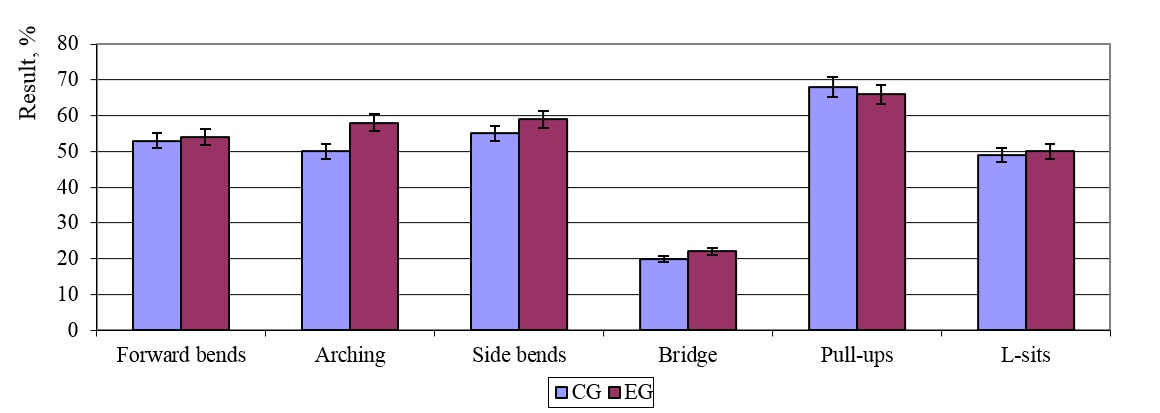
Fig. 1. Indices of special flexibility and strength endurance of 11–12-year-old schoolchildren from control (CG) and experimental (EG) groups before the experiment
At the end all children from the experimental group performed all standard exercises (fig. 2). In the control group, all children performed only one exercise properly (pull-ups), the bridge still caused difficulties for 40% of the participants, results of the remaining exercises met standard values for 60-80% of the children (fig. 2).
Before the experiment, in the control group, average group values in forward bend (6,1 cm) and pull-up (17,6 раз) were higher than those in the experimental group (5.4 cm and 19.6 cm respectively), the other values were practically similar (table 1).
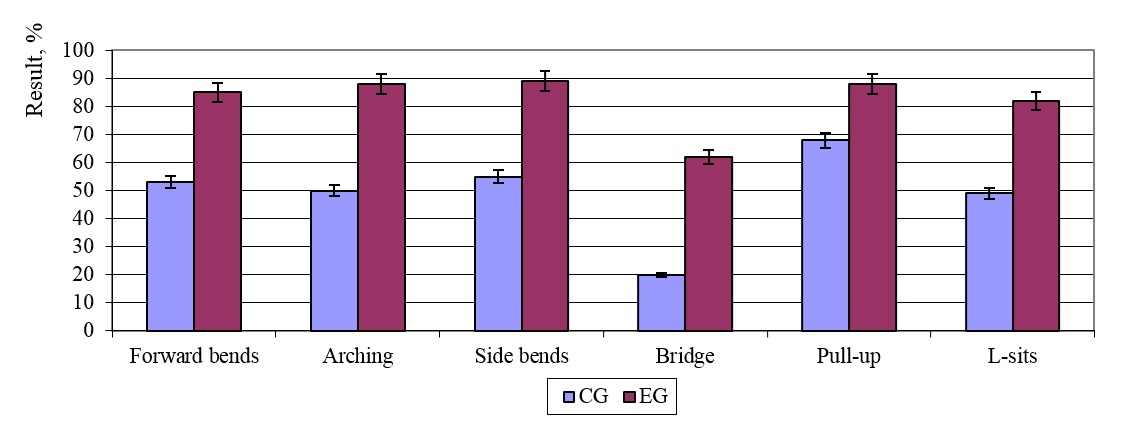
Fig. 2. Indices of special flexibility and strength endurance of 11–12-year-old schoolchildren from the control (CG) and experimental (EG) groups after the experiment
Table 1
Changes in the indices of special flexibility and strength endurance in 11–12-year-old sambo wrestlers before and after the experiment, x±σ
|
№ |
Test |
Control group |
Experimental group |
||
|
Before the experiment |
After the experiment |
Before the experiment |
After the experiment |
||
|
1 |
Forward bends, cm |
6.1±2.23 |
7.9±3.98 |
5.4±2.59 |
14.6±2.27* |
|
2 |
Side bends, cm |
23.1±3.35 |
26.0±3.77 |
23.5±3.72 |
33.0±3.23* |
|
3 |
Arching, cm |
22.0±2.54 |
23.5±3.21 |
21.6±2.27 |
29.3±1.42* |
|
4 |
Bridge, cm |
39.4±2.63 |
37.4±2.67 |
39.9±1.20 |
28.6±1.43* |
|
5 |
Pull-ups, times |
17.6±1.71 |
18.1±1.20 |
16.5±0.97 |
22.6±1.07* |
|
6 |
L-sits on parallel bars, s |
3.5±0.53 |
4.8±0.63* |
3.4±0.52 |
10.7±0.67* |
Note: * – the differences are significant when р<0.05
Analysis of the results of the special physical fitness average group indices in the experimental group has shown that they were significantly higher (p<0.05) than in the control group. Thus, the experimental group was ahead of the control group in all studied indices: in forward bend – 14.6 cm, while in KG – 7.9 cm, in side bend – 33 cm, in KG – 26.0 cm, in flexion – 29.3 cm, while in KG – 23.5 cm, in bridge – 28.6 cm, in KG – 37.4 cm, in pull-ups – 22.6 times, while in KG – 18.1 times, l-sits on parallel bars – 10.7 s, while in KG – 4.8 s.
It should be noted that in the control group by the end of the experiment there was a decrease in the average group values in pull-ups, which is associated with a decrease in the volume of training load, while in the experimental group no decrease in these indices was registered.
Growth rates of special physical fitness in the CG amounted to 5.2-21.3%, in the EG –14.2-58.3% (table 2).
Table 2
Growth rates of special flexibility and strength endurance of the control and experimental groups, %
|
№ |
Test |
CG |
EG |
|
1 |
Forward bend, cm |
25.7 |
57.3 |
|
2 |
Side bend, cm |
11.8 |
21.0 |
|
3 |
Arching, cm |
6.6 |
19.6 |
|
4 |
Bridge, cm |
-5.2 |
-14.2 |
|
5 |
Pull-ups, times |
5.2 |
23.4 |
|
6 |
L-sits on parallel bars, с |
21.3 |
50.5 |
It is also important to note that the control group had low growth rates in all exercises, the lowest ones – in bridge, pull-ups (5.2% both) and arching (6.6%).
In the experimental group, average growth rates were registered in forward bend (57.3%) and l-sits on parallel bars (50.5%), accompanied by low growth rates in the rest of the exercises (14.2-23.4%). However, they were higher than those in the control group (5.2-11.8%).
Therefore, application of the aforementioned methodology has an effect on special flexibility of 11–12-year-old schoolchildren. 80% of the participants managed to reach standard values.
Conclusion. Consequently, application of the methodology for developing special flexibility for 11–12-year-old beginners in sambo in conditions of additional school education allows achieving and exceeding standard values in the development of special flexibility and strength endurance. In the experimental group, average group values exceeded those of the control group in all indices and were as follows (p≤0.05): in forward bend – 14.6±2.27 cm; in side bend – 29.0±3.23 cm; in arching – 26.3±1.42 cm; in bridge – 34.6 cm; in pull-ups – 19.6±1.07 times; in l-sits on parallel bars – 5.7±0.67 s.
Conflict of interest. The authors declare no conflict of interest.
REFERENCES
- Amelin, S.G., Mukhin I.A. Increasing the effectiveness of teaching throws in sambo. Voprosy pedagogiki, 2022, no. 3-1, pp. 24-26. (in Russ.)
- Gorskaya I.Yu., Golubeva G.N., Kravchuk T.A. Qualitative and quantitative analysis of indicators of the involvement of the population of the Russian Federation in sports and physical training. Science and sport: current trends, 2023, vol. 11, no. 4, pp. 113-125. (in Russ.)
- Kondakov A.M., Semynin I.V., Vinokurov D.S., Chukhareva A.V. Project “Sambo to school” as an effective measure of preventing asociality among young people. Youth in the New Millennium: Problems and Solutions: materials of the II All-Russian Scientific and Practical Conference. Omsk: Siberian State University of Physical Culture and Sport, 2019. pp. 73-78. (in Russ.)
- Order of the Ministry of Education of the Russian Federation dated July 27, 2022 No. 629 “On approval of the Procedure for organizing and implementing educational activities in additional general education programs” (Registered September 26, 2022, No. 70226) Available at: http://publication.pravo.gov.ru/Document/View/0001202209270013?index=16 (accessed 23.02.2024) (in Russ.)
- Kalachev G.A. Physiology of muscular activity and sport: a textbook for students of physical education departments. 2nd ed. Barnaul: BSPU Publishing House, 2008. 225 p. (in Russ.)
- Osipov, A.Yu. Formation of motor actions of beginners in sambo based on the development of statokinetic stability and endurance: an author’s abstract. Krasnoyarsk, 2008. 23 p. (in Russ.)
- Koryagina Yu.V., Nopin S.V., Ter-Akopov G. N., Abutalimova S.M. Hardware-software complex for sports orientation, selection and stage control: potential for judo and sambo. Theory and Practice of Physical Culture, 2022, no. 3, pp. 3-5. (in Russ.)
- Nopina V.S., Nopin A.S., Koryagina Yu.V. Morphological features of children in early childhood not engaged in sports and engaged in judo and rhythmic gymnastics. Modern Issues of Biomedicine, 2023, vol. 7, no. 4(25). DOI: 10.51871/2588-0500_2023_07_04_13 (in Russ.)
- Shestakov V.B., Eregina S.V., Emelianenko F.V. Sambo. Science Of Winning. Theoretical and Methodical Basis of Sambo Fighters Training. Moscow: OlmaMediaGroup/Prosveshchenie, 2013. 224 p.
- Popova E.V., Latura A.V. Project “Sambo to school” as a way to reduce a teenager’s aggression and motivate to choose a healthy lifestyle. The Role of Social Institutions in the Bad Habit Prevention: Materials of Scientific and Practical Conference. St. Petersburg: Leningrad Regional Institute for Educational Development, 2018. pp. 130-138. (in Russ.)
- Koryagina Yu.V., Nopin S.V., Ter-Akopov G.N., Popov A.N., Abutalimova S.M. Psychofunctional state of young judokas and sambo wrestlers. Certificate of the database registration RF 2021622065, 2021. (in Russ.)
INFORMATION ABOUT THE AUTHORS:
Natal’ya V. Gubareva – Candidate of Pedagogical Sciences, Associate Professor of the Department of Theoretical Basics in Physical Education, Institute of Physical Culture and Sport, Altai State Pedagogical University, Barnaul,
Polina N. Antipova – Bachelor of the Department of Theoretical Basics in Physical Education, Institute of Physical Culture and Sport, Altai State Pedagogical University, Barnaul.
For citation: Gubareva N.V., Antipova P.N. Rationale for special flexibility development in conditions of additional school education. Russian Journal of Sports Science: Medicine, Physiology, Training, 2024, vol. 3, no. 1. DOI: 10.24412/2782-6570-2024_03_01_6