


Download the article in pdf format
Publication date: 01.03.2024
DOI: 10.24412/2782-6570_2024_03_01_1
UDC 612; 796.4
ASSESSMENT OF CHANGES IN MORPHOLOGICAL STATUS AND PHYSICAL QUALITIES OF 4–17-YEAR-OLD GIRLS ENGAGED IN RHYTHMIC GYMNASTICS
Yu.V. Koryagina, S.V. Nopin, O.N. Akimkina
FSBI “North-Caucasian Federal Research and Clinical Center of the Federal Medical and Biological Agency”, Essentuki, Russia
Annotation. Aim of the study: to evaluate dynamics of the morphological status and physical qualities of 4–17-year-old girls engaged in rhythmic gymnastics. Calculation of indices and their estimation were done with the hardware and software complex titled “Psychofunctional status control in rhythmic gymnastics classes”. As a result, we have discovered that the age of 7, 11 and 13-14 years is a sensitive period of an increase in longitudinal body dimensions of gymnasts. Body mass increases simultaneously with body length. Body girth dimensions also significantly increase at 7, 11, 13-14 and 16 years. Physical qualities also have significant changes: strength and speed-strength indices increased at 7 and 13-15 years (puberty), flexibility – at 7 and 14 years, performance – at 8 and 12 years, vestibular stability (coordination) – at 10 and 14 years. The conducted study allowed us to receive substantial data on age-related differences of young gymnasts according to morphological and functional indices, on the development of physical qualities and performance.
Keywords: rhythmic gymnastics, sport girls, morphological status, vestibular stability, physical qualities.
Introduction. Modern rhythmic gymnastics are described with stressful competitive activity and training process, a constantly increasing difficulty in coordination of performed exercises, a need to form stable and reliable skills [1-2]. Researchers share an opinion of a significant role of discovering increase rates of special qualities and functional properties during training, which correlates with a need for not only initial, but also stage diagnosis with the standard specially developed testing technology. Stage-based control allows to assess stage development of an athlete, which is a cause of a prolonged training effect as a result of long-term training – during a phase (or period), macrocycle (year), over a number of years (Olympic cycle). Prompt data on changes in functional processes and state of a body plays a substantial role in both planning training loads during athlete preparation and in arranging restorative measures within the biomedical support system [3-8].
Aim of the study: to evaluate dynamics of the morphological status and physical qualities of 4–17-year-old girls engaged in rhythmic gymnastics.
Methods and organization. The study included 4–17-year-old girls engaged in rhythmic gymnastics, including members of the Russian national team (adult and junior athletes), Moscow team, Donetsk team, as well as pupils of the Pyatigorsk Sports School No. 1, the Zheleznovodsk Sports School, and the TANDEM club located in Moscow, 206 people total.
All participants gave their consent for participation in accordance with the WMA Declaration of Helsinki – Ethical Principles for Medical Research Involving Human Subjects, (2013), as well as a permission to process personal data. For minor participants, such permission was given by their legal representatives. The study was also approved by the Bioethics Committee of the North-Caucasian Federal Research and Clinical Center (protocol No. 1 dated 20.01.2022).
Calculation and estimation of the indices were done with the “Psychofunctional status control in rhythmic gymnastics classes” complex [9]. Standing and hand dynamometry parameters were identified with corresponding dynamometers DS 200 and EN 101. To assess physical development, we used standard anthropometric methods: identifying body length (height) and mass, chest girth on inhale, exhale and pause, wrist girth. Standard requirements were met during the anthropometric study [10-12].
According to the study’s data, we also calculated and analyzed morphological and functional values and indices: body surface area, chest girth, chest excursion, Quetelet index I, Quetelet index II (BMI), Broca index, Erisman index, Levi chest-height index, Levi body mass-length index, Pinier index, vital index, muscular strength to mass ratio index, back strength to mass ratio index.
Physical performance was rated with the Harvard step test [10]. Speed-strength abilities were determined with the standing long jump test. The sit and reach test was applied to evaluate flexibility, the ability to move the joints of the spine and the hip joints. In order to estimate vestibular stability, which is one of the main components of coordination abilities of gymnasts, we applied stabilometry with the “Stabilotrenazher ST-150” force plate (LLC “Mera-TSP”, Moscow)
The statistical data processing was carried out -with the Statistica 13.0 software. We compared the parameters with the non-parametric Kruskal-Wallis and Dunn’s tests. The data is presented in a form of medians and quartiles (Me (Q1; Q3)).
Results and discussion. The test parameters were included in the “Psychofunctional and morphological indices of rhythmic gymnasts of different age (4 to 20 years)” [13] and “Postural stability indices of rhythmic gymnasts” electronic databases [14].
Table 1
Morphological (physical development) status indices of female rhythmic gymnasts, Me (Q1; Q3)
|
№ |
Groups |
Body mass*, kg |
Body length*, cm |
Leg length*, cm |
Arm length*, cm |
Foot length*, cm |
|
1 |
4 years (n=14) |
18 (15;18) |
107 (105;110) |
55 (54;55) |
43 (42;45) |
17 (16;18) |
|
2 |
5 years (n=7) |
18 (17;18) |
116 (108;118) |
57 (55;64) |
47 (43;48) |
17 (16;18) |
|
3 |
6 years (n=10) |
19 (18;20) |
116 (112;118) |
63 (61;64) |
50 (47;50) |
18 (17;19) |
|
4 |
7 years (n=10) |
24 (22;28) |
127 (125;132) |
69 (66;75) |
54 (53;57) |
20 (19;20) |
|
5 |
8 years (n=12) |
25 (23;27) |
130 (127;134) |
72 (71;76) |
56 (54;58) |
20 (20;21) |
|
6 |
9 years (n=18) |
28 (23;30) |
134 (130;139) |
73 (72;78) |
57 (54;58) |
21 (20;22) |
|
7 |
10 years (n=17) |
28 (26;32) |
137 (134;144) |
77 (75;79) |
61 (59;63) |
21 (20;23) |
|
8 |
11 years (n=21) |
33 (30;37) |
148 (143;152) |
84 (81;87) |
64 (60;65) |
23 (21;24) |
|
9 |
12 years (n=16) |
34 (33;37) |
149 (146;154) |
87 (83;89) |
66 (64;68) |
23 (22;24) |
|
10 |
13 years (n=16) |
39 (37;42) |
159 (157;164) |
88 (83;93) |
70 (67;71) |
24 (23;25) |
|
11 |
14 years (n=14) |
43 (39;49) |
163 (160;165) |
92 (85;93) |
71 (70;72) |
24 (23;25) |
|
12 |
15 years (n=12) |
50 (43;52) |
169 (162;171) |
101 (94;101) |
75 (72;78) |
25 (25;26) |
|
13 |
16 years (n=11) |
50 (48;56) |
168 (166;169) |
94 (92;101) |
76 (73;77) |
25 (24;27) |
|
14 |
17 years and older (n=28) |
53 (50;55) |
172 (168;173) |
101 (96;101) |
73 (71;75) |
25 (24;26) |
|
15 |
Number of intergroup pairwise differences, Dunn’s test |
38 |
37 |
35 |
39 |
28 |
Note: significance of differences was calculated with the Kruskal-Wallis (* – p<0.01, differences between all groups are significant) and Dunn’s (p<0.05) tests, the data are described with the median and quartiles
Table 2
Morphological (physical development) status indices of female rhythmic gymnasts, Me (Q1; Q3)
|
№ |
Groups |
Chest girth*, cm |
Chest girth (at rest)*, am |
Body surface, |
|
1 |
4 years (n=14) |
12 (12;12) |
56 (53;57) |
7338 (6788;7504) |
|
2 |
5 years (n=7) |
12 (11;12) |
55 (54;57) |
7489 (7269;7640) |
|
3 |
6 years (n=10) |
12 (12;12) |
58 (55;58) |
7748 (7607;8123) |
|
4 |
7 years (n=10) |
13 (12;13) |
61 (60;64) |
9210 (8803;10345) |
|
5 |
8 years (n=12) |
12 (12;13) |
62 (61;64) |
9399 (9050;9926) |
|
6 |
9 years (n=18) |
13 (13;13) |
64 (61;67) |
10224 (9213;10797) |
|
7 |
10 years (n=17) |
13 (13;14) |
64 (63;67) |
10404 (9869;11350) |
|
8 |
11 years (n=21) |
14 (13;15) |
69 (65;72) |
11740 (10949;12373) |
|
9 |
12 years (n=16) |
14 (13;15) |
70 (68;72) |
11905 (11389;13024) |
|
10 |
13 years (n=16) |
15 (14;15) |
74 (72;78) |
12998 (12697;13802) |
|
11 |
14 years (n=14) |
15 (14;15) |
76 (74;83) |
13697 (13290;15170) |
|
12 |
15 years (n=12) |
15 (15;15) |
81 (79;84) |
15324 (14786;16041) |
|
13 |
16 years (n=11) |
16 (15;17) |
83 (81;87) |
15302 (14847;15995) |
|
14 |
17 years and older (n=28) |
15 (15;15) |
84 (81;84) |
15215 (15015;15964) |
|
15 |
Number of intergroup pairwise differences, Dunn’s test |
30 |
34 |
40 |
Note: significance of differences was calculated with the Kruskal-Wallis (* – p<0.01, differences between all groups are significant) and Dunn’s (p<0.05) tests, the data are described with the median and quartiles
A comparative study (tables 1, 2) revealed statistically significant differences between all age-related groups in almost all studied parameters: body length, body mass, arm length, leg length, foot length, wrist girth, body surface area, chest girth, BMI.
An analysis of age-related changes and separate rapid increases in morphological parameters of female gymnasts showed that the most substantial increase in body length was registered at 7, 11 and 14 years, body mass – at 7, 11 and 14 years, leg length – at 7, 11 and 13 years, arm length – at 7 and 11 years, foot length – 7, 11 and 14 years, wrist girth – 7, 11 and 16 years, chest girth – 7, 11, 13-14 and 16 years, BMI –14 and 16 years.
Therefore, the age of 7, 11 and 13-14 years is a sensitive period of an increase in longitudinal body dimensions of the gymnasts. Body mass increases simultaneously with body length. Body girth dimensions also significantly increase at 7, 11, 13-14 and 16 years. Body mass to length ratio indices and proportionality indices practically do not change with age, which reflects a sufficient proportionality of the body of the girls who passed the initial selection in rhythmic gymnastics.
The results revealed a great number of statistically significant differences in physical qualities of gymnasts at different ages. The greatest increase rates in hand strength were noted at 7, 13 and 15 years (fig. 1). Results of the standing long jump test that evaluates speed-strength qualities improved at 7, 10 and 14-15 years (fig. 2). The best flexibility values in the sit and reach test were registered at 7 and 14 years (fig. 3). Results of the Harvard step test that characterizes physical performance (endurance) showed a significant increase at 8 and 12 years (fig. 4).
Vestibular stability (movement coordination) according to the statokinesiongram area index (table 3) with eyes both opened and closed improved by the age of 10 years, in terms of the statokinesiogram area and simultaneously the velocity of the center of mass movement – by the age of 14 years.
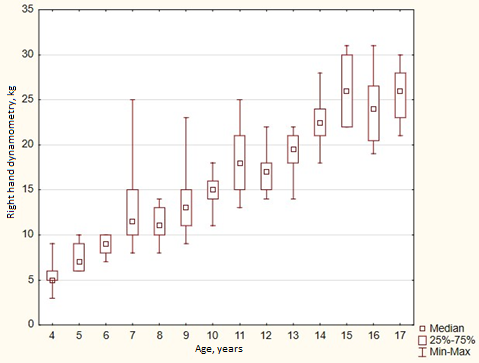
Fig. 1. Right hand dynamometry of 4–17-year-old rhythmic gymnasts, Me (Q1; Q3)
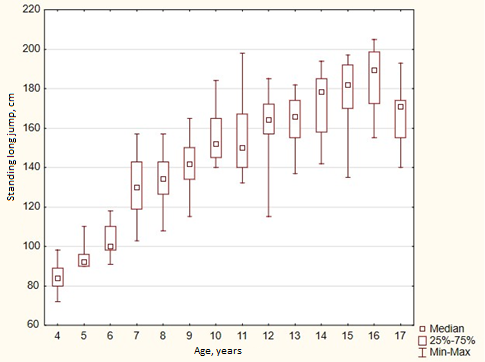
Fig. 2. Parameters of the standing long jump test among 4–17-year-old rhythmic gymnasts, Me (Q1; Q3)
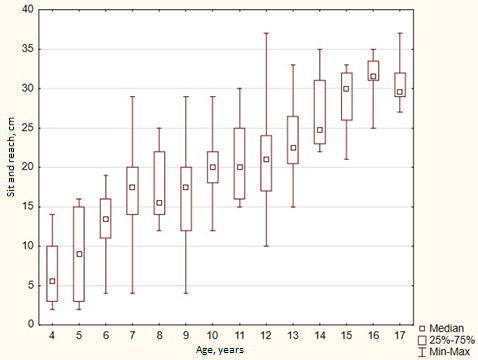
Fig. 3. Parameters of the sit and reach test among 4–17-year-old rhythmic gymnasts, Me (Q1; Q3)
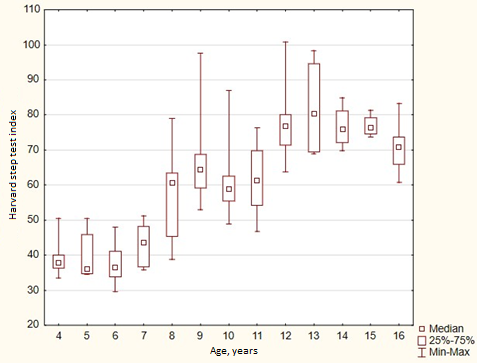
Fig. 4. Harvard step test index among 4–17-year-old rhythmic gymnasts, Me (Q1; Q3)
Table 3
Vestibular stability (Romberg test) parameters on a force plate among 4–17-year-old rhythmic gymnasts, Me (Q1; Q3)
|
№ |
Groups |
S* (eyes open), mm2 |
S* (eyes closed), mm2 |
V* (eyes open), mm/s |
V* (eyes closed), mm/s |
P* (eyes open), mW |
P*, (eyes closed), mW |
|
1 |
4 years (n=14) |
904 (741;1893) |
978 (634;2048) |
29 (26;37) |
29 (27;49) |
615 (466;1547) |
717 (507;2014) |
|
2 |
5 years (n=7) |
1170 (762;1286) |
943 (426;1096) |
29 (22;39) |
30 (22;36) |
926 (427;1306) |
665 (387;1106) |
|
3 |
6 years (n=10) |
393 (269;784) |
432 (396;674) |
18 (14;27) |
23 (20;26) |
253 (148;688) |
449 (324;656) |
|
4 |
7 years (n=10) |
673 (380;728) |
919 (581;1074) |
19 (16;21) |
28 (24;30) |
271 (170;294) |
499 (338;722) |
|
5 |
8 years (n=12) |
330 (196;735) |
561 (322;675) |
15 (12;18) |
20 (16;28) |
157 (102;273) |
286 (193;728) |
|
6 |
9 years (n=18) |
429 (257;880) |
391 (256;808) |
15 (13;16) |
17 (15;22) |
139 (86;232) |
230 (169;330) |
|
7 |
10 years (n=17) |
158 (109;329) |
256 (212;337) |
12 (10;14) |
17 (13;20) |
93 (68;133) |
191 (160;279) |
|
8 |
11 years (n=21) |
189 (108;253) |
235 (167;375) |
10 (8;13) |
15 (12;15) |
55 (50;88) |
120 (83;193) |
|
9 |
12 years (n=16) |
169 (114;413) |
253 (190;396) |
11 (11;14) |
14 (13;20) |
112 (97;149) |
182 (125;275) |
|
10 |
13 years (n=16) |
200 (127;289) |
292 (248;317) |
12 (10;12) |
16 (12;21) |
110 (83;117) |
218 (125;392) |
|
11 |
14 years (n=14) |
203 (113;374) |
326 (278;418) |
9 (7;14) |
13 (10;20) |
68 (42;145) |
141 (67;389) |
|
12 |
15 years (n=12) |
302 (219;899) |
12 (11;24) |
210 (155;264) |
10 (9;15) |
185 (99;791) |
93 (55;160) |
|
13 |
16 years (n=11) |
221 (151;572) |
11 (9;16) |
284 (140;423) |
16 (10;21) |
116 (85;222) |
210 (81;327) |
|
14 |
17 years and older (n=28) |
200 (124;400) |
9 (7;12) |
178 (96;274) |
8 (6;10) |
85 (66;160) |
62 (34;91) |
|
15 |
Number of intergroup pairwise differences, Dunn’s test |
7 |
12 |
13 |
14 |
11 |
14 |
Note: significance of differences was calculated with the Kruskal-Wallis (* – p<0.01, differences between all groups are significant) and Dunn’s (p<0.05) tests, the data are described with the median and quartiles; S – statokinesiogram area; V – mean velocity of the center of pressure; P – statokinesiogram power
Conclusion. Consequently, the conducted study allowed us to receive substantial data of scientific and practical interest on age-related differences of young gymnasts according to morphological and functional parameters, on the level of developing physical qualities and performance.
We have found that the age of 7, 11 and 13-14 years is a sensitive period of an increase in longitudinal body dimensions of gymnasts. Body mass increases simultaneously with body length. Body girth dimensions also significantly increase at 7, 11, 13-14 and 16 years. Indices of body mass to length ratio and proportionality indices slightly changed, which shows a proper proportionality of the gymnasts’ bodies. Physical qualities also underwent age-related changes: strength and strength-speed parameters improved at 7 and at 13-15 years, flexibility – at 7 and 14, total performance – at 8 and 12 years, vestibular stability (coordination) improved by the age of 10 and perfected by the age of 14. All physical qualities studied reached the adult level by puberty, which usually occurs somewhat later in gymnasts [15].
Conflict of interest. The authors declare no conflict of interest.
Financing. The article was prepared for the State Task of the FSBI “North-Caucasian Federal Research and Clinical Center of the Federal Medical and Biological Agency”, for completion of the research project titled: “Development of technology, software and hardware complex for biomedical and psychological assessment of underage female athletes – prospective reserve in rhythmic gymnastics”, code name: “Gymnastics reserve 22/24”.
REFERENCES
- Pavlova E.V. Improving the sports selection system in rhythmic gymnastics according to the indices of coordination abilities development: an author’s abstract. Surgut: Surgut State Pegagogical University, 2008. 25 p. (in Russ.)
- Shinkaruk O.A., Sivash I.S. Rhythmic gymnastics: a monograph. Kyiv: Olimpijskaya literatura, 2016. 120 p. (in Russ.)
- Abalyan A.G., Fomichenko T.G., Shestakov M.P. Modern approaches to improving a system of scientific and methodological support of training the national teams of Russia. Sport science bulletin, 2010, no. 5, pp. 3-6. (in Russ.)
- Timofeev V.D., Obvintsev A.A., Zekrin F.Kh., Zebzeev F.Kh., Kaverin V.F. Comparative analysis of models of scientific and methodological support for the training of national teams of the USSR and Russia. Scientific Notes of the P.F. Lesgaft University, 2022, no. 10 (212), pp. 437-443. (in Russ.)
- Lauber B., Keller M. Improving motor performance: selected aspects of augmented feedback in exercise and health. European journal of sport science, 2014, vol. 14, no. 1, pp. 36-43. DOI: 10.1080/17461391.2012.725104.
- Blumenstein B., Orbach I. Biofeedback for Sport and Performance Enhancement. 2014. Available at: http://www.oxfordhandbooks.com/view/10.1093/oxfordhb/9780199935291.001.0001/oxfordhb-9780199935291-e-001?&mediaType=Article (accessed 24.06.2023)
- Dupee M., Werthner P., Forneris T. A preliminary study on the relationship between athletes' ability to self-regulate and world ranking. Biofeedback, 2015, vol. 43, no. 2, pp. 57-63. DOI: 5298/1081-5937-43.2.01.
- Wälchli M., Ruffieux J., Bourquin Y., Keller M., Taube W. Maximizing performance: augmented feedback, focus of attention, and/or reward? Medicine & Science in Sports & Exercise, 2016, vol. 48, no. 4, pp. 714-719. DOI: 10.1249/MSS.0000000000000818.
- Nopin S.V., Koryagina Yu.V., Ter-Akopov G.N. Psychofunctional status control in rhythmic gymnastics classes. Certificate for the computer program registration RU 2023660925, 2023. (in Russ.)
- Baranov A.A., Kuchma V.R. Methods of studying the physical development of children and adolescents. Physical development of children and adolescents at the turn of the millennium. Moscow: Scientific children health center of the Russian Academy of Medical Sciences, 2008. p. 216. (in Russ.)
- Graevskaya N.D., Dolmatova T.I. Sports medicine. Course of lectures and practical classes. Moscow: Sport, Chelovek, 2018. 712 p. (in Russ.)
- Abramova T.A., Nikitina T.M., Kochetkova N.I. Morphological criteria – indices of fitness, physical fitness and control of current and long-term adaptation to training activity: a study guide. Moscow: TVT Divizion, 2010. 104 p. (in Russ.)
- Koryagina Yu.V., Nopin S.V., Ter-Akopov G.N., Abutalipova S.M., Popov A.N., Kushnareva V. Psychofunctional and morphological indices of rhythmic gymnasts of different age (4 to 20 years). Certificate for the computer program registration RU 2023621664, 2023. (in Russ.)
- Koryagina Yu.V., Ter-Akopov G.N., Kostyuk E.V., Tychinina A.P., Abutalimova S.M., Nopin S.V., Popov A.N. Postural stability indices of rhythmic gymnasts. Certificate for the computer program registration RU 2023620387, 2023.
- Bugaevskij, K.A., Olejnik E.A. Studying the influence of the relationship of the menarche's debut and the time of starting sports. Actual Issues of Physical and Adaptive Physical Culture in the Education System: materials of the III All-Russian Scientific and Practical Conference with International Participation. 2021. pp. 46-49. (in Russ.)
INFORMATION ABOUT THE AUTHORS:
Yulia V. Koryagina – Doctor of Biological Sciences, Professor, Head of the Center of Biomedical Technologies, FSBI “North-Caucasian Federal Research-Clinical Center of Federal Medical and Biological Agency”, Essentuki, e-mail:
Sergej V. Nopin – Candidate of Technical Sciences, Leading Researcher of the Center of Biomedical Technologies, FSBI “North-Caucasian Federal Research-Clinical Center of Federal Medical and Biological Agency”, Essentuki, e-mail:
Oxana N. Akimkina – Junior Researcher of the Center of Biomedical Technologies, FSBI “North-Caucasian Federal Research-Clinical Center of the FMBA of Russia”, Essentuki, e-mail:
For citation: Koryagina Yu.V., Nopin S.V., Akimkina O.N. Assessment of changes in morphological status and physical qualities of 4–17-year-old girls engaged in rhythmic gymnastics. Russian Journal of Sports Science: Medicine, Physiology, Training, 2024, vol. 3, no. 1. DOI: 10.24412/2782-6570_2024_03_01_1