


Download the article in pdf format
Publication date: 01.03.2024
DOI: 10.24412/2782-6570-2024_03_01_9
UDC 796.015.527.2
THE INFLUENCE OF CLUSTER SETS DURING WEIGHT TRAINING ON ATHLETES' STRENGTH PERFORMANCE: AN UMBRELLA REVIEW OF SYSTEMATIC REVIEWS AND META-ANALYSES
A.V. Shevtsov, A.V. Meshtel, A.B. Miroshnikov
Russian University of Sports “GTSOLIFK”, Moscow, Russia
Abstract. Cluster resistance training is aimed at improving athletic performance by increasing the maximum number of repeats, jump height and sprint efficiency. Objective: to conduct a systematic search and analysis of systematic reviews and meta-analyses on the impact of cluster sets on athletes’ strength performance. The study was conducted in accordance with the recommendations on Preferred Reporting Items for Systematic Reviews and Meta-Analyses (PRISMA) and umbrella reviews (Preferred Reporting Items for Overviews of Reviews (PRIOR)). Literature was searched in the PubMed and Epistemonikos databases. Filter by date – from 2004 to March 7, 2024. The methodological quality of the included articles was assessed using A MeaSurement Tool to Assess systematic Reviews (AMSTAR-2). A total of 34 mentions were identified in the databases. 2 systematic reviews met the inclusion criteria. The authors of 2 systematic reviews came to a conclusion on the effectiveness of using cluster sets for strength training of athletes.
Keywords: cluster sets, strength training, resistance training, athletic performance.
Introduction. Structured and continuous resistance training (RT) is an important component in the development of various physical performance characteristics of athletes [1]. In particular, strength [2], power and speed [3], muscle hypertrophy [4] and endurance [5] are essential components of athletes' development, performance and overall health. RT variables such as exercise selection, exercise intensity (mass of weights), number of repeats and sets, rest interval between sets and training sessions’ frequency have received a lot of attention from the scientific community in recent decades. It is well known that traditional RT [6] is prescribed based on attempt configurations in which continuous repeats are performed followed by rest periods of 1 to 5 minutes between sets. These configurations are referred to as “traditional sets” in the literature [7], and although “traditional sets” cause severe fatigue and metabolite accumulation, they can have positive effects on muscle hypertrophy [8] and strength [9]. In addition to “traditional sets”, some advanced RT methods have been created and developed to enhance the adaptation of strength training [10]. Among these methods, cluster sets (CS) have attracted special attention of the scientific community [11]. The CS method can be defined as an approach that includes short rest periods between individual repeats or groups of repeats [12]. By providing short rest periods, athletes can dramatically reduce fatigue, thereby achieving greater strength, speed, and power in each repeat. In addition, studies have shown that CS improves performance and training volume compared to the traditional set configuration [13]. Although CS has the potential to induce stronger hypertrophic response, the literature on the effects of CS on strength adaptations in athletes is contradictory. Based on the analysis of the matter, data from current scientific literature and requests from sports biologists, coaches and athletes, the purpose of the study was formed.
Objective: to search and analyze systematic reviews and meta-analyses on the effects of CS on athletes' strength performance.
Methods and organization. Protocol. The study was conducted in the Department of Sports Medicine of the Russian University of Sport in accordance with the recommendations on the Preferred Reporting Items for Systematic Reviews and Meta-Analyses (PRISMA) [14] and umbrella reviews (Preferred Reporting Items for Overviews of Reviews (PRIOR)) [15]. The study protocol was established before and was not changed during or after the search, according to the Preferred Reporting Items for Systematic Review and Meta Analysis Protocols (PRISMA-P) [16]. The study protocol was registered in the OSF international database: https://doi.org/10.17605/OSF.IO/BSGXP.
Prior to the search, it was determined that only systematic reviews and/or meta-analyses would be included, as this type of study is the gold standard of evidence-based medicine and provides a comprehensive picture of the benefits and harms associated with an intervention.
Sources of information and search strategies. The literature search for the umbrella review was performed in the PubMed and Epistemonikos databases as advised by Goossen et al [17]. The search was performed using the following keywords (table 1).
Table 1
Keywords for literature search
|
Pubmed |
All Fields: (“cluster sets in sports”) OR (“cluster sets and athletes”) |
|
Epistemonikos |
Title/Abstract: “cluster sets”, “inter-set rest”, “rest-pause”, “intra set”, “traditional set”, “work-to-rest ratio” |
Studies from the last ~20 years were examined (filtered by date from 2004 to March 07, 2024). Exclusion of systematic reviews published before 2004 was based on methodological, statistical, and protocol limitations of previous work compared to the current evidence base. A language barrier was not considered in the search. In order to increase the coverage of the topic at hand, a search for “gray” literature was conducted in the SportRχiv database according to the checklist of Benzies et al [18]. The reference lists of retrieved studies were then manually searched to identify potentially relevant studies not covered by the search. For a study to be included in the review, it had to meet the following PICOS inclusion criteria [19].
P (Population) – athletes over 18 years of age;
I (Intervention) – cluster sets in resistance training;
C (Comparison) – comparison with control group;
O (Outcomes) – any strength tests; S (Study) – systematic reviews and/or meta-analyses only.
Selection of studies. Initially, two review authors (A.V. Shevtsov and A.V. Meshtel) in parallel, independently of each other, checked article titles, abstracts, and, if necessary, full texts from the database records according to the eligibility criteria. Duplicates and articles not meeting the criteria were excluded from the search. Any discrepancies were resolved by consensus discussion, and any disagreements were resolved by another reviewer (A.B. Miroshnikov).
Retrieval of studies. After the search, two review authors (A.V. Shevtsov and A.V. Meshtel) extracted full texts in parallel, independently of each other, in accordance with the inclusion criteria. Whenever there was disagreement between the two researchers' assessments, consensus was reached either through discussion or with the help of a third reviewer (A.B. Miroshnikov). Interrater (kappa) agreement ranged from 0.56 (weak) to 1.00 (almost perfect), as recommended by M. McHugh [20].
Quality of research and data extraction. The methodological quality of included articles was assessed with A MeaSurement Tool to Assess Systematic Reviews (AMSTAR-2) [21], which consists of 16 items. The quality of each eligible article was independently analyzed by two researchers (A.V. Shevtsov and A.V. Mestel). Whenever there was disagreement between the assessments of the two researchers, consensus was reached either through discussion or with the help of a third reviewer (A.B. Miroshnikov). This review highlighted critical issues that could significantly affect the validity of the review and its conclusions, as was suggested by Shea et al [21]. Since in this study the data were presented descriptively, statistical analysis was not performed.
Results and discussion. A total of 34 references were identified in the databases. Only 2 systematic reviews met the inclusion criteria [22-23]. The figure shows a flowchart of the PRISMA study selection process.
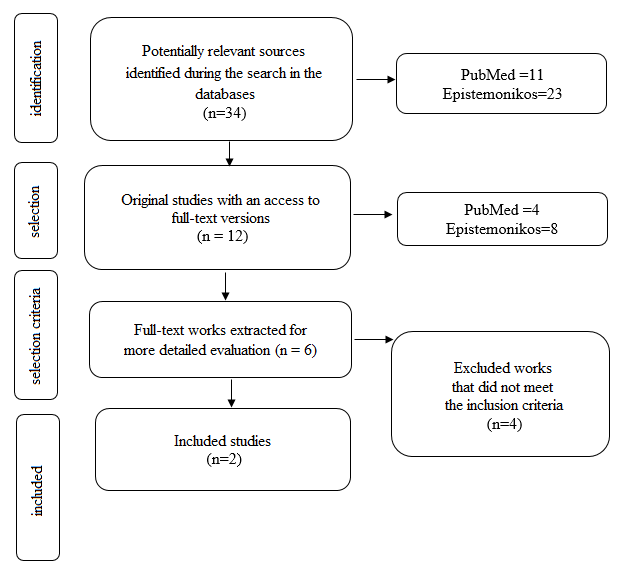
Fig. PRISMA study search and selection flowchart
We excluded the following systematic reviews for noncompliance with PICOS: Refalo et al [24], Marshall et al [25], Jukic et al [26], Davies et al [27], and Krzysztofik et al [28]. Of the 2 articles included in this comprehensive review, one study was a systematic review [22] and the other was a meta-analysis [23]. The chronological analysis of the articles considered in this review shows the recent advances in this field of research, emphasizing that 100% of the systematic reviews were published within the last 7 years (from 2017 to 2023), with the earliest one published in 2017 (table 2). The number of studies included in these reviews ranged from 25 [23] to 34 [22].
The reviews combined randomized controlled trials (RCTs) and non-RCTs without explaining the reason for this combination. None of the reviews identified conflicts of interest or funding for the studies included in them. Latella et al [23] analyzed studies that used cluster sets in the training of weightlifters, basketball players, soccer players, and judokas. Tufano et al [22] analyzed studies that used cluster sets in the training of track-and-field athletes, weightlifters, rugby players, judokas, basketball players and soccer players.
Table 2
Included systematic reviews evaluating the effects of cluster sets on athletes' strength performance
|
Review authors, publication year |
Number of included studies |
Main summary findings |
AMSTAR-2 |
|
Tufano et al., 2017 [22] |
34 |
Different types of CS can help maintain peak strength throughout a training session, and the length of rest between repeats or rest interval within a set appears to influence the ability to attenuate strength loss, with longer rest intervals resulting in better maintenance of peak strength. |
CL |
|
Latella et al., 2019 [23] |
25 |
CS are a useful strategy to reduce the loss of speed, power and peak strength during RT and should be used to maintain neuromuscular performance, especially when emphasizing kinetic outcomes. |
CL |
Note: CS – cluster sets; RT – resistance training
Review quality. The overall methodological quality of the two included reviews is summarized in table 2. Based on the overall validity assessment using AMSTAR-2 [12], the total reliability of the reviews was rated as “extremely low”. As systematic reviews and meta-analyses are a recent method of research in sport and sports medicine, we did not exclude any of the studies from further analysis based on quality assessment.
Discussion. Analysis of systematic reviews has shown that adding short rest periods within a set and while maintaining normal rest periods between sets may offer a methodology to reduce the accumulated fatigue observed during exercise [22]. Since resistance training at maximal speed may be more effective for strength development, and speed is better maintained with CS than with “traditional sets”, CS may play a role in increasing maximal strength and hypertrophy [29]. In addition, CS allows for a greater number of repeats to be performed with a given load [13], resulting in a greater volume load, and this leads to a greater stimulus to develop maximal strength [26]. Furthermore, the use of CS appears to allow for a greater number of repeats to be performed compared to traditional sets [13], which will ultimately lead to a greater volume of total work, providing a stimulus for increased muscle hypertrophy. Alternatively, if the number of repeats remains constant, CS may allow the use of a higher training intensity, which may also increase the hypertrophic stimulus. Given this potential advantage of CS, they may be most suitable for sports where strength is fundamental (martial arts, weightlifting, sprinting, etc.), as higher training loads may induce specific hypertrophy of type II fibers that athletes need to improve their performance [10]. However, strength and conditioning professionals should be mindful of the additional time that may be required to perform CS as part of a resistance training program. Any increase in training time depends on the structure of the set, including rest intervals within the set and between repeats, and the number of repeats performed in each cluster. Therefore, the scientific literature often suggests using CS with only one or two key exercises. Wave and ascending clusters can be unique methods for adding variation to a resistance training program and may be appropriate for strength sports or well-trained athletes [10].
Conclusion. An umbrella review of systematic reviews and meta-analyses on the effects of cluster sets on athletes' strength performance was conducted to identify current gaps in the literature and to make suggestions for further research. Study on the effects of cluster sets on athletes' strength performance has been of growing interest over the past 20 years. However, a significant number (100% in this review) of systematic reviews and meta-analyses have been published in the last 6 years (i.e., 2017 to 2023). In addition to potential shortcomings (small sample size, lack of randomization rules, etc.) found in the original studies, the present umbrella review revealed an overall critically low methodological quality of systematic reviews, suggesting the need for significant improvements in methodological procedures in such reviews. The authors of the 2 systematic reviews included in the umbrella review agreed on the efficiency of cluster sets for strength training in athletes. Additional RCTs in this area on national and elite level athletes are needed.
Conflict of interest. The authors declare no conflict of interest.
Financing. The authors declare that there was no external funding in conducting the study and preparing the publication.
Authors' contribution: conception, research design – A.V. Shevtsov; text writing – A.V. Shevtsov; data collection – A.V. Shevtsov and A.V. Meshtel; reviewing and editing – A.B. Miroshnikov.
REFERENCES
- Zhu Z., Wu H., Li L., Jia M., Li D. Effects of diverse resistance training modalities on performance measures in athletes: a network meta-analysis. Front Physiol, 2024, vol. 15, p. 1302610. DOI: 10.3389/fphys.2024.1302610.
- Suchomel T.J., Nimphius S., Stone M.H. The Importance of Muscular Strength in Athletic Performance. Sports Med, 2016, vol. 46(10), p. 1419-1449. DOI: 10.1007/s40279-016-0486-0.
- Serdar E.L., Nebahat E.L. Cluster Method: Effects on Performance in Handball. International Journal of Disabilities Sports and Health Sciences, 2023, vol. 7(1), pp. 144-151. DOI: 10.33438/ijdshs.
- Krzysztofik M., Wilk M., Wojdała G., Gołaś A. Maximizing Muscle Hypertrophy: A Systematic Review of Advanced Resistance Training Techniques and Methods. Int J Environ Res Public Health, 2019, vol. 16(24), p. 4897. DOI: 10.3390/ijerph16244897.
- Kahraman Y., Varol İ. Resistance training status detection via local muscular endurance adaptation maximum repetition strategy: Brief review. Scientific Journal of Sport and Performance, 2024, vol. 3(2), pp. 160-169. DOI: 10.55860/SWDB1533.
- Santos C.S., Pinto J.R., Scoz R.D. Alves B.M., Oliveira P.R., Soares W.J., D.A. Silva Jr R.A. Jr, Vieira E.R., Amorim C.F. What is the traditional method of resistance training: a systematic review. J Sports Med Phys Fitness, 2022, vol. 62(9), pp. 1191-1198. DOI: 10.23736/S0022-4707.21.12112-7.
- Vargas-Molina S., Petro J.L., Bonilla D.A., Baz-Valle E., Carbone L., Cannataro R., Benitez-Porres J. Cluster Sets for Muscle Hypertrophy: A Short Review. OBM Integrative and Complementary Medicine, 2022, vol. 7(1), pp. 1-8. DOI: 10.21926/icm.2201010.
- Gligoroska J.P., Manchevska S., Petrovska S., Dejanova B. Physiological mechanisms of muscle hypertrophy.Research in Physical Education, Sport & Health, 2022, vol. 11(1). DOI: 10.46733/PESH22111153pg.
- Androulakis-Korakakis P., Fisher J.P., Steele J. The Minimum Effective Training Dose Required to Increase 1RM Strength in Resistance-Trained Men: A Systematic Review and Meta-Analysis. Sports Med, 2020, vol. 50(4), pp. 751-765. DOI: 10.1007/s40279-019-01236-0.
- Nagatani T., Haff G.G., Guppy S.N., Kendall K.L. Practical application of traditional and cluster set configurations within a resistance training program. Strength and Conditioning Journal, 2022, vol. 44(5), pp. 87-101. DOI: 10.1519/SSC.0000000
- Totó E.C., Conceição M.S., Vieira A., Pareja-Blanco F., Bottaro M., Boulossa D. Are cluster sets an effective method to induce muscular hypertrophy in response to resistance training? Revista Brasileira de Ciências do Esporte, 2020, vol. 42, p. e2034. DOI: 10.1590/rbce.42.2019.071.
- García-Ramos A., González-Hernández J.M., Baños-Pelegrín E., Castaño-Zambudio A., Capelo-Ramírez F., Boullosa D., Haff G.G., Jiménez-Reyes P. Mechanical and Metabolic Responses to Traditional and Cluster Set Configurations in the Bench Press Exercise. J Strength Cond Res, 2020, vol. 34(3), pp. 663-670. DOI: 10.1519/JSC.0000000000002301.
- Iglesias-Soler E., Carballeira E., Sánchez-Otero T., Mayo X., Fernández-del-Olmo M. Performance of maximum number of repetitions with cluster-set configuration. Int J Sports Physiol Perform, 2014, vol. 9(4), pp. 637-642. DOI: 10.1123/ijspp.2013-0246.
- Dickson K., Yeung C.A. PRISMA 2020 updated guideline. Br Dent J, 2022, no. 232(11), pp. 760-761. DOI: 10.1038/s41415-022-4359-7.
- Gates M., Gates A., Pieper D. Fernandes R.M., Tricco A.C., Moher D., Brennan S.E., Li T., Pollock M., Lunny C. et al. Reporting guideline for overviews of reviews of healthcare interventions: development of the PRIOR statement. BMJ, 2022, no. 378, p. e070849. DOI: 10.1136/bmj-2022-070849.
- Shamseer L., Moher D., Clarke M., Ghersi D., Liberati A., Petticrew M., Shekelle P., Stewart L.A. PRISMA-P Group. Preferred reporting items for systematic review and meta-analysis protocols (PRISMA-P) 2015: elaboration and explanation. BMJ, 2015, no. 350, p. g7647. DOI: 10.1136/g7647.
- Goossen K., Hess S., Lunny C., Pieper D. Database combinations to retrieve systematic reviews in overviews of reviews: a methodological study. Med Res Methodol, 2020, vol. 20(1), p. 138. DOI: 10.1186/s12874-020-00983-3.
- Benzies K.M., Premji S., Hayden K.A., Serrett K. State-of-the-evidence reviews: advantages and challenges of including grey literature. Worldviews Evid Based Nurs, 2006, vol. 3(2), pp. 55-61. DOI: 10.1111/j.1741-6787.2006.00051.x.
- Amir-Behghadami M., Janati A. Population, Intervention, Comparison, Outcomes and Study (PICOS) design as a framework to formulate eligibility criteria in systematic reviews. Emerg Med J, 2020, vol. 37(6), p. 387. DOI: 10.1136/emermed-2020-209567.
- McHugh, M. L. Interrater reliability: the kappa statistic. Biochem Med (Zagreb), 2012, no. 22(3), pp. 276-282.
- Shea B.J., Reeves B.C., Wells G. [et al] AMSTAR 2: a critical appraisal tool for systematic reviews that include randomised or non-randomised studies of healthcare interventions, or both. BMJ, 2017, no. 358, p. j4008. DOI: 10.1136/bmj.j4008.
- Tufano, J.J., Brown L.E., Haff G.G. Theoretical and Practical Aspects of Different Cluster Set Structures: A Systematic Review. J Strength Cond Res, 2017, vol. 31(3), pp. 848-867. DOI: 10.1519/0000000000001581.
- Latella C., Teo W.P., Drinkwater E.J., Kendall K., Haff G.G. The Acute Neuromuscular Responses to Cluster Set Resistance Training: A Systematic Review and Meta-Analysis. Sports Med, 2019, vol. 49(12), pp. 1861-1877. DOI: 10.1007/s40279-019-01172-z.
- Refalo M.C., Helms E.R., Trexler E.T. Hamilton D.L., Fyfe J.J. Influence of Resistance Training Proximity-to-Failure on Skeletal Muscle Hypertrophy: A Systematic Review with Meta-analysis. Sports Med, 2023, vol. 53(3), pp. 649-665. DOI: 10.1007/s40279-022-01784-y.
- Marshall J., Bishop C., Turner A., Haff G.G. Optimal Training Sequences to Develop Lower Body Force, Velocity, Power, and Jump Height: A Systematic Review with Meta-Analysis. Sports Med, 2021, vol. 51(6), pp. 1245-1271. DOI: 10.1007/s40279-021-01430-z.
- Jukic I., Van Hooren B., Ramos A.G., Helms E.R., McGuigan M.R., Tufano J.J. The Effects of Set Structure Manipulation on Chronic Adaptations to Resistance Training: A Systematic Review and Meta-Analysis. Sports Med, 2021, vol. 51(5), pp. 1061-1086. DOI: 10.1007/s40279-020-01423-4.
- Davies T.B., Tran D.L., Hogan C.M., Haff G.G., Latella C. Chronic Effects of Altering Resistance Training Set Configurations Using Cluster Sets: A Systematic Review and Meta-Analysis. Sports Med, 2021, vol. 51(4), pp. 707-736. DOI: 10.1007/s40279-020-01408-3.
- Krzysztofik M., Wilk M., Wojdała G., Gołaś A. Maximizing Muscle Hypertrophy: A Systematic Review of Advanced Resistance Training Techniques and Methods. Int J Environ Res Public Health, 2019, vol. 16(24), p. 4897. DOI: 10.3390/ijerph16244897.
- Oliver J.M., Jagim A.R., Sanchez A.C., Mardock M.A., Kelly K.A., Meredith H.J., Smith G.L., Greenwood M., Parker J.L., Riechman S.E. et al. Greater gains in strength and power with intraset rest intervals in hypertrophic training. J Strength Cond Res, 2013, vol. 27(11), pp. 3116-3131. DOI: 10.1519/JSC.0b013e3182891672.
INFORMATION ABOUT THE AUTHORS:
Aleksej V. Shevtsov – Candidate of Pedagogical Sciences, Professor, Professor of the Department of Theory and Methodology of Martial Arts, Russian University of Sport “GTSOLIFK”, Moscow, e-mail:
Aleksandr B. Miroshnikov – Doctor of Biological Sciences, Associate Professor, Professor, Department of Sports Medicine, Russian University of Sport “GTSOLIFK”, e-mail:
Aleksandr V. Meshtel – Post-Graduate Student of the Department of Sports Medicine, Assistant of the Department of Anatomy and Biological Anthropology, Russian University of Sport “GTSOLIFK”, e-mail:
For citation: Shevtsov A.V., Meshtel A.V., Miroshnikov A.B. The influence of cluster sets during weight training on athletes' strength performance: an umbrella review of systematic reviews and meta-analyses. Russian Journal of Sports Science: Medicine, Physiology, Training, 2024, vol. 3, no. 1. DOI: 10.24412/2782-6570-2024_03_01_9