


Download the article in pdf format
Publication date: 15.09.2024
DOI: 10.24412/2782-6570-2024_03_03_1
UDC 616.8-009.18; 796.4
CHANGES IN SPECTRAL ANALYSIS INDICES IN A STABILOMETRIC STUDY OF FEMALE GYMNASTS OF DIFFERENT AGE
S.M. Abutalimova, Yu.V. Koryagina, Yu.V. Kushnareva, V.V. Korneva
FSBI “North-Caucasian Federal Research-Clinical Center of Federal Medical and Biological Agency”, Essentuki, Russia
Abstract. Currently, stabilometry is one of the main methods that provide an informative assessment of the ability to maintain the correct posture and purposefully manage the overall body mass center of athletes. The aim of the study is to evaluate the age-related changes of the frequency spectrum indices in a stabilometric study of female athletes specializing in rhythmic gymnastics. 157 gymnasts took part in the study, all athletes were divided into groups by age categories from 3 to 20 years old. The statokinetic function analysis was carried out using the STPL (MERA) force platform. The results of the study showed an age-related decrease in the frequency power of the spectrum in the sagittal and frontal planes away from the zone of medium oscillations to the transition zone, closer to the zone of slow oscillations during static tests. The analysis of the stabilometric indices revealed higher values of the energy intensity parameters of the ballistogram in the athletes of younger age groups. Thus, it was revealed that older athletes have a more advanced system of postural control, as well as better sensory and proprioceptive regulation in comparison with younger gymnasts.
Keywords: stabilometry, spectral analysis, rhythmic gymnastics, postural balance, Romberg test.
Introduction. Currently, stabilometry is one of the main methods that provide an informative assessment of the ability to maintain the correct posture and purposefully manage the overall body mass center of athletes [1-3]. An analysis of stabilometric indices in athletes engaged in complex coordination sports, such as rhythmic gymnastics, is of great importance, since the activity in such sports is closely connected with performing motor actions that differ fundamentally in volume and biomechanical structure from the movements performed by a person in ordinary life [4-7].
High-intensity physical loads combined with an early start of an athletic career of rhythmic gymnasts lead to an endcoding of atypical motor stereotypes, resulting in joint hypermobility and ligamental apparatus hypermobility [8-12].
It is necessary to note that frequently, when interpreting results of the stabilometric study, researchers primarily estimate indices of the statokinesiogram surface area and power, as well as the pressure center movement speed, not giving proper attention to the frequency spectrum indices, which reflect the distribution of the signal’s energy inside the set frequency range [13-15]. In addition, the assessment of the ballistogram energy intensity that reflects not only the length and speed of the statokinesiogram, but also its complex shape, will allow to reveal how easy or difficult the posture maintenance was for an athlete [16-17].
Aim of the study – to estimate age-related changes of the frequency spectrum parameters in a stabilometric study of female athletes specialized in rhythmic gymnastics.
Methods and organization. The study was carried out in the Center of biomedical technologies, North-Caucasian Federal Research-Clinical Center, during training camps in the Yug Sport center (Kislovodsk), as well as in sports schools in cities of Caucasian Mineral Waters.
The study included 157 female athletes specialized in rhythmic gymnastics with different qualifications: from the 3rd Junior Category to Masters of Sports of International Class and Honored Masters of Sports. All the athletes were divided into groups by age categories from 3 to 20 years (8 groups total: group 1: 3-4 years, group 2: 5-6 years, group 3: 7-8 years, group 4: 9-10 years, group 5: 11-12 years, group 6: 13-14 years, group 7: 15-16 years, group 8: 17-20 years).
The postural function analysis was conducted using the STPL force platform (МЕRА). 2 tests were used in the study: the Romberg test in the “heels in, toes out” position, and the combined test that assesses an athlete’s ability to maintain a pose according to a visible marker. The Romberg test was performed in two stages: first stage – an athlete holds a vertical pose with eyes open, second stage – with eyes closed, to estimate proprioceptive control. The combined test also included two stages: first stage – mark on a screen is static, second stage – mark on a screen is moving, reflecting the movement of an athlete's pressure center on the platform. The analyzed parameters included: FX – main oscillation frequency in the frontal plane (X-axis) (Hz), FY – main oscillation frequency in the sagittal plane (Y-axis) (Hz), Az – ballistogram energy intensity (J).
The statistical data processing was made in Microsoft Excel, Statistica 13.0 (Mann-Whitney U-test, Kruskal-Wallis test). The data are presented as the mean and mean square deviation.
Results and discussion. For the most complete assessment of body balance control in female athletes of different age groups, the Romberg test was performed. We estimated the main oscillation frequency in the frontal and sagittal planes. In addition, we analyzed the ballistogram energy intensity. Considering the fact that a significant role in maintaining balance is played by the sensory system, i.e. somatosensory, vestibular and visual parts, exclusion of one of these parts (visual analyzer) allows for more accurate estimation of the proprioceptive regulation. The data received from the stabilometric study (Romberg test with eyes open and closed) of rhythmic gymnastics of different age groups are shown in table 1.
Table 1
Comparative description of the spectral analysis indices in the Romberg test of rhythmic gymnasts of different age, M±m (n=157)
|
№ |
Indices |
Age |
P |
|||||||
|
3-4, |
5-6, n=18, (2) |
7-8, n=35, (3) |
9-10, n=39, (4) |
11-12, n=25, (5) |
13-14, n=6, |
15-16, n=11, (7) |
17-20, n=15, (8) |
|||
|
1 |
FX (eo), Hz |
0.192± 0.108 |
0.224± 0.164 |
0.175 ± 0.087 |
0.173± 0.125 |
0.194± 0.173 |
0.120± |
0.163± 0.106 |
0.167± 0.084 |
1-2,3,4,6,7,8 2-3,4,5,6,7,8 3-5,6,7,8 |
|
2 |
FY (eo), Hz |
0.192± 0.108 |
0.148± 0.068 |
0.18± 0.121 |
0,146± 0.067 |
0.161± 0.070 |
0.140± 0.055 |
0.130± 0.017 |
0.117± 0.038 |
1-4,5,6,7,8 <0.006; 2-4,5,6,7,8 3-4,5,6,7,8 8-4,6 |
|
3 |
Az (eo), J |
76.2± 52.2 |
14.3± |
5.3± |
5.31± |
2.99± |
2.87± |
2.58± |
2.49± |
1-2,3,4,5,6,7,8 2-3,4,5,6,7,8 3-5,6,8 8-4 |
|
4 |
FX (ec), Hz |
0.375± 0.142 |
0.295± 0.116 |
0.217 ± 0.128 |
0.222± 0.142 |
0.233± 0.103 |
0.200± 0.117 |
0.131± |
0.142± 0.111 |
1-2,3,4,5,6,7,8 2-5,7,8 3-6,7,8 |
|
5 |
FY (ec), Hz |
0.200± 0.135 |
0.201± 0.101 |
0.219± 0.139 |
0.193± 0.121 |
0.206± 0.100 |
0.180± 0.110 |
0.192± 0.120 |
0.161± 0.061 |
1-2,3,6,8 2-4,5,6,7,8 3-4,5,6,7,8 8-4,6 |
|
6 |
Az (ec), J |
85.0± |
17.7± |
12.9± 9.6 |
7.79± |
4.12± |
6.70± |
5.91± 1.12 |
3.98± |
1-2,3,4,5,6,7,8 2-4,5,6,7,8 3-5,6,8 8-4,5,7 |
Note: FX (eo), Hz – main oscillation frequency in the frontal plane (X-axis), eyes open; FX (ec), Hz – main oscillation frequency in the frontal plane (X-axis), eyes closed; FY(eo), Hz – main oscillation frequency in the sagittal plane (Y-axis), eyes open; FY(ec), Hx – main oscillation frequency in the sagittal plane (Y-axis), eyes closed; Az (eo), J – ballistogram energy intensity, eyes open; Az (ec), J – ballistogram energy intensity, eyes closed
During the Romberg test with eyes open, we have found a tendency for decreasing oscillation frequency parameters both in the frontal and sagittal plane in older groups compared with the younger ones. The age-related changes in the spectral parameters were more pronounced in the estimation of the main oscillation frequency in the frontal plane when conducting the Romberg test with eyes closed. The changes in the main oscillation frequency in the sagittal plane do not so clearly reflect the age-related decrease of values, although the statistical tendency remains.
The ballistogram energy intensity analysis in both test with eyes open and test with eyes closed revealed a statistically significant reduction of values in older groups (11 years and older).
Thus, it is necessary to note an age-related reduction in the frequency power of the spectrum in the sagittal and frontal planes away from the zone of medium oscillations to the transition zone, closer to the zone of slow oscillations, which is most likely the result of a decrease in the influence of proprioceptive control.
The data obtained from the combined test of rhythmic gymnasts of different age are presented in table 2.
Table 2
Comparative description of the spectral analysis indices in the combined test of rhythmic gymnasts of different age, M±m (n=157)
|
№ |
Indices |
Age |
Р |
|||||||
|
3-4, |
5-6, |
7-8, n=35, (3) |
9-10, n=39, (4) |
11-12, |
13-14, |
15-16, n=11, (7) |
17-20, |
|||
|
1 |
FX (1), Hz |
0.233± 0.150 |
0.190± |
0.197± 0.148 |
0.202± 0.164 |
0.217± 0.169 |
0.200± 0.129 |
0.163± 0.177 |
0.167± 0.097 |
1-2,3,4,5,6,7,8 5-6,7,8 8-4,5,6 |
|
2 |
FY (1), Hz |
0.283± 0.204 |
0.195± |
0.164± 0.093 |
0.166± 0.065 |
0.167± 0.097 |
0.161± 0.084 |
0.155± 0.149 |
0.133± 0.059 |
1-2,3,4,5,6,7,8 2-5,6,7,8 8-4,5 |
|
3 |
FX (2), Hz |
0.342± 0.231 |
0.343 ±0.136 |
0.378± 0.179 |
0.395± 0.184 |
0.489± 0.128 |
0.320± 0.205 |
0.413± 0.247 |
0.372± 0.167 |
- |
|
4 |
FY (2), Hz |
0.200± 0.104 |
0.214± |
0.206± 0.153 |
0.334± 0.213 |
0.317± 0.158 |
0.300± 0.108 |
0.463± 0.130 |
0.267± 0.178 |
- |
Note: FX (1), Hz – main oscillation frequency in the frontal plane (X-axis), static part of the test; FX (2), Hz – main oscillation frequency in the frontal plane (X-axis), dynamic part of the test; FY(1), Hz – main oscillation frequency in the sagittal plane (Y-axis), static part of the test; FY(2), Hz – main oscillation frequency in the sagittal plane (Y-axis), dynamic part of the test
During the static part of the combined test, we have found a decrease in the oscillation frequency both in the frontal and the sagittal plane in older groups compared to the younger ones. During the dynamic part, no statistically significant differences between different age groups were found.
Analysis of the ballistogram energy intensity parameters in athletes of different age during the static part of the test is presented in figure 1.
A statistically significant reduction in the ballistogram energy intensity was revealed in the athletes of older groups (1-2,3,4,5,6,7,8 р<0.001; 2-5,6,7,8 р<0.004; 8-3,4,5,6,7 р<0.001), which shows how energy consuming a process of maintaining a static pose was in different age groups.
Analysis of the ballistogram energy intensity parameters in athletes of different age during the dynamic part of the test is presented in figure 2.
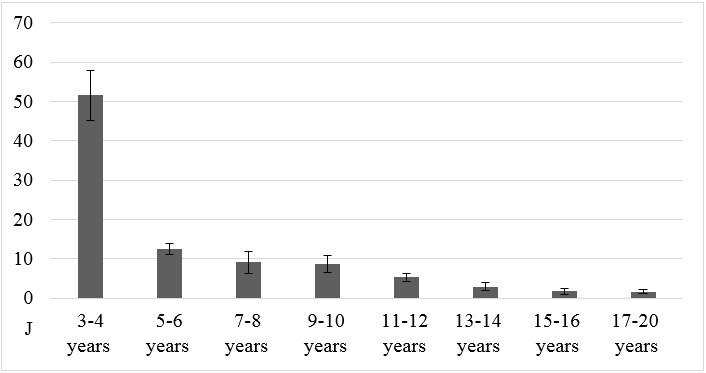
Fig. 1. Ballistogram energy intensity parameters in athletes of different age during the static part of the combined test
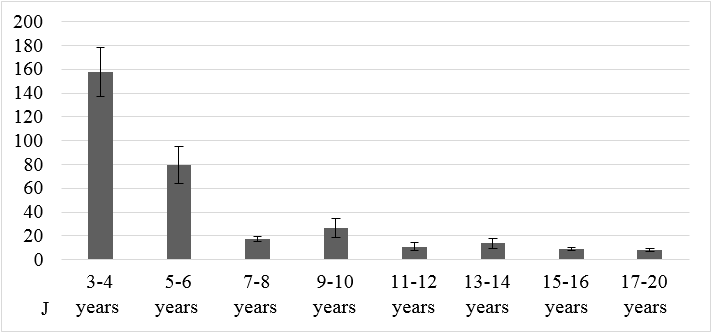
Fig. 2. Ballistogram energy intensity parameters in athletes of different age during the dynamic part of the combined test
The stabilometric analysis has revealed higher values of the ballistogram energy intensity in the athletes of younger age groups (1-2,3,4,5,6,7,8 р<0.002; 2-5,6,7,8 р<0.001; 4-5,6,7,8 р<0.002).
Therefore, taking into account higher values of the oscillation frequency in the frontal and the sagittal planes in the athletes of younger groups combined with higher parameters of the energy intensity index, we can speak about higher stress of their proprioceptive and somatosensory systems in holding static and dynamic pose. However, we need to consider the generally accepted classification, according to which the frequency spectrum in a range of 0-0.3 Hz corresponds with respiratory, fixative movements and can be controlled voluntarily; 0.5-1.5 Hz – result of muscle contraction, cannot be controlled voluntarily; higher than 2 Hz is practically undetectable in a healthy person [1]. Despite the difference in the frequency spectrum and the ballistogram energy intensity indices, it is worth mentioning about a high level of postural control in the athletes of younger age groups.
Conclusion. Thus, it is necessary to notice high informational value of the spectral analysis parameters when conducting a stabilometric research on athletes engaged in complex coordination sports. We have found an age-related reduction in the spectrum frequency power both in the sagittal and frontal plane from the zone of medium oscillations to the transition zone, closer to the zone of slow oscillations, which is most likely the result of the improvement of the mechanisms of sensory and proprioceptive regulation. There was also a significant decrease in the ballistogram energy intensity in the athletes of older age groups, which indicates a more rational use of energy resources with the growth of sportsmanship.
Conflict of interest. The authors declare no conflict of interest.
REFERENCES
- Romanov Yu.N., Romanova L.A., Batyrshina G.R. The resarch of indices of ballistogrammy and the spectral analysis of the kickboxers in computer stabilometry. Human. Sport. Medicine, 2012, no. 28, pp. 44-47. (in Russ.)
- Ivanova G.E., Skvortsov D.V., Klimov L.V. Postural function evaluation in clinical practice. Bulletin of Rehabilitation Medicine, 2014, no. 1, pp. 19-25. (in Russ.)
- Malichenko A.A., Kostyuchik I.Yu., Nikolaeva Yu.V., Olenskaya T.L., Kruchinskij N.G. Stabilometry in sport: realities and prospects. Vestnik of Polotsk State University. Part E. Pedagogic Sciences, 2019, no. 15, pp. 142-146. (in Russ.)
- Andreeva A.M., Mel’nikov A.A., Skvortsov D.V. Postural stability in athletes: the role of sport direction. Olympic Sports and Sports for Everyone: materials of the XXV International Scientific Congress. Minsk: 2020. pp. 41-48. (in Russ.)
- Grakhov I.A., Zekrin F.H., Zebzeev V.V., Zekrin A.F., Vetrov V.A. Comparative analysis of stabilometric indicators of athletes of various types of martial arts. Scientific notes of P.F. Lesgaft University, 2019, no. 5 (171), pp. 88-93. (in Russ.)
- Karantysh G.V. Misirov D.N., Dmitrenko L.M., Khakobyan M.A., Khovkhannisyan L.A. Diagnostic criteria for postural control of skilled and unskilled gymnasts and cheerleaders. Human. Sport. Medicine, 2022, vol. 22, no. S2, pp. 107-114. (in Russ.)
- Kolokolneva K.V., Botova L.N. Analysis of stabilometric indices in elite gymnasts. Problems and Prospects of Physical Culture, Sports Training and Adaptive Physical Culture: materials of the III All-Russian Scientific and Practical Conference with international participation. Kazan: 2019. pp. 51-54. (in Russ.)
- Koryagina Yu.V., Nopin S.V., Abutalimova S.M., Tychinina A.P. Implementation of the Sports orientation of children to rhythmic gymnastics complex to study age-related features of 4-8-year old rhyrhmic gymnasts. Modern Issues of Biomedicine, 2022, vol. 6, no. 4. DOI: 10.51871/2588-0500_2022_06_04_26 (in Russ.)
- Koryagina Yu.V., Nopin S.V., Akimkina O.N. Assessment of changes in morphological status and physical qualities of 4-17-year-old girls engaged in rhythmic gymnastics. Russian Journal of Sports Science: Medicine, Physiology, Training, 2024, vol. 3, no. 1, pp. 7-16. DOI: 10.24412/2782-6570-2024_03_01_1 (in Russ.)
- Medvedeva E.N., Kryuchek E.S. Modern approaches to the systematic analysis of coordination mechanisms of gymnastic exercises. Nauchno-pedagogicheskie shkoly Universiteta, 2021, no. 6, pp. 160-173. (in Russ.)
- Misnikova M.O., Medvedeva E.N., Kivikharyu I.V., Suprun A.A. Features of keeping the vertical posture in the process of performing basic elements with various apparatus in rhythmic gymnastics. Izvestiya Tula State University. Physical Culture. Sports, 2023, no. 7, pp. 61-67. (in Russ.)
- Serebryakov A.I. Identification of student body balance parameters with the method of stableometry. VSU Bulletin, 2020, no. 4. (109), pp. 85-90. (in Russ.)
- Skrzhinskij A.M., Zhigareva S.A., Eremina E.V. Objective analysis of the performance of basic exercises in gymnastics using a stable platform. Scientific Notes of P.F. Lesgaft University, 2023, no. 6 (220), pp. 387-392. (in Russ.)
- Sheshko V.V. The stabilometry method in the assessment and development of postural stability of female rhythmic gymnasts. Values, Traditions and Innovations of Modern Sports Materials of the II International Scientific Congress. Minsk, 2022. pp. 437-440. (in Russ.)
- Bigoni M., Turati M., Gandolla M. Balance in young male football players: dominant leg versus non-dominant. Sports sciences for health, 2017, vol.13 (2), pp. 253-258.
- Lemos L.F.K., de David A.K., Mota K.B. Equilíbrio postural: correlações com desempenho motor e variáveis antropométricas em crianças de 4 a 10 anos de idade. Saúde e Desenvolvimento Humano, 2016, vol. 4, no. 1, pp. 27-36. (in Portuguese)
- Schmid M., Conforto S., Lopez L., Renzi P., D'Alessio T. The development of postural strategies in children: a factorial study Journal of Neuroengineering and Rehabilitation, 2005, vol. 2, pp. 1-11.
INFORMATION ABOUT THE AUTHORS:
Sabina M. Abutalimova – Candidate of Medical Sciences, Senior Researcher of the Center of Biomedical Technologies, FSBI “North-Caucasian Federal Research-Clinical Center of Federal Medical and Biological Agency”, Essentuki, e-mail:
Yulia V. Koryagina – Doctor of Biological Sciences, Professor, Head of the Center of Biomedical Technologies, FSBI “North-Caucasian Federal Research-Clinical Center of Federal Medical and Biological Agency”, Essentuki, e-mail:
Yulia V. Kushnareva – Candidate of Biological Sciences, Senior Researcher of the Center of Biomedical Technologies, FSBI “North-Caucasian Federal Research-Clinical Center of Federal Medical and Biological Agency”, Essentuki, e-mail:
Viktoria V. Korneva – Junior Researcher of the Center of Biomedical Technologies, FSBI “North-Caucasian Federal Research-Clinical Center of Federal Medical and Biological Agency”, Essentuki, e-mail:
For citation: Abutalimova S.M., Koryagina Yu.V., Kushnareva Yu.V., Korneva V.V. Changes in spectral analysis indices in a stabilometric study of female gymnasts of different age. Russian Journal of Sports Science: Medicine, Physiology, Training, 2024, vol. 3, no. 3(11). DOI: 10.24412/2782-6570-2024_03_03_1