


Download the article in pdf format
Publication date: 15.09.2024
DOI: 10.24412/2782-6570-2024_03_03_5
UDC 796.015.527
EFFECT OF OCCLUSION TRAINING ON ELECTROCELLOGRAM PARAMETERS IN FEMALE AESTHETIC GYMNASTS: A RANDOMIZED CONTROLLED TRIAL
F.A. Koloskov1, P.D. Rybakova2, A.B. Miroshnikov1
1Russian University of Sport “GTSOLIFK”, Moscow, Russia
2Center for Sports Innovative Technologies and Training of National Teams, Moscow, Russia
Abstract. Maintaining the integrity of muscle cell membranes at the proper level is crucial for successful performance. The aim of the study is to develop and experimentally substantiate the technique of occlusion training application to increase the phase angle of female athletes engaged in aesthetic gymnastics. Twenty level female athletes participated in the study. Electrocellogram was performed using bioelectrical impedance analysis. In the experimental group a special elastic cuff for occlusal training and a portable device for ultrasonic diagnostics were used. After 180 days of intervention, the phase angle increased by 0.19° (p>0.05) in the experimental group and by 0.48° (p≤0.01) in the control group. The difference between groups was 0.29°, and it was not statistically significant (p<0.05). 180 days of regular blood flow restriction training did not impair cell stability and integrity assessed using phase angle.
Keywords: aesthetic gymnastics, electrocellogram, phase angle, occlusal training, blood flow restriction training.
Introduction. Aesthetic gymnastics is a complex sport requiring high muscle strength, strength endurance, flexibility, balance, aerobic and anaerobic metabolism [1]. In this regard, there is clear evidence that the demands on muscle cell integrity both during training and especially during competition are higher than previously thought. Therefore, maintaining the integrity of muscle cell membranes at a proper level in aesthetic gymnastics is crucial for a successful performance.
The bioelectrical impedance analysis (BIA) of body composition was suggested as cheap, portative and efficient method for estimating body composition of athletes [2]. The electrical impedance is defined by a vector ratio between resistance, which is represented by hydration, and reactive resistance associated with cell membrane integrity. The angle created by both vectors is a phase angle (PhA) [3], the value of which reflects cellular health [4]. PhA is an indicator of stability, integrity and nutritive status of cell membranes [5]. The intact cell membranes are important for a proper cellular function, i.e. for intercellular communication and intracellular signal transfer. It also relates to the quality of neuromuscular communication or the ability of the neural system to control motor activity, which explains the increase in PhA after training [6]. This method can be comprehended in the same way as other “electrogram” methods, which record the electrical activity of organs such as the brain and the heart by measuring changes in electrical processes. This new term is called “cell electrogram” or “electrocellogram” [7]. PhA is used in clinical practice [8] and sports as a possible indicator of health, physical performance and muscle strength [9-10]. A recent systematic study of Cirillo et al [11] revealed positive correlation between PhA and countermovement jump, wrist strength and lower limb strength in athletes. Since skeletal muscle is the largest conductive tissue in the body, PhA is strongly correlated with body muscle mass [12].
Blood flow restriction training (BFR) includes exercise with low mechanical load or intensity using a device capable to limit blood flow to the trained limb [13]. Such training method has demonstrated results similar to high-intensity training in terms of increasing strength and muscle mass [14]. This is the reason why during BFR training became popular in sports. However, research shows that working muscles acidify more during BFR training than during traditional training [15]. Cell swelling, acidosis and oxidation degrade membrane properties and lead to membrane permeability [16]. Changes in cell membrane fluidity play a key role in regulation of structural, functional and dynamic properties of membranes. Therefore, potential of implementing BFR for muscle cell of aesthetic gymnasts remains to be explored. According to the analysis of the problem situation, data of modern scientific literature and requests of sports physiologists, biologists, coaches and athletes, the following aim was formulated.
Aim of the study – to develop and experimentally prove the effectiveness of occlusion training for improving the phase angle of aesthetic gymnasts.
Methods and organization. The study took place in the Department of Sports Medicine, Russian University of Sport, Moscow and lasted for 180 days [17]. The study included 20 elite aesthetic gymnasts, level of sportsmanship – 15 Masters of Sport and 5 Candidates for Master of Sport. They were randomized into two groups using the random number table (fig.): the experimental group trained with BFR (8 Masters of Sport and 2 Candidates for Master of Sport, n=10), the control group trained according to a traditional method (7 Masters of Sport and 3 Candidates for Master of Sport, n=10). All the participants gave voluntary informed consent to participate in the study in accordance with the 2020 Ethical Standards for Research in Sports and Physical Activity [18] (Extract from Minutes No 2, meeting of the GTSOLIFK Ethics Committee dated 12.09.23). The program, protocols and methods of the RCT were developed based on modern concepts and regulations of evidence-based medicine, which were applied in accordance with the aim of the study. All gymnasts had a comprehensive examination before and at the end of the study, including: interview, examination and body composition analysis. Electrocellogram was registered on the Medass ABC-02 device (Russia).
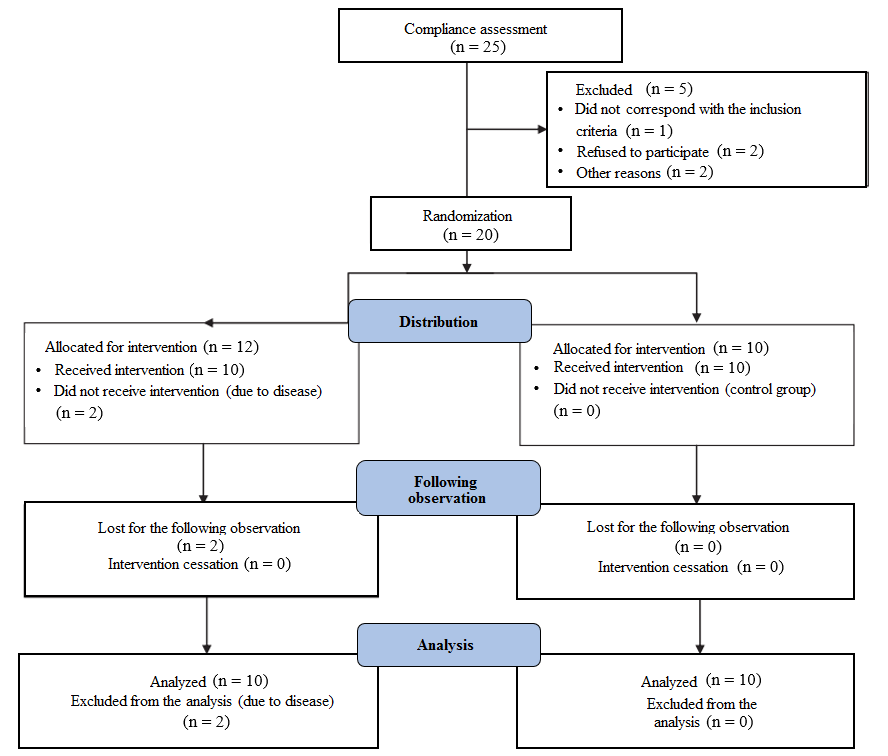
Fig. The CONSORT flowchart
Pressure of specific occlusion training bands was registered with the Logiq V2 portative device for ultrasound diagnosis (General Electric, USA). A 50% blood flow occlusion was recorded in accordance with a twofold increase in linear blood flow velocity in the artery below the applied band compared to the velocity without it. The band has numerical divisions, and after ultrasound diagnosis a table was created for the experimental group, in which the numbers of turns for tightening the band were marked in order to see the necessary degree of BFR during training. According to the available literature data, we also developed a following protocol for special gymnast training. We used a series of familiar 17 exercises performed with one’s own body mass for 8 repetitions each, these exercises include dynamic movements, holding static postures, and jumps. The protocol lasted 15 minutes, with 15-30 second rest between exercises. This protocol was performed in the experimental group after the main training with the bands on the upper and lower limbs, taking into account necessary occlusion pressure (40-80%), frequency of occlusion training sessions – 3 times a week. The special training protocol included following exercises:
1) hip flexion while sitting on the floor;
2) hip hyperextension while lying on the stomach;
3) sitting up from lying position, 4 movement variations;
4) hip hyperextension with abduction while lying on the stomach, 2 movement variations;
5) double alternating crunches while lying on the floor;
6) cross arm flexion and leg hyperextension while lying on the stomach;
7) one-arm push-ups while lying on the side;
8) cross hip flexion and adduction while lying on the back;
9) high-amplitude hip flexion while lying on the back;
10) hip abduction while lying on the side;
11) squat hip hyperextension;
12) forearm plank for one minute;
13) burpees without push-ups, with jumps;
14) double jumps with side splits;
15) bouncing on one leg;
16) high knees running in place;
17) squats while standing on toes.
The statistical analysis was done with the STATISTICA 10 software package (StatSoft, USA). The statistical differences in the groups were calculated with the Wilcoxon’s signed rank test, between the groups – with the Mann-Whitney’s test. The differences deemed statistically significant at p<0.01. Differences between groups were identified for each participant within the study groups separately, and medians, upper and lower quartiles were then calculated.
Results and discussion. Biological tissues are complex heterogenic environments consisting of cells with different intracellular characteristics and signaling systems, which are coded by genes in cell core and activated when external signals are received from foreign cells or non-cell components in human tissues [19]. Interaction between intracellular components (for examples, the structure and functions of organelles, hydration level) and extracellular matrices creating structural and biochemical cell support is a basis for the development and function of body tissues, organs and systems in more complicated cases. Although dynamic cellular processes are constantly at work providing a biological balance between tissue and organ functions, mechanical and non-mechanical processes may lead to disruption or alteration in these functions. And though exposure of the cell to extreme stress in a form of high-intensity or prolonged exercise represents the most significant mechanical factor affecting cellular health and tissue function, there are other parameters of more physical, chemical and biological origin to consider. Since such changes have a direct impact on cell structure and physiological functions, acting as an indirect indicator of total health, a better understanding of cell properties for cellular health monitoring purposes was the aim of the study.
According to Campa et al [20], the participants were included into the 50th percentile of standard PhA for female gymnasts. After 180 days of intervention (table), PhA in the experimental group increased by 0.19° (p>0.05), in the control group – by 0.48° (p<0.01). The difference between the groups reached 0.29° being statistically insignificant (p<0.05).
Table
Phase angle parameters in female athletes
|
Experimental group |
||||
|
Parameter |
0 days |
180 days |
∆ |
|
|
PhA, ° |
Me |
6.02 |
6.18 |
0.19 |
|
Q1; Q3 |
[5.86; 6.06] |
[5.84; 6.41] |
[-0.22; 0.35] |
|
|
Control group |
||||
|
Parameter |
0 days |
180 days |
∆ |
|
|
PhA, ° |
Me |
5.97 |
6.49 |
0.48 |
|
Q1; Q3 |
[5.41; 6.13] |
[6.26; 6.61] |
[0.42; 0.65]* |
|
Note: Me – Median; Q1; Q3 – Quartile 1 and Quartile 3; ∆ – changes in parameters within the group (0-180 days); PhA – phase angle; * – statistically significant changes in the group over the course of 180 days, p<0.01
The cell membrane integrity is of great interest when examining efficiency of BFR-based interventions. The data received show that regular acidification of muscle cells caused by BFR does not degrade stability and integrity of cell membranes of gymnasts [21]. Researchers show that regular interval BFR training improves the ability to regulate pH during dynamic exercise, mainly by improving muscle lactate-dependent H+ transport function and blood H+ buffering capacity. It is possible that such adaptive mechanisms improve structures and functions of cells in the working muscles.
Conclusion. The biophysical response of a human body to electric currant is widely known as a barometer for fluid distribution and cell function. Among different BIA indices used for estimating body composition, PhA was repeatedly considered as a functional marker of muscle cellular health. Although programs of BFR training have demonstrated their efficiency in improving PhA with varying degrees of change depending on other BIA indices, there is still a limited number of studies explaining biological mechanisms underlying these changes. Cell membranes are crucial for cellular health, since they divide intercellular and extracellular environment, create a barrier controlling the movement of substances inside and outside of cells (e.g. nutritious substances and metabolism products) and provide a platform for intercellular signaling [6]. Cell membrane integrity reflects an ability to resist damage and ability of the membrane to recover. It may be estimated according by the penetration of impermeable molecules into the cell and by changes in the extracellular membrane [22]. Many researchers pointed out an increased acidosis of the working muscles as a result of BFR training, which raised concerns on cell membrane integrity in the long run. Our data show, that 180 days of regular BFR training do not degrade indices of cell stability and integrity assessed with PhA. Additional RCTs are required in this field.
Study limitations. The study had some limitations, including a relatively low number of participants. In addition, in order to estimate damage and recovery of cell membrane we used a single electrocellogram indicator, i.e. phase angle. We also did not take into account the ovarian menstrual cycle phases of the study participants, as well as, consequently, the effect of the cycle phase on phase angle indices.
Ethical Standards. All studies were conducted in accordance with the principles of biomedical ethics formulated in the Helsinki Declaration of 1964 and its subsequent updates and approved by the local bioethical committee of RUS “GTSOLIFK” on 12.09.2023 Protocol No 2.
Informed Consent. Each participant of the study provided voluntary written informed consent, signed by them after explaining to them the potential risks and benefits and the nature of the upcoming study.
Funding. The authors report that they did not receive any funding and all costs of the study were personal contributions of the authors.
Conflict of interest. The authors declare that they have no apparent or potential conflicts of interest related to the publication of this article.
REFERENCES
- Armada Martínez C., Cavas-García F., Díaz-Suárez A., Martínez-Moreno A. Psychological Profile and Competitive Performance in Group Aesthetic Gymnastics. Front Sports Act Living, 2021, no. 3, pp. 625944. DOI: 10.3389/fspor.625944.
- Campa F., Gobbo L.A., Stagi S., Cyrino L.T., Toselli S., Marini E., Coratella G. Bioelectrical impedance analysis versus reference methods in the assessment of body composition in athletes. Eur J Appl Physiol, 2022, no. 122 (3), pp. 561-589. DOI: 10.1007/s00421-021-04879-y.
- Vásquez M.A., Alonso J.C., de la Maza B.P., Arnáiza E.G., Sastrea D.G., Coboa D.G.A., Fondoa A.M.U., Gonzáleza M.A., del Carmen Dameto Ponsa M., Ballesteros Pomar M.D. Ángulo de fase: diferencias entre desnutrición relacionada con la enfermedad, obesidad y población sana. Endocrinología, Diabetes y Nutrición, 2024, no. 22. DOI: 10.1016/j.endinu.2024.07.004.
- Lukaski H.C., Kyle U.G., Kondrup J. Assessment of adult malnutrition and prognosis with bioelectrical impedance analysis: phase angle and impedance ratio. Curr Opin Clin Nutr Metab Care, 2017, no. 20(5), pp. 330-339. DOI: 10.1097/MCO.0000000000000387.
- Cattem M., Orsso C.E., Gonzalez M.C., Koury J.C. One-Year Changes in Bioelectrical Impedance Data in Adolescent Athletes. Nutrients, 2024, no. 16(5), pp. 701. DOI: 10.3390/nu16050701.
- Short T., Yamada P. Exploring the Mechanistic Trail Connecting Cellular Function, Health, and Athletic Performance With Phase Angle: A Review on the Physiology of Phase Angle and Exercise-Based Interventions. Topics in Exercise Science and Kinesiology, 2024, no. 5(1), p. 7.
- Bellido D., García-García C., Talluri A., Lukaski H.C., García-Almeida J.M. Future lines of research on phase angle: Strengths and limitations. Rev Endocr Metab Disord, 2023, no. 24(3), pp. 563-583. DOI: 10.1007/s11154-023-09803-7.
- Custódio Martins P., de Lima T.R., Silva M., Santos Silva D.A. Association of phase angle with muscle strength and aerobic fitness in different populations: A systematic review. Nutrition, 2022, no. 93, p. 111489. DOI: 10.1016/j.nut.2021.111489.
- Marini E., Campa F., Buffa R. Stagi S, Matias C.N., Toselli S., Sardinha L.B., Silva A.M. Phase angle and bioelectrical impedance vector analysis in the evaluation of body composition in athletes. Clin Nutr, 2020, no. 39(2), pp. 447-454. DOI: 10.1016/j.clnu.2019.02.016.
- Silvino V.A., Barros K.R.B., Brito F.M., Magalhaes F.M.D., Carioca A.A.F., Phase angle as an indicator of body composition and physical performance in handball players. BMC Sports Sci Med Rehabil, 2024, no. 16(1), p. 114. DOI: 10.1186/s13102-024-00899-1.
- Cirillo E., Pompeo A., Cirillo F.T., Vilaça-Alves J., Costa P., Ramirez-Campillo R., Dourado A.C., Afonso J., Casanova F. Relationship between Bioelectrical Impedance Phase Angle and Upper and Lower Limb Muscle Strength in Athletes from Several Sports: A Systematic Review with Meta-Analysis. Sports (Basel), 2023, no. 11(5), p. 107. DOI: 10.3390/sports11050107.
- Martins P.C., Alves Junior C.A.S., Silva A.M., Silva D. Phase angle and bodycomposition: A scoping review. Clin Nutr ESPEN, 2023, no. 56, pp. 237-250. DOI: 10.1016/j.clnesp.2023.05.015.
- de Queiros V.S., Rolnick N., Kamiş O., Formiga M.F., Rocha R.F.C., Alves J.C.M, Vieira J.G., Vianna J.M., Wilk M., Fostiak K., Cabral B.G. dA.T., Dantas P.M.S. Body position and cuff size influence lower limb arterial occlusion pressure and its predictors: implications for standardizing the pressure applied in training with blood flow restriction. Front Physiol, 2024, no. 15, p. 1446963. DOI: 10.3389/fphys.2024.1446963.
- Kamiş O., Gürses V.V., Şendur H.N., Altunsoy M., Pekel H.A., Yıldırım E, Aydos L. With Blood Flow Restriction Versus High-Load Resistance Exercise on Hamstring Muscle Adaptations in Recreationally Trained Men. J Strength Cond Res, 2024, no. 7. DOI: 10.1519/JSC.0000000000004
- Fukuta H. Effect of One Session of Muscle Blood Flow Restriction Training Versus Normal Training on Blood Lactate Level. Prog Rehabil Med, 2024, no. 9, p. 20240017. DOI: 10.2490/prm.
- Dias C., Nylandsted J. Plasma membrane integrity in health and disease: significance and therapeutic potential. Cell Discov. 2021, no. 7(1), p.4. DOI: 10.1038/s41421-020-00233-2.
- Cuschieri S. The CONSORT statement. Saudi J Anaesth, 2019, no. 13(Suppl 1), pp. S27-S30. DOI: 10.4103/sja.SJA_559_18.
- Harriss, D. J. MacSween A., Atkinson G. Ethical Standards in Sport and Exercise Science Research: 2020 Update. Int J Sports Med, 2019, no. 40(13), pp.813-817. DOI: 10.1055/a-1015-3123.
- Sardinha L., Rosa G.B. Phase angle, muscle tissue, and resistance training. Rev Endocr Metab Disord, 2023, no. 24(3), pp. 393-414. DOI: 10.1007/s11154-023-09791-8.
- Campa F., Thomas D. M., Watts K., Clark N., Baller D., Morin T., Toselli S., Koury J.C., Melchiorri G., Andreoli A., Mascherini G., Petri C., Sardinha L.B., Silva A.M. Reference Percentiles for Bioelectrical Phase Angle in Athletes. Biology (Basel), 2022, no. 11(2), p. 264. DOI: 10.3390/biology11020264.
- Christiansen D., Eibye K., Hostrup M., Bangsbo J. The effect of blood-flow-restricted interval training on lactate and H+ dynamics during dynamic exercise in man. Acta Physiol (Oxf), 2021, no. 231(3), p. e13580. DOI: 10.1111/apha.
- Ammendolia, D.A., Bement W.M., Brumell J.H. Plasma membrane integrity: implications for health and disease. BMC Biol, 2021, no. 19(1), p. 71. DOI: 10.1186/s12915-021-00972-y.
INFORMATION ABOUT THE AUTHORS:
Filipp A. Koloskov – Post-Graduate Student of the Department of Sports Medicine, Russian University of Sport ‘GTSOLIFK’, Moscow, e-mail:
Polina D. Rybakova – Analyst of the Sports Nutritionology Department, Centre for Sports Innovative Technologies and National Team Training of the Moscow City Sports Department, Moscow, e-mail:
Aleksandr B. Miroshnikov – Doctor of Biological Sciences, Associate Professor, Professor of the Department of Sports Medicine, Russian University of Sport “GTSOLIFK”, Moscow, e-mail:
For citation: Koloskov F.A., Rybakova P.D., Miroshnikov A.B. Effect of occlusion training on electrocellogram parameters in female aesthetic gymnasts: a randomized controlled trial. Russian Journal of Sports Science: Medicine, Physiology, Training, 2024, vol. 3, no. 3(11). DOI: 10.24412/2782-6570-2024_03_03_5