


Download the article in pdf format
Publication date: 15.12.2024
DOI: 10.24412/2782-6570-2024_03_04_3
UDC 615.83; 796
CONSERVATIVE RECONSTRUCTIVE TREATMENT OF ACHILLES TENDINOPATHY FOR ELITE ATHLETES OF VARIOUS SPORTS
E.V. Kostyuk, Yu.V. Koryagina
FSBI “North-Caucasian Federal Research-Clinical Center of Federal Medical and Biological Agency”, Essentuki, Russia
Abstract. The aim of the study – development and scientific substantiation of the conservative reconstructive treatment of Achilles tendinopathy for elite athletes of different sports. The study involved 120 highly qualified athletes with complaints of pain in the Achilles tendon area during training camps. According to the survey results, the athletes with calcification and exostosis detected on ultrasonogram had undergone a 5-procedure course of extracorporeal shockwave therapy. The athletes with anterior (or posterior) Achilles tendon bursitis after surgical treatment of the ankle were treated with a course of combined endomassage and magnetic field (MANTIS MR991). The results have shown that endomassage and magnetic field combined with the optimized lower leg muscle balance in acute and subacute Achilles tendon injuries is a more effective method than extracorporeal shockwave therapy, except in cases of chronic injuries. After the treatment, signs of inflammation in the Achilles tendon have been eliminated, and the athletes were able to regain their former level of motor activity.
Keywords: athletes, muscle strength, muscle balance, Achilles tendinopathy, anterior (posterior) Achilles tendon bursitis, extracorporeal shockwave therapy, pulsating magnetic field, stimulation electromyography.
Introduction. Exposure to intense and prolonged physical activity, constrained posture in sports exercises cause adaptive changes of the neuromuscular system of athletes [1-5], which can result in muscle imbalances. As noted by experts, muscle imbalances are caused by impaired muscle antagonism and myotatic reflexes as a result of prolonged same-type training exercises and disproportional strength [6]. Neuromuscular imbalance is accompanied by redistribution of loads in the kinematic chain links with the development of biomechanical disorganization and the emergence of compensatory processes [7].
Track-and-field athletes engaged in high running activity may have an imbalance in the lower leg flexors/extensors that disturbs natural asymmetry and enhances dystrophic reactions in the Achilles tendon [8]. An incomplete recovery from the fatigue-related Achilles injuries leads to additional stress and increased risk of re-injury, Achilles tendon ruptures, reduces a possibility of regaining former motor activity [9]. Therefore, there is a need in the development of a method of effective conservative reconstructive treatment of Achilles tendinopathy for elite athletes of different sports.
Methods and organization. The study involved 120 athletes (qualification: MS (Master of Sports), MS IC (Master of Sports of International Class), HMS IC (Honored Master of Sports of International Class); sports: rhythmic gymnastics, track-and-field, fencing, judo, triathlon, field hockey; age – 17 to 30 years) during training camps. The athletes complained of pain in the Achilles tendon area during or after training.
For proper rehabilitation and treatment of Achilles tendinopathy we need to consider peculiarities of the ankle joint anatomy (fig.).
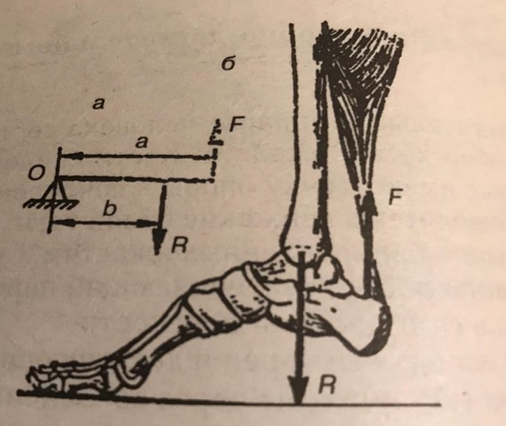
Fig. The ankle joint anatomy
The ankle joint is a second-class lever. The axis of oscillation (О) passes through the head of the metatarsal bones, and two forces are applied on the foot on the same side of the axis. The force of gravity (R) is equal to the half of the force (½R) applied to the whole body. The leverage of this force is labelled b, i.e. the distance from the joint of the foot to the contact point between the metatarsus and the floor (usually 12 cm). The traction force (F) is transmitted by the Achilles tendons and is applied to the back of the heel, the leverage of this force is labeled a, i.e. the distance from the fulcrum to the point of action of the Achilles tendons (usually 18 cm), the lever balance condition is F*a = R*b, in this case a>b = >F<R, so by strengthening the flexors we gain in strength but lose in speed. The Achilles tendon has a very poor blood supply. The Achilles tendon is perfused by the paratenon vessels, which are branches of the posterior tibial and peroneal arteries. The middle part of the Achilles tendon has the poorest blood supply. In case of elastic lengthening of the Achilles tendon, the temperature rises to 45° in the tendon’s thickness after 7 minutes. Tenocyte death occurs at this temperature. Only a proper blood supply allows sufficient hemostasis by cooling the tendon.
Taking the above-mentioned into account, we have developed the following method. The athletes with calcification and exostosis detected on ultrasonogram (27 track-and-field athletes) had undergone a 5-procedure course of extracorporeal shockwave therapy (ESWT) on WellWave (“PHYSIOMED”), a trigger-point effect was applied at 14-20 intensity level and 6 Hz shock frequency in the place of distal enthesis.
The athletes with anterior (or posterior) Achilles tendon bursitis after surgical treatment of the ankle joint (93 athletes of different sports) were treated with a course of procedures on the MANTIS MR991 complex (endomassage and magnetic field). The procedures were performed with the “VIXO” handpiece, following characteristics were applied: vacuum pump pressure – 0 to -75 kPa, peak magnetic induction on the surface of the handpiece’s emitter inductors – 0.85.3±5% mT; stochastic pulses of electromagnetic field – 0.1 kHz to 1 MHz. The spot analgesia procedure in the professional mode was applied: 10 minutes in the spot suction mode (suction force – 70, suction frequency – 5) and 10 minutes in the magnet therapy mode with the “Dolobene” ointment. The effect was applied to the place where the Achilles tendon is attached to the heel tubercle and to the calf muscle. The course included 5-7 procedures.
The ultrasound study of the Achilles tendon was done on MyLab90 (“Esaote”, Italy) with 12-15 MHz high-frequency linear markers. The Achilles tendon was examined from the point of attachment to the heel bone to the transition to the calf and soleus muscles. Dimensions of the tendon depended on gender and type of sport: thickness did not exceed 5-6 mm, width at the attachment point varied from 10 to 19 mm, length – 70-110 mm. Echographic signs of tendinopathy included spindle-shaped thickenings and decreased echogenicity of the examined tendon in comparison with the opposite tendon. Some track-and-field athletes had hyperechogenic spot inclusions: calcification or signs of upper exostosis formation were identified in the place of distal enthesis. In some cases tendinopathy was accompanied by echo-signs of anterior Achilles tendon bursitis.
Therapeutic exercise and the study of the functional state of the musculo-articular system of the ankle joint were performed on the CON-TREX MJ complex. Muscle strength and flexibility tests of flexors and extensors of both legs were performed in the isokinetic ballistic mode with a given speed and a given movement amplitude in degrees. Twenty repetitions with a pause of 10 s each were performed. The work of ankle flexors and extensors of the right and left lower legs was evaluated: maximum torque (N•m), maximum angle (º), work, fatigue (J/s), work average (J), power average (W).
The statistical data processing was carried out in Statistics 13.0. We calculated standard indices of descriptive statistics (mean (M) and error (m)). The Wilcoxon signed rank test was used in comparison of the indices before and after the course.
Results and discussion. According to the results of the ESWT course, all the athletes showed a tendency for optimizing balance of the lower leg flexors and extensors and improving the functional state of the musculo-articular system of the ankle joint. Subjectively the patients noted reduced pain symptoms and demonstrated a possibility to fully participate in the training process. According to the medical survey data, the inflammation signs have been eliminated, the volume of movement in the ankle joint has also increased. The data on the work of the lower leg flexors and extensors among elite track-and-field athletes before and after ESWT and therapeutic exercise on CON-TREX MJ are presented in table 1.
Table 1
Work of the lower leg flexors and extensors in elite track-and-field athletes before and after ESWT and therapeutic exercise on CON-TREX MJ
|
|
Before |
After |
Before |
After |
|
Maximum torque, N•m/kg |
||||
|
|
Left leg |
Right leg |
||
|
Extensors |
34.0±13.7 |
38.5±12.8 |
45.0±25.7 |
49.4±22.4 |
|
Flexors |
43.1±16.3 |
42.7±12.6 |
51.0±25.5 |
50.7±22.8 |
|
Fatigue, J/s |
||||
|
|
Left leg |
Right leg |
||
|
Extensors |
0.1±0.1 |
0.2±0.2 |
0.1±0.1 |
0.1±0.1 |
|
Flexors |
0.1±0.1 |
0.1±0.1 |
0.1±0.1 |
0.1±0.1 |
Note: ESWT – extracorporeal shockwave therapy
Comparison of results received before and after the course of spot analgesia procedures on MANTIS MR991 (endomassage and magnetic field) have demonstrated a significant improvement of almost all the indices of the functional state of the musculo-articular system of the ankle joint both for flexors and extensors of both legs (table 2).
Table 2
Indices of the functional state of the musculo-articular system of the ankle joint in athletes with anterior Achilles tendon bursitis before and after endomassage and magnetic field in the “spot analgesia” mode
|
Indices |
Right leg |
P |
Left leg |
P |
||
|
before |
after |
before |
after |
|||
|
Flexors |
||||||
|
Maximum torque, N•m |
36.6±14.0 |
50.1±16.6 |
0.0004 |
35.9±13.2 |
47.7±17.8 |
0.0004 |
|
Maximum angle, ° |
26.1±5.2 |
18.9±6.8 |
0.004 |
26.9±5.9 |
23.2±10.1 |
0.004 |
|
Work, fatigue, J/s |
0.4±0.5 |
0.6±0.5 |
- |
0.2±0.4 |
0.1±0.1 |
- |
|
Work average, J |
4.9±1.3 |
5.6±1.5 |
0.03 |
5.7±2.0 |
6.3±2.6 |
- |
|
Power average, W |
5.7±2.0 |
7.0±1.7 |
0.005 |
6.6±2.8 |
8.2±2.4 |
0.004 |
|
Extensors |
||||||
|
Maximum torque, N•m |
21.1±10.5 |
39.5±14.4 |
0.005 |
15.1±4.1 |
26.6±6.3 |
0.0004 |
|
Maximum angle, ° |
4.1±2.7 |
5.4±4.0 |
0.007 |
2.5±1.1 |
4.3±2.6 |
0.004 |
|
Work, fatigue, J/s |
0.1±0.0 |
0.0±0.0 |
0.002 |
0.0±0.0 |
0.0±0.0 |
- |
|
Work average, J |
3.1±1.2 |
2.9±2.2 |
- |
4.5±2.0 |
5.6±2.0 |
0.0001 |
|
Power average, W |
3.2±1.2 |
2.1±1.4 |
0.004 |
4.5±2.0 |
5.9±1.1 |
0.004 |
Conclusion. Consequently, application of endomassage and magnetic field combined with the optimized lower leg muscle balance in acute and subacute Achilles conditions is more effective than ESWT. However, in chronic injuries, ESWT is still a very highly effective method. In both groups, the magnitude of pain sensations decreased and the functional state of the ankle joint muscular system improved. In all the athletes, the signs of inflammation in the Achilles tendon area were eliminated and the former motor activity was restored.
Conflict of interest. The authors declare no conflict of interest.
REFERENCES
- Kotenko K.V., Ujba V.V., Korchazhkina N.B., Petrova M.S., Mikhajlova A.A., Galkin G.N. A guide for additional methods of athlete observation and rehabilitation. Moscow, 2012. 25 p. (in Russ.)
- Mikhajlova A.A., Petrova M.S., Petrova V.V., Fomkin P.A., Ivanova I.I. Technologies for monitoring the body condition of athletes and individuals actively engaged in sport. Healthy Family – Healthy Generation: materials of the conference (Pyatigorsk, December 13-14, 2011). Pyatigorsk, 2011. pp. 64–65. (in Russ.)
- Abutalimov A.Sh., Abutalimova S.M., Ter-Akopov G.N., Nopin S.V., Koryagina Yu.V. Immediate effects of the robot-assisted therapy on track-and-field athletes during recovery from intense exercise. Human. Sport. Medicine, 2023, no. 23(2), pp. 193–199.
- Alekseeva N.D., Svyatchenko P.B., Zinov’ev A.A., Kupreev M.V. Influence of physical training on technical features of young skiers. Scientific Notes of the P.F. Lesgaft University, 2018, no. 10(164), pp. 15–18. (in Russ.)
- Alekseeva N.D., Svyatchenko P.B., Zinov’ev A.N., Davydov M.V. Diagnosis of alpine skiers’ muscle imbalances. Scientific Notes of the P.F. Lesgaft University, 2019, no. 9(175), pp. 6–10. (in Russ.)
- Alfimov M.N. Biological criteria of effectiveness in the lower limb muscle imbalance correction of elite athletes: an author’s dissertation. Moscow, 2011. 137 p. (in Russ.)
- Alfimov M.N., Abramova T.F., Arkov V.V., Nikitina T.M. Characteristics of compensatory mechanisms changes under the condition myoneural imbalance of the professional sportsmen’s lower extremities muscles. Journal Biomed, 2011, no. 2, pp. 58–65. (in Russ.)
- Abutalimova S.M., Kostiuk E.V., Koryagina Yu.V. The use of the robotic complex CON-TREX MJ for the diagnosis and correction of an imbalance of leg muscles in athletes. Modern Issues of Biomedicine, 2018, vol. 2, no. 4 (5), pp. 63–68. (in Russ.)
- Kostyuk E.V., Koryagina Yu.V. Peculiarities of the research of functional state of the Achilles tendon and shin muscles with CON-TREX MJ complex in athletes with symptoms of achillotendopathy. Modern Issues of Biomedicine, 2018, vol. 2, no. 1, pp. 70–77. (in Russ.)
INFORMATION ABOUT THE AUTHORS:
Elena V. Kostyuk – Trauma Orthopedist, Head of the Department, Center of Sports Medicine and Rehabilitation, FSBI “North-Caucasian Federal Research-Clinical Center of Federal Medical and Biological Agency”, Essentuki.
Yulia V. Koryagina – Doctor of Biological Sciences, Professor, Head of the Center of Biomedical Technologies, FSBI “North-Caucasian Federal Research-Clinical Center of Federal Medical and Biological Agency”, Essentuki, e-mail:
For citation: Kostyuk E.V., Koryagina Yu.V. Conservative reconstructive treatment of Achilles tendinopathy for elite athletes of various sports. Russian Journal of Sports Science: Medicine, Physiology, Training, 2024, vol. 3, no. 4(12). DOI: 10.24412/2782-6570-2024_03_04_3