


Download the article in pdf format
Publication date: 15.12.2024
DOI: 10.24412/2782-6570-2024_03_04_5
UDC 376
FITBALL GYMNASTICS IN THE DEVELOPMENT OF COORDINATION ABILITIES OF 10-11-YEAR-OLD SCHOOLCHILDREN WITH HEARING LOSS
N.L. Litosh
FSBI “North-Caucasian Federal Research-Clinical Center of Federal Medical and Biological Agency”, Essentuki, Russia
Abstract. The aim of the study – to substantiate a method of coordination ability development for 10-11-year-old schoolchildren with hearing loss by means of fitball gymnastics. The results of the conducted studies have proven that the most effective ways to develop coordination abilities of schoolchildren with hearing loss include physical exercises with fitball and elements from fitball gymnastics. The growth rate of the studied indices of the coordination ability development has changed from 16.4 to 30.4% in the experimental group, where we introduced elements from fitball gymnastics.
Keywords: coordination abilities, schoolchildren with hearing loss, fitball gymnastics.
Introduction. Disorders in the activity of the auditory analyzer alter the function of the vestibular apparatus, and vestibular abnormalities affect the formation of the motor sphere of children with hearing loss. The results of scientific studies have revealed various manifestations of vestibular dysfunction in 62% of hearing loss cases [1-3].
Researchers also note that schoolchildren with varying degrees of hearing loss are behind their hearing peers in terms of the level of development of physical qualities, especially pronounced delay is observed in terms of coordination abilities [1, 2, 4, 5, 6].
Recreation and sports activities under adapted educational programs in inclusive forms and in the system of special (correctional) general education institutions help to improve motor abilities and increase the level of physical fitness of schoolchildren with hearing loss [5, 7, 8, 9, 10].
Fitball gymnastics is a complex way and method of influence both in educational and health-improving direction of personal development of children and adolescents with hearing loss. Practically, it is the only type of gymnastics, where during physical exercises on fitballs the motor, vestibular, visual and tactile analyzers are simultaneously involved, which enhances the positive effect of this type of health-improving gymnastics. Exercises with a fitball develop the functions of the vestibular apparatus, movement coordination, balance function and spatial orientation in children with hearing loss [7-12].
The scientific literature analysis has demonstrated that currently such an effective method as fitball gymnastics is insufficiently studied and applied in adaptive physical education of schoolchildren from special (correctional) educational institutions [7, 11].
The search for and development of new scientifically justified methods of health-improving gymnastics introduction in classes for schoolchildren with various degrees of hearing loss are relevant.
The aim of the study – to substantiate a method for developing coordination abilities of 10-11-year-old schoolchildren with hearing loss by means of fitball gymnastics.
Methods and organization. In the study, we used the following methods: testing and assessment of the level of motor ability development of schoolchildren with hearing loss, pedagogical experiment, math-and-stats methods.
To identify the level of coordination abilities of 10-11-year-old schoolchildren with hearing loss we carried out a preliminary and control testing, the program of which included the following motor tests.
The Romberg test (the classic variant: standing position with feet shifted (heels and toes together), eyes closed, arms stretched forward). The test reveals the ability to maintain static balance (Romberg symptom – increased body sway or falling), the result is evaluated by how long the subject can hold this pose (in seconds).
The Romberg test (the stork position): standing on one leg, the other leg bent at the knee, the foot of the bent leg touches the support leg just above the knee and is slightly turned to the right, arms stretched forward, eyes closed. The test shows an ability to maintain static balance (raising the foot of the supporting leg or when the other foot touches the floor). The result is evaluated by how long the subject can hold this pose (in seconds).
To evaluate dynamic balance, we used the Bench balance test (P. Hartz et al., 1985). The subject makes 4 consecutive 90° turns (left or right) from the initial position on a narrow surface of the bench, the result is evaluated when the subject returns to the initial position (in seconds).
The Yarotskij test: the subject makes continuous head rotations in one direction at a pace of 1 rotation per second. The test evaluates the level of static balance with a constant irritation of the vestibular apparatus. The result is identified by how long the subject can maintain balance (in seconds).
The following math-and-stats methods were used to process the results of the study: to calculate the reliability of the obtained data, we used the Wilcoxon signed rank test, the Mann-Whitney’s U-test with a 0.05 level of significance (p≥0.05). The growth rate of the indices was calculated with the Brody’s equation:
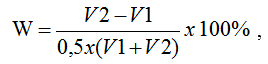
where W – growth rate; V1 and V2 – initial and final results in the tests. For each of the studied tests we calculated the arithmetic mean (x̅), and mean square deviation (σ)
The research was organized in the Shadrinsk Special (Correctional) Boarding School No 11. The study involved 10-11-year-old schoolchildren, who were divided into two experimental groups (EG-1 and EG-2): the first group included 11 children, the second group – 13.
We have developed a method for development and improvement of coordination abilities of the schoolchildren with hearing loss, the content of which included four blocks of exercises:
- Exercises with a changing support surface area;
- Exercises on a small support surface area;
- Exercises for the vestibular apparatus irritation (semicircular canals);
- Exercises performed with eyes closed.
The presented blocks of exercises were included in the program material of classes for 10-11-year-old schoolchildren with hearing loss in both experimental groups, the exercises were mastered sequentially, with gradual complication of the studied material. Two weeks were allotted for learning each block of exercises. A distinctive feature of the classes with EG-1 was the introduction of exercises with fitballs and elements of fitball gymnastics.
The detailed content of the experimental methodology for development and improvement of coordination abilities of 10-11-year-old schoolchildren with hearing loss are presented in table 1.
Table 1
Content of the method for coordination ability development of 10-11-year-old schoolchildren with hearing loss
|
Content of classes for EG-1 |
Content of classes for EG-2 |
|
I. Exercises with a changing support surface area |
|
|
- walking with a fitball; - walking with throwing and catching a fitball; - walking while dribbling a fitball (in a straight line, in a circle, in different directions); - exercises in a following initial position – siting on a fitball, legs wide apart, legs together; - exercises in a following initial position – sitting on a fitball with alternate leg lifts; - rocking and exercises on a fitball in a following initial position – lying on the stomach with support: 2 legs – 2 arms, 1 arm – 1 leg (same and opposite); - rocking and exercises in a following initial position – lying sideways on a fitball with support: 1 arm and 2 legs or the same arm and leg. |
- walking along the path (with various objects, stepping over objects); - walking in a circle (in different directions); - walking and stepping over the rails of the gymnastic ladder; - standing on one leg, the other straight forward (sideways, backwards, leg bend); - walking on planks (“bumps”). |
|
II. Exercises on a small support surface area |
|
|
- exercises in a following initial position – sitting on an elastic ball; - exercises in a following initial position – sitting with a support on one leg; - exercises in a following initial position – sitting on a fitball without leg support; - exercises in a following initial position – lying on the stomach on the fitball with different arm and leg support. |
- walking on a narrow surface with various tasks; - walking, running, jumping, crawling on a tilted surface. |
|
III. Exercises on the vestibular apparatus irritation (semicircular canals) |
|
|
- rocking with low and high amplitude in a following initial position – lying on the stomach or on the back on a fitball, sitting on a fitball; - head tilts and turns while rocking simultaneously in a following initial position – sitting on a fitball; - combination of head tilts and turns with bends and turns of the torso in a following initial position – sitting on a fitball. |
- eye movements; - head tilts and turns in different planes; - head turns while the torso is tilted; - 90°, 180°, 360° turns (with jumping as well); - forward and backward rolls. |
|
IV. Exercises performed with eyes closed |
|
|
- initial position – sitting on a fitball, legs apart; - head tilts and turns in a following initial position – sitting on a fitball; - rocking on a fitball in different positions – sitting, lying on the back or stomach with four support points. |
- walking (backwards, with sidesteps, sideways); - circling; - head tilts and turns; - toe stand, on one leg (the same on an elevated support). |
Note: EG-1 – experimental group No 1; EG-2 – experimental group No 2
The pedagogical experiment on the introduction of the experimental method for development and improvement of coordination abilities of 10-11-year-old children with hearing loss was conducted during the second school term. The EG-1 children were studying three times a week: sets of exercises on a fitball were introduced in a preparative part of a physical education class, as well as one additional correctional fitball gymnastics class under the adapted educational program. Children from EG-2 visited classes aimed at development of coordination abilities of 10-11-year-old children with hearing loss in the same form and volume, except for the fitball exercises. The conducted sets of exercises did not contradict the thematic planning and sections of the physical education curriculum according to the requirements of the Federal State Educational Standard for schoolchildren with disabilities. During the period of the experiment, the schoolchildren went through the “Gymnastics” section of the curriculum, which provides for development of coordination abilities.
Results and discussion. Before the pedagogical experiment, we have conducted a test to identify the level of coordination ability development. According to the obtained motor test results, there were no significant differences between EG-1 and EG-2, as evidenced in the table 2.
After the experiment, we also conducted a control test, which demonstrated that the EG_1 schoolchildren had significant differences compared to the initial data (p≤0.05). The EG-2 children have also revealed positive changes in coordination abilities, however the results were not statistically significant (р≥0.05) (table 2).
Table 2
Development of coordination abilities of 10-11-year-old schoolchildren with hearing loss before and after the experiment
|
Test |
Before |
Р |
After |
Р |
||
|
EG-1 |
EG-2 |
EG-1 |
EG-2 |
|||
|
The Romberg test, classic position, s |
14.5±2.6 |
14.0±1.69 |
≥0.05 |
17.75±2,84 |
15.25±1.8 |
≤0.05 |
|
The Romberg test, stork position, s |
10.6±2.11 |
9.92±1.53 |
≥0.05 |
13.5±2.31 |
11.33±1.67 |
≤0.05 |
|
Bench balance test, s |
12.2±1.34 |
12.25±1.63 |
≥0.05 |
10.2±1.12 |
11.08±1.63 |
≥0.05 |
|
The Yarotskij test, s |
20.4±2.36 |
21.6±2.18 |
≥0.05 |
26.6±2.4 |
23.25±2.2 |
≤0.05 |
Note: EG-1 – experimental group No 1; EG-2 – experimental group No 2
We have also calculated the growth rate of the studied indices of both experimental groups that identify the level of coordination abilities of schoolchildren with hearing loss. The obtained results show that the suggested sets of physical exercises have a positive effect on development of coordination abilities of the studied group, but the most effective is the method introduced in EG-1, with fitball exercises. The growth rate indices in EG-1 correspond with average and high levels of changes in the results, while in the EG-2 – with a low level (table 3).
Table 3
The growth rate of coordination abilities of 10-11-year-old schoolchildren with hearing loss after the pedagogical experiment, %
|
Test |
EG-1 |
EG-2 |
|
The Romberg test, classic position |
22.41 |
8.9 |
|
The Romberg test, stork position |
27.36 |
13.9 |
|
Bench balance test |
16.39 |
9.55 |
|
The Yarotskij test |
30.39 |
7.64 |
Note: EG-1 – experimental group No 1; EG-2 – experimental group No 2
Conclusion. Therefore, results of the conducted study on the introduction of the designed method for development and improvement of coordination abilities of 10-11-year-old schoolchildren with hearing loss have shown that the most effective ways to develop the studied abilities in the studied group include sets of physical exercises, which include fitball exercises and fitball gymnastics elements.
Conflict of interest. The author declares no conflict of interest.
REFERENCES
- Gorskaya I.Yu. Theoretical and methodological foundations of improving basic coordination abilities with different health conditions: an author's abstract. Omsk, 2001. 46 p. (in Russ.)
- Gubareva N.V. A differentiated approach in a process of correction and development of coordination abilities of schoolchildren with different types of hearing loss: an author’s abstract. Omsk, 2009. 24 p. (in Russ.)
- Marygina A.G. Peculiarities of motor functions in young schoolchildren with hearing loss. Psychology of Health and Disease: Clinical Psychological Approach: materials of the X Anniversary All-Russian Scientific and Practical Conference with International Participation. Kursk, 2020. pp. 107–110. (in Russ.)
- Busheneva I.S., Volobuev S.I., Azizov A.K. Assessment of coordination abilities in middle schoolchildren with hearing loss. Relevant Issues, Modern Trends in the Development of Physical Culture and Sports, Taking into Account Implementation of National Projects: Materials of the IV All-Russian Scientific and Practical Conference with International Participation. Moscow, 2022. pp. 603–608. (in Russ.)
- Paramonova D.B. Development of coordination abilities in young schoolchildren with hearing loss. Psychological and Pedagogical support of General, Special and Inclusive Education of Children and Adults: Materials of the II All-Russian Scientific and Practical Conference with Inter-national Participation. Cheboksary, 2022. pp. 86–88. (in Russ.)
- Filatkin A.S., Deryabina G.I., Kalmykov D.A. Features of manifesting coordination abilities when performing motor actions in 8-10 children with hearing loss. Innovations and Traditions in Modern Physical Education: Materials of the Interuniversity Scientific and Practical Conference, 2019. pp. 373–380. (in Russ.)
- Berdnikova V.A. Adaptive Physical Education of primary schoolchildren with hearing loss by means of aesthetic group gymnastics. Relevant Issues of Theory and Practice of Physical Culture, Sports and Tourism: Materials of the VII All-Russian Scientific and Practical Conference with International Participation. 2019. pp. 21–23.
- Varlamova M.I. Aesthetic group gymnastics for the development of coordination abilities of primary school children with hearing loss. Physical Culture, Sport, Science and Education: materials of the III All-Russian Scientific and Practical Conference dedicated to the 70th Anniversary of R.M. Dmitriev, the Olympic Champion. 2019. pp. 42–44. (in Russ.)
- Kalicheva Ya.V. Influence of health-improving aerobics lessons on rates of statistics balance and speed of reaction of 12-15 year old hard-of-hearing school children. Tambov University Review. Series: Humanities, 2011, no. 9 (101), pp. 99–104. (in Russ.)
- Oblova E.N. Influence of outdoor games and exercises with a ball on development of dexterity at hard of hearing schoolboys of 11-13 years. Science Almanac, 2019, no. 2-1(52), pp. 152–154. (in Russ.)
- Verbina V.V., Drobysheva S.A. The method of adaptive physical education for deaf preschool children using fitball exercises, and «low» acrobatics. Adaptive Physical Education, 2011, no. 4 (48), pp. 16–18. (in Russ.)
- Nizamutdinova N.N., Gindullina L.A., Kasmakova L.E. Complex of basic aerobics for the development of coordination abilities of 7-8-year-old children with hearing loss. Issues and Prospects of Physical Education, Sports Training and Adaptive Physical Culture: Materials of the All-Russian Scientific and Practical Conference with International Participation. Kazan, 2018. pp. 909–913. (in Russ.)
INFORMATION ABOUT THE AUTHORS:
Nina L. Litosh – Candidate of Pedagogical Sciences, Associate Professor, Senior Researcher of the Center of Biomedical Technologies, FSBI “North-Caucasian Federal Research-Clinical Center of Federal Medical and Biological Agency”, Essentuki, e-mail:
For citation: Litosh N.L. Fitball gymnastics in the development of coordination abilities of 10-11-year-old schoolchildren with hearing loss. Russian Journal of Sports Science: Medicine, Physiology, Training, 2024, vol. 3, no. 4(12). DOI: 10.24412/2782-6570-2024_03_04_5