


Download the article in pdf format
Publication date: 15.12.2024
DOI: 10.24412/2782-6570-2024_03_04_1
UDC 615.825
IMPROVEMENT OF UPPER LIMB FUNCTIONALITY AFTER SHOULDER JOINT ARTHROPLASTY BY MEANS OF PHYSICAL THERAPY
A.V. Plakhotin1, N.V. Lunina1,2
1Russian University of Sport “GTSOLIFK”, Moscow, Russia
2FSBI “North-Caucasian Federal Research-Clinical Center of Federal Medical and Biological Agency”, Essentuki, Russia
Annotation. The article presents the results of the upper limb functionality after shoulder arthroplasty using physical therapy. The duration of the physical therapy course aimed at restoring the functionality of the upper limb after shoulder arthroplasty was 4 weeks. The following were used in the recovery: therapeutic gymnastics, therapeutic massage, hydrokinesitherapy, electrical myostimulation of the shoulder muscles, mechanotherapy, and exercises on cable machines. Restoration of the upper limb functionality after shoulder arthroplasty using physical therapy is determined by a reliable (p≤0.05) improvement in the following indices: when conducting goniometry, the amplitude of shoulder abduction to the side increased by 51%; the circumference of the upper third of the shoulder increased by 6%, the middle third of the shoulder (p≥0.05) – by 4.5%, the lower third of the shoulder – by 8%. The strength of the upper limb muscles, assessed by wrist dynamometry, increased: in the healthy arm – by 3.6%, in the operated arm – by 27.7%. The results obtained during the study reflect the improvement of the functionality of the upper limb after shoulder joint arthroplasty using physical therapy means.
Keywords: recovery, functionality, upper limb, shoulder joint, arthroplasty, physical therapy means.
Introduction. The incidence of the shoulder rotator cuff injuries ranges from 16% to 45% of all injuries of soft structures in large joints [1, 2]. In some cases, these injuries are the result of acute trauma, they are often the result of chronic microinjury, and asymptomatic rotator cuff injuries may occur [1].
One of the operative ways of treating the ligamentous system of the shoulder joint is arthroscopy [3, 4]. Meanwhile, in a long-term postoperative period after restoration of anatomical integrity of the damaged structures of the shoulder rotator cuff, patients still have significant functional disorders, such as pain, restriction of shoulder joint mobility and reduction of the quality of life caused by the aforementioned factors [1, 5].
Inadequate rehabilitation measures in a postoperative period lead to a significant deterioration of clinical outcomes. In this regard, the issues of postoperative rehabilitation of patients remain of high scientific and practical importance and are widely discussed in the professional environment. In particular, the issues of selecting the most effective rehabilitation programs with the use of physical therapy (PT), controlled physical activity, and patient activation rates remain relevant [2, 5, 6, 7].
Aim of the study: assessment of the upper limb functionality after shoulder joint arthroplasty by means of PT.
Methods and organization. The study took place in the Neuro-Clinic LLC (Moscow). It involved men (n=10, age – 25-35 years) with damaged structures of the shoulder rotator cuff after shoulder joint arthroplasty in a long-term postoperative period. The main complaints from the patients included an inability to work out as usual, shoulder joint pain, reduced movement amplitude in the shoulder joint.
We examined the injured upper limb’s functional state with the following methods:
1) goniometry (°);
2) wrist dynamometry (kg);
3) anthropometry (circumferential dimen-sions of the shoulder muscles – biceps, triceps and deltoid, cm).
The physical therapy course aimed at recovery of the upper limb functionality after shoulder joint arthroplasty took 4 weeks. The following were used: therapeutic gymnastics (every other day, 20 to 40 minutes), therapeutic massage (15 procedures), hydrokinesitherapy (3 times a week for 25 minutes), shoulder muscle electrical myostimulation (10 procedures), mechanotherapy on ARTROMOT S3 (3 times per week for 30-40 minutes), sessions on cable machines (we applied resistance with 50-85% of the maximum weight possible, 3 times a week, 60-80 minutes).
The obtained results were statistically processed with the Statistica 13 software package, the following were calculated: arithmetic mean (X) and standard deviation (σ). The reliability of the differences between the parameters during the study was studied by the Wilcoxon’s signed rank test (p<0.05).
Results and discussion. Restoration of the upper limb functionality after shoulder joint arthroplasty is determined by a reliable improvement of the studied indices (table). When conducting goniometry, the amplitude of shoulder abduction to the side (р≤0.05) increased by 51%: from 99.0±0.69° to 149.7±6.5°.
Table
The upper limb functionality after shoulder joint arthroplasty when using means of PT, X±σ
|
Index |
Before PT |
After PT |
|
Shoulder joint goniometry, ° |
||
|
Shoulder abduction to the side |
99.0±0.69 |
149.7±6.5* |
|
Anthropometry of the operated arm’s shoulder muscles, circumference, cm |
||
|
Upper third of the shoulder, cm |
31.12±0.4 |
33.0±1.98* |
|
Middle third of the shoulder, cm |
29.0±0.48 |
30.3±2.02 |
|
Lower third of the shoulder, cm |
25.0±0.79 |
27.0±2.34* |
|
Wrist dynamometry, kg |
||
|
Strength of the healthy arm, kg |
37.0±4.62 |
39.06±4.64* |
|
Strength of the operated arm, kg |
25.8±2.41 |
35.67±3.72* |
Note: PT – physical therapy; * – reliable changes in the index, р≤0,05
Positive changes were revealed in the anthropometry indices of the operated arm’s shoulder muscles (cm) after physical therapy (table, fig.). A circumference of the upper third of the shoulder increased (р≤0.05) by 6%, from 31.12±0.4 cm to 33.0±1.98 cm, middle third of the shoulder (р≥0.05) – by 4.5%, from 29.0±0.48 cm to 30.3±2.02 cm, lower third of the shoulder (р≤0.05) – by 8%, from 25.0±0.79 cm to 27.0±2.34 cm (fig).
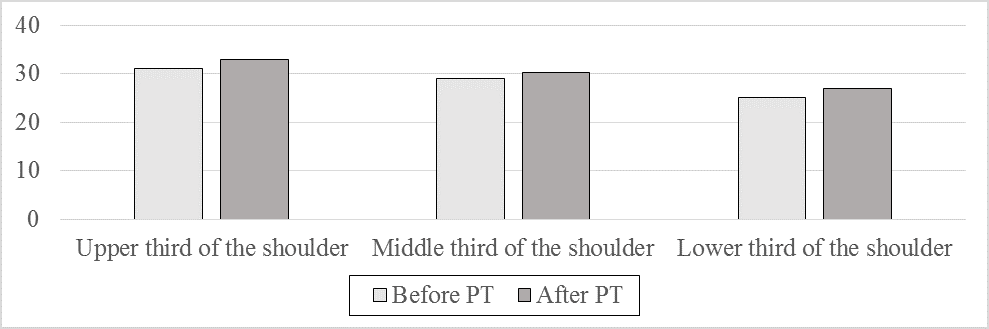
Fig. Changes in the anthropometry of the shoulder muscles in the operated arm (cm) with the use of physical therapy (PT)
Muscle strength of the upper limbs, estimated with wrist dynamometry, also improved: the healthy arm – by 3.6% from 37.0±4.62 kg to 39.06±4.64 kg, the operated arm – by 27.7% from 25.8±2.41 kg to 35.67±3.72 kg.
Conclusion. Assessment of the upper limb functionality after shoulder joint arthroplasty demonstrated positive changes when using means of PT, which reflects the effectiveness of introducing the developed rehabilitation method for the studied population in a long-term postoperative period.
Conflict of interest. The authors declare no conflict of interest.
REFERENCES
- Slajkovskij E.N., Ponomarenko N.S., Kuklin I.A Rotator cuff tendon ruptures (literature review). Acta biomedica scientifica, 2023, no. 8 (5), pp. 150–156. DOI: 10.29413/ABS.2023-8.5.16. (in Russ.)
- Mitchell C., Adebajo A., Hay E., Carr A. Shoulder pain: Diagnosis and management in primary care. BMJ, 2005, no. 331 (7525). pp. 1124–1128. DOI: 10.1136/bmj.331.7525.1124.
- Makarevich E.R., Beletsky A.V. Treatment of rotator cuff injuries. Minsk: BSU, 2001. (in Russ.)
- Fomenko S.M., Alekperov A.A., Simagaev R.O. Damage to the rotator cuff. Modern problems of science and education, 2017, no. 6. (in Russ.)
- Men’shova D.V., Kuklin I.A., Ponomarenko N.S. Treatment of patients with rotator cuff injuries (review of literature). Acta biomedica scientifica, 2020, no. 5 (6). pp. 216–223. DOI: 10.29413/ABS.2020-5.6.27. (in Russ.)
- Kotenko K.V., Ujba V.V., Korchazhkina N.B., Petrova M.S., Mikhajlova A.A., Galkin G.N. A guide for additional methods of athlete observation and rehabilitation. Moscow, 2012. 25 p. (in Russ.)
- Mikhajlova A.A., Petrova M.S., Petrova V.V., Fomkin P.A., Ivanova I.I. Technologies for monitoring the body condition of athletes and individuals actively engaged in sport. Healthy Family – Healthy Generation: materials of the conference (Pyatigorsk, December 13-14, 2011). Pyatigorsk, 2011. pp. 64–65. (in Russ.)
INFORMATION ABOUT THE AUTHORS:
Artyom V. Plakhotin – Master of the Department of Physical Rehabilitation, Massage and Health-improving Physical Culture named after I.M. Sarkizov-Serazini, Russian University of Sport “GTSOLIFK”, Moscow.
Natal’ya V. Lunina – Candidate of Biological Sciences, Associate Professor of the Department of Physical Rehabilitation, Massage and Health-improving Physical Culture named after I.M. Sarkizov-Serazini, Russian University of Sport “GTSOLIFK”, Moscow; Senior Researcher of the North Caucasus Federal Scientific and Clinical Center of the Federal Medical and Biological Agency of Russia, Essentuki, e-mail:
For citation: Plakhotin A.V., Lunina N.V. Improvement of upper limb functionality after shoulder joint arthroplasty by means of physical therapy. Russian Journal of Sports Science: Medicine, Physiology, Training, 2024, vol. 3, no. 4(12). DOI: 10.24412/2782-6570-2024_03_04_1