


Download the article in pdf format
Publication date: 15.03.2025
DOI: 10.24412/2782-6570-2025_04_01_8
UDC 796
OVERVIEW OF SCIENTIFIC RESEARCH ON PHYGITAL SPORTS
V.A. Beresneva1,2, N.S. Skarzhinskij2
1Sports and Methodological Center “Department of eSports”, Moscow, Russia
2Synergy University, Moscow, Russia
Abstract. Objective of the study – to identify main directions of research on phygital sports and justify topics of prospective scientific works. The article provides a retrospective analysis of scientific articles on phygital sports on the eLibrary platform. 469 publications were studied, which allowed us to identify the main areas of research. Scientific research on phygital sports are of increasing significance in a context of rapid digital transformation of various fields of society, including sports. The greatest attention is paid to the integration of phygital sports into the educational environment, conceptual understanding of it as a phenomenon of digital transformation of sports, as well as comparison with esports. It has been revealed that the issues of sports training of phygital athletes and the effect of hybrid activity on the physiological parameters of phygital athletes have not been studied at the present time.
Keywords: phygital sports, phygital movement, sports, sports training, phygital.
Introduction. In the conditions of rapid digital transformation of all spheres of society, sport is not left aside from innovative solutions. One of the most promising sports are “phygital sports (functional and digital sports)” (hereinafter –phygital sports), which combine elements of classic (physical) sports and digital environments.
Phygital sports have been officially recognized in Russia since 2023 (Order of the Ministry of Sport of the Russian Federation № 58 dated 31.01.2023) and the format combining digital technologies and physical activity became actively supported by the state after the international multi-sport tournament “Games of the Future” and the emergence of the phygital movement (Order of the Government of the Russian Federation No. 3387-r of 24.11.2024). Its scientific study is necessary for the development of methodological foundations, optimization of training processes and analysis of various psychophysiological effects. Scientific research will ensure its effective implementation and Russia's competitiveness in the field of sports technology.
Holding the “Games of the Future” tournament, the basis of which included phygital sports, makes its scientific research relevant.
Objective of the study – to identify main directions of scientific study of phygital sports and justify topics of prospective scientific works.
Methods and organization. This study included a retrospective analysis of scientific articles on phygital sports (functional and digital sports) in the Elibrary database.
Results and discussion. During the study, a search by the keyword “phygital sports” resulted in 469 publication of different direction. The table below shows data on the availability of articles in the last 5 years.
Based on the data in the table it can be seen that the number of research papers has increased in 2023 and the 2024 of the international “Games of the Future” tournament.
Current research on phygital sports covers a wide range of topical areas, reflecting its interdisciplinary nature and rapid development. The analysis of published articles shows that researchers are most interested in the topic of integrating phygital sports into the student environment (22.8%). This indicates the high relevance of the introduction of phygital technologies into the higher education system, which is probably due to the active digitalization of educational processes and the involvement of young people in hybrid sports (fig.).
Considerable attention is also paid to the conceptualization of phygital sports as a phenomenon of digital transformation in sports (19.8%). This area includes research on the changes in the sports industry caused by the integration of digital technologies, as well as analyses of new formats of sports activities.
Table
Number of articles found in a search by the keyword “phygital sports”
|
№ |
Year of publication |
Number of scientific papers |
|
1 |
2021 |
- |
|
2 |
2022 |
13 |
|
3 |
2023 |
121 |
|
4 |
2024 |
322 |
|
5 |
2025 (February 2025) |
13 |
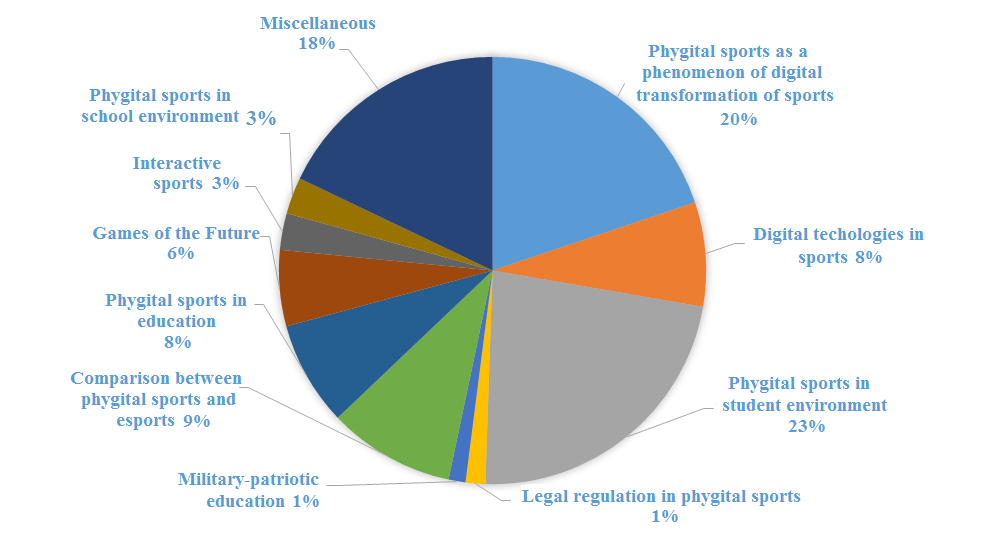
Fig. Research areas in phygital sports
One of the key issues remains the comparison between phygital sports and esports (9.4%), which confirms the existing debate on the boundaries between virtual and hybrid sport disciplines. The study of digital technologies in sports (7.9%) and issues related to educational aspects also play an important role in the research agenda. This emphasizes the tendency towards new pedagogical approaches in physical education based on the synergy between traditional and digital sports.
Less developed, but significant are the areas related to the legal regulation of phygital sports (1.5%) and military-patriotic education (1.3%). The lack of attention to these aspects may be due to the novelty of the phenomenon and the absence of an established regulatory framework, which makes these areas promising for further research.
In addition, there is a significant amount of research related to the “miscellaneous” category (17.9%), which indicates the presence of many specific and interdisciplinary works that require further systematization.
There are still unsolved and insufficiently studied issues related to sports training in phygital sports, taking into account the dual nature of their activity. Physiological features of phygital athletes also need to be studied in detail, as the simultaneous combination of physical activity and interaction with the digital environment can have a specific effect on the body, which is not yet studied.
The most cited are the directions encompassing general issues of phygital sports development and its main characteristics [1-5], phygital sports development in the student environment [6-10], comparison between phygital sports and esports [11], legal regulation [12, 13], digital technologies in phygital sports [14-17], management and commercializing in phygital sports [18], peculiarities in phygital sports disciplines [19, 20] etc.
Since Russia is the origin place of this sport, there are currently no foreign studies of it.
Conclusion. Scientific study of phygital sports are of increasing significance in the context of rapid digital transformation of all spheres of society, including sports. They are necessary for the development of methodological foundations, optimization of the training process, as well for an analysis of psychophysiological effects, which, in its own turn, would ensure competitiveness of the state in sports technology. The scientific publication analysis has demonstrated a significant growth of interest towards phygital sports. However, some issues remain unsolved, such as legal regulation and sports training of phygital athletes (including study of physiological features of phygital athletes), reflecting a need in further study. These directions have prospects for more detailed scientific analysis and development of innovational approaches, which would ensure effective integration of phygital sports into sports industry and educational practice.
Conflict of interest. The authors declare no conflict of interest.
REFERENCES
- Computer sport (esport): problems and prospects of development: materials of the All-Russian Scientific and Practical Conference. Novoselov M.A., ed. Moscow: RUS “GTSOLIFK”, 2022. 181 p. (in Russ.)
- Pleshakov V.A. Integrative possibilities of cybersocialization and socialization in phygital sports: collection of scientific papers based on the results of the II All-Russian Scientific and Practical Conference of the Ministry of Education and Science of Russia on the formation of new approaches to the design of physical education in educational organizations of higher education “New Approaches – 2022”. Moscow: A.N. Kosygin Russian State University (Technology. Design. Art), 2022.
pp. 35–39. (in Russ.) - Gil’manshin R.A. Role of phygital sport in realization of the Strategy 2030: materials of the All-Russian Scientific and Practical Conference with International Participation “Physical Culture, Sport, Tourism: Science, Education, Information Technologies”. Kazan: Kazan State Energy University, 2023. pp. 294–298. (in Russ.)
- Efremova T.A., Mikhajlov B.A., Novozhilova K.M. Phygital games – at the crossroads of classical and digital sport: Proceedings of the All-Russian Scientific and Practical Conference with International Participation “Student Sport in a Modern World”. Saint Petersburg: Peter the Great St.Petersburg Polytechnic University, 2023. pp. 299–302. (in Russ.)
- Panaev M.V. Promotion of phygital sport in physical culture. Nauchnye vyskazyvania, 2023, no. 11(35), pp. 81–83. (in Russ.)
- Lubysheva L.I. Phygital-sport is an innovative project for the development of extracurricular activities of students. Theory and Practice of Physical Culture, 2023, no. 7, p. 101. (in Russ.)
- Galitsyn S.V., Ziganshin O.Z., Popov P.D., Voloshin G.R. Prospects for the development of phygital sports at the student level. Scientific Notes of the P.F. Lesgaft University, 2023, no. 8(222), pp. 87–92. DOI: 10.34835/issn.2308-1961.2023.08.p87-92. (in Russ.)
- Yas’kov I.O., Pashkova D.V., Zaripov N.A., Gorbunov G.G., Mumina M.M., Fakhretdinov A.R., Zemtsov D.I. State of student esport in universities of the Russian Federation. Moscow: HSE, 2023. 64 p. DOI: 10.17323/978-5-7598-2902-7. (in Russ.)
- Skarzhinskaya E.N., Novoselov M.A. Harmonization of sports and esports activities in educational organizations: collection of scientific papers based on the results of the II All-Russian Scientific and Practical Conference of the Ministry of Education and Science of Russia on the formation of new approaches to the design of physical education in educational organizations of higher education “New Approaches – 2022”. Moscow: A.N. Kosygin Russian State University (Technology. Design. Art), 2022. pp. 46–50. (in Russ.)
- Pashchenko A.Yu., Zhalbe M.G., Gladysheva A.A., Gladyshev A.A. Application of the digital format in the educational practice of the university. Theory and Practice of Physical Culture, 2023, no. 9, pp. 23-25. (in Russ.)
- Sedov I.A., Krasil’nikova Yu.S., Trusova D.S., Antonova V.V. Phygital games as integration of sports and cybersports within competitive disciplines. Scientific Notes of the P.F. Lesgaft University, 2023, no. 3(217), pp. 411–414. DOI: 10.34835/issn.2308-1961.2023.03.p411-415. (in Russ.)
- Generalov V.V. Computer and phygital sports in Russia: administrative and legal regulation and prospects. Bulletin of the Ural Law Institute of the Ministry of Internal Affairs of the Russian Federation, 2023, no. 3(39), pp. 5–9. (in Russ.)
- Aslaev S.T., Gorbatova V.V., Zarpov R.U., Zaripov Sh.R., Kartashev N.I., Kudashev R.K. Legal regulation of digital and esports in Russia. Education and Law, 2023, no. 7, pp. 342–345. DOI: 10.24412/2076-1503-2023-7-342-345. (in Russ.)
- Khalatyan B.V. Digital technologies in sports. Forum molodykh uchenykh, 2022, no. 12(76),
pp. 323–326. (in Russ.) - Ibragimov I.F., Kokhan D.A. Technologies applied in phygital sports. Tendentsii razvitia nauki i obrazovania, 2023, no. 97-10, pp. 43-46. DOI: 10.18411/trnio-05-2023-541. (in Russ.)
- Ermakov A.V., Skarzhinskaya E.N., Beresneva V.A. Requirements to hardware and software support for sport phygitalization. Theory and Practice of Physical Culture, 2024, no. 11, pp. 44–46. (in Russ.)
- Sel’skij A.K. Reflection of issues of sports technologisation in scientific concepts. Scientific Bulletin of MSUST: sport, tourism, hospitality, 2023, no. 1(75), pp. 22–30. (in Russ.)
- Lednev V.A., Charyeva M.O. Development of phygital sports: strategy, management and comercialization: collection of scientific papers based on the results of the II All-Russian Scientific and Practical Conference of the Ministry of Education and Science of Russia on the formation of new approaches to the design of physical education in educational organiza-
tions of higher education “New Approaches – 2022”. Moscow: A.N. Kosygin Russian State University (Technology. Design. Art), 2022. С. 32–35. (in Russ.) - Lopatnikov D.A. Structure of competitive exercise in the discipline “rhythm-simulator” taken into account the specifics of phygital sports. Physical Culture: Upbringing, Education, Training, 2024, no. 2, pp. 26–28. (in Russ.)
- Karvounis Yu.A., Karvounis N.A., Kalinnikova Yu.G., Kapilevich L.V. Psychophysiological characteristics of cybersportsmen during intense game activity. Theory and Practice of Physical Culture, 2023, no. 8, pp. 42–43. (in Russ.)
INFORMATION ABOUT THE AUTHORS:
Viktoria A. Beresneva – Director, Sports and Methodological Center “Department of eSports”; Senior Lecturer, Synergy University, Moscow, e-mail:
Nikolaj S. Skarzhinskij – Senior Lecturerб Synergy University, Moscow, e-mail:
For citation: Beresneva V.A., Skarzhinskij N.S. Overview of scientific research on phygital sports. Russian Journal of Sports Science: Medicine, Physiology, Training, 2025, vol. 4, no. 1(13). DOI: 10.24412/2782-6570-2025_04_01_7