


Download the article in pdf format
Publication date: 15.09.2025
DOI: 10.24412/2782-6570-2025_04_03_5
UDC 615.825.6
DEVELOPING THE METHOD OF READAPTATION AND RECOVERY OF THE TORSO MUSCLES OF ASTRONAUTS USING MECHANOTHERAPY ON THE CENTAUR COMPLEX
Yu.V. Koryagina, S.M. Abutalimova, E.V. Kostyuk, A.Sh. Abutalimov, S.V. Nopin
North-Caucasian Federal Research-Clinical Center of Federal Medical and Biological Agency, Essentuki, Russia
Abstract. Introduction. The results of many years of research have established the negative influence of space flight factors on the functional state of the musculoskeletal of astronauts, including the torso muscles. Therefore, there is a need to develop efficient methods for their restoration and strengthening. Objective – to develop a method of robot-assisted mechanotherapy on the Centaur complex for post-flight rehabilitation of the astronauts’ musculoskeletal system. Methods. The study involved 7 male astronauts and the control group (healthy men). The study of the torso muscles’ force was carried out on the Centaur complex (diagnosis and training of the autochthonous torso muscles). Results. Taking into account the data of theoretical analysis and diagnosis of the force parameters of the torso muscles of astronauts and male volunteers, a method of robot-assisted mechanotherapy on the Centaur complex for the post-flight rehabilitation of the musculoskeletal system was developed. The technique consists in rotating the patient around their own axis with preset parameters to strengthen various muscle groups of the torso and differs depending on the diagnosed parameters of muscle balance. Conclusion. The developed technique is aimed at optimizing the balance of the autochthonous torso muscles, eliminating the deficit and restoring the force parameters of the muscles, centralizing movement and load along the main anatomical axes.
Keywords: astronauts, post-flight rehabilitation, musculoskeletal system, torso muscles, robot-assisted mechanotherapy.
Introduction. The work of astronauts on orbit is considered as an extremely complicated activity associated with substantial physical loads against the background of constant influence of specific spaceflight (SF) factors, such as zero gravity, overloading, radiation, vibration and physical inactivity. All of it lead to substantial morphological and functional changes, which should be considered as adaptive. Microgravity in SF conditions affects almost all functional systems of a human body [1-4]. Musculoskeletal system (MSS) is the most vulnerable. Zero gravity or microgravity, excluding physiological axial loading on MSS and joints as a basis of amortization in case of vertical movement in space, shift of the center of gravity and disturbance of adequate muscle stimulus and balance of calcium and other microelements cause significant changes in the function of support and movement organs of astronauts. A decrease in muscle tone leads to a reduced muscle mass, a redistribution of the volume of circulating blood and body fluids, demineralization of bone tissue, which, in turn, leads to impaired posture, displacement of internal organs and other negative changes [5-6].
It was established that at earlier stage of readaptation after support unloading, lumbar enlargement reduction is not compensated, the volume of white and gray matter remains reduced, which is accompanied by a decrease in the average sizes of motor neurons [7].
The lack of influence of body weight in microgravity entails a cascade of disorders, primarily related to the axial loading on the supporting skeleton, joints and muscular system. The absence of gravitational stimuli blocks anti-gravitational reactions from the musculoskeletal system. The idea of a chain of pathological disorders, first expressed as a hypothesis based on theoretical assumptions, was subsequently confirmed during flights and post-flight reactions. A decrease in afferent impulses in microgravity forms a violation of the responses of all physiological functions. An analysis of the features of the readaptation process in astronauts, as well as observations made during prolonged inactivity, indicate changes in general reactivity, regulation of autonomic and motor functions. The imperfection of reverse afferentation can be explained by violations of coordination of movements in statics and dynamics after the end of space flights [8].
Lack of compression effects on the musculoskeletal system alters exposure on the external vascular tone and blood circulation. Functional muscle stiffness in microgravitation is a triggering mechanism that reduces anti-gravity muscle tone, their resistance and their working response. Microgravity reduces the tone of the muscles that ensure the vertical position of the body and the extensor muscles with the development of atrophic/atonic processes, which, in turn, reduces the resistance of the vascular wall with the development of dilation effects [9].
Metabolism disturbance in bone and muscle structure are also the consequence of reduced load on MSS. Moreover, protein catabolism intensifies, calcium deficit in muscle tissue, as well as endocrine status imbalance occur [8].
It has been shown that chronic decrease of motor activity causes large-scale changes in the transcriptome (several thousand mRNAs), as well as in the skeletal muscle proteome. These changes are primarily associated with the activation of the inflammatory response and the extracellular matrix restructuring, as well as with a decrease in the expression of genes encoding various mitochondrial enzymes [10].
Reduced tissue respiration and oxidative phosphorylation with the development of a disproportion of demand and energy consumption indicates the possibility of increased O2 consumption and oxygenation deficiency [11].
A ten-year experience of observing the state of astronauts generalized complicated shifts that occur in the macro- and microelement base. Microgravity inevitably followed by adaptive clinical-biochemical, hormonal and metabolic processes of MSS relate to bone and muscle tissue. If there is no gravitational stimulus, a disturbance of macro- and microelement balance with the leaching of sodium, water, potassium, chlorine, and iron ions occurs. At the same time, negative nitrogen balance develops, which, together with the loss of water, leads to a decrease in body weight due to the loss of fluid, muscle mass, and mineral composition with the development of new correlations of chemical elements in biological environments [12].
The studies conducted on aging muscles demonstrated reduced synthesis of the main contractile proteins – heavy chains of myosin, which correlates with a decrease in muscle force, the content of insulin-like growth factor, dehydroepiandrosterone sulfate, and free testosterone. In turn, reduced protein synthesis in muscles can be explained by their decreased sensitivity to insulin and amino acids [13].
Therefore, results of long-term study proved negative effect of SF factors on the functional state of MSS of astronauts, including the torso muscles. Therefore, there is a need to develop effective methods for their restoration and strengthening. Mechanotherapy on robot-assisted biomechanical complexes, such as the Centaur complex, which are successfully implemented in restorative and sports medicine, may be used as one of these methods [14-17].
Objective – to develop a method of robot-assisted mechanotherapy on the Centaur complex for post-flight rehabilitation of the astronauts’ MSS.
Methods and organization. The study took place in the North-Caucasian Federal Research-Clinical Center. The study involved 7 male astronauts (Me [Q1; Q3]), age – 55 [52; 57] years, height – 176 [172; 178] cm, weight – 89 [82; 102] kg and the control group (CG) – healthy men, coaches of different sports. All the participants gave an informed consent in accordance with the Declaration of Helsinki developed by the World Medical Association, as well as permission for personal data processing. The study was approved by the local Ethics Committee for biomedical research examination of the North-Caucasian Federal Research-Clinical Center (protocols No. 2 dated 26.01.2021, No. 2 dated 14.05.2024).
The study of the torso muscles was carried out on the Centaur complex (diagnosis and training of the autochthonous torso muscles) (BFMS, Germany) (fig.).
Statistical data processing was performed in the Statistica 13.0 software. We calculated standard indicators of descriptive statistics (median, first and third quartiles). Distribution normality was identified with the Shapiro-Wilk test. Comparison of the indices was done using the non-parametric Mann-Whitney test.
Results and discussion. A comparison of force of the autochthonous muscles of the torso in astronauts and CG showed that the total index of the maximum force of the torso muscles applied to maintain body position when changing the adjusted rotational angles during testing, as well as the indices of the maximum force applied to maintain body position when the training complex is tilted to the left and right, is statistically substantially higher in astronauts than that in CG.
Consequently, the astronauts put the highest possible effort to maintain their body position during rotation, compared to CG, apparently due to their greater weight. They had less relative force applied. It should also be noted that the study was conducted in conditions of gravity. In general, it is possible to indicate higher force indicators and better coordination of the autochthonous deep-lying muscles of the astronauts’ torso, which may be due to the adaptation of their work in conditions of gravity and zero gravity.
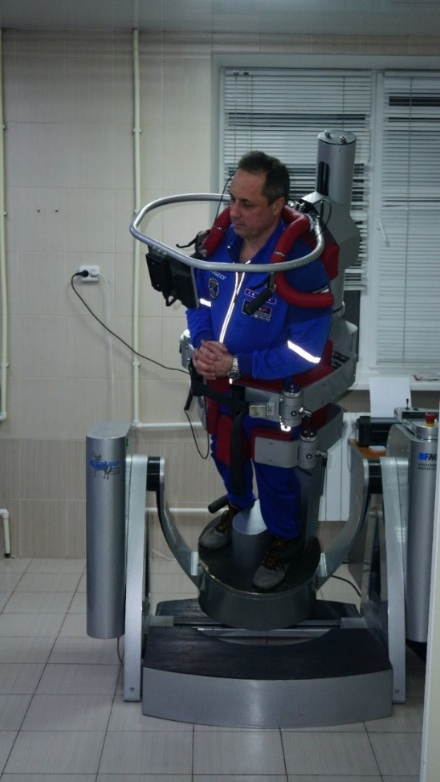
Fig. Study of the functional state of the musculoskeletal system of an astronaut on the Centaur complex
Table
Indicators of the muscular force applied to maintain body position when changing the adjusted rotational angles during the dynamometric testing on the Centaur complex for astronauts and CG, Me [Q1; Q3]
|
Indices |
Astronauts (n=7) |
CG (n=54) |
P< |
|
MMF, Nm |
241 [240; 247] |
167.3 [137.9; 214.2] |
0.03 |
|
RMF, % |
100 [94.9; 100] |
218.53 [179.19; 309.61] |
- |
|
MMFL, Nm |
226 [217.2; 240] |
159.8 [132.6; 206.8] |
0.05 |
|
RMFL, % |
89 [88; 100] |
100 [100; 100] |
- |
|
MMFR, Nm |
240 [224.4; 242] |
160.7 [132.6; 206.8] |
0.04 |
|
RMFR, % |
94.9 [90.9; 100] |
100 [99.9; 100] |
- |
|
Imbalance, Nm |
4.1 [0; 8.2] |
0 [0; 0.75] |
- |
Note: CG – control group; MMF – maximum muscle force; RMF – relative muscle force; MMFL – maximum muscle force applied to maintain body position when the training complex is tilted to the left during testing; RMMFL – relative muscle force applied to maintain body position when the training complex is tilted to the left during testing; MMFR – maximum muscle force applied to maintain body position when the training complex is tilted to the right during testing; RMMFR – relative muscle force applied to maintain body position when the training complex is tilted to the right during testing; Imbalance – differences between the parameters of maximum muscle force on the right and on the left applied to maintain body position when the training complex is tilted during testing.
As a result of diagnosing the initial level of the torso muscle force, we have identified the program of post-flight rehabilitation of MMS of astronauts:
- Enhancing and increasing the force of the upper and lower limbs’ muscle groups, optimizing the balance of force of the muscles of the right and left half of the body.
- Maintaining force of the torso muscles.
In order to maintain force of the torso muscles and optimize their balance we have developed a specialized method with the Centaur complex.
The method of restoring the functional state of the autochthonous stabilizing spine muscles includes application of the Centaur complex in the “Rotation in space” mode: the patient rotates around their own axis with adjusted parameters to strengthen various torso muscle groups. This technique differs in the diagnosis of muscle imbalance in different parts of the spine.
Program for muscle imbalance in the thoracic spine:
- Inactivity of the muscle group on the left:
- rotation angle (tilt) – adjusted individually, taking into account the diagnosis protocol, in the range of 0 to 90°;
- number of sets – 5;
- number of repetitions for one set – adjusted individually, depending on a number of preset tilt angles in a set (the diagnosis protocol);
- movement time – 5 s;
- tilt duration – 5-6 s;
- number of pauses – 4;
- pause duration – 7 s.
- Physical inactivity of the muscle groups on the right:
- rotation angle (tilt) – adjusted individually, taking into account the diagnosis protocol, in the range of 0 to -90°;
- number of sets – 5;
- number of repetitions for one set – adjusted individually, depending on a number of preset tilt angles in a set (the diagnosis protocol);
- movement time – 5 s;
- tilt duration – 5-6 s;
- number of pauses – 4;
- pause duration – 7 s.
Program for muscle imbalance in the lumbar spine:
- Physical inactivity of the muscle group on the left:
- rotation angle (tilt) – adjusted individually, taking into account the diagnosis protocol, in the range of 90 to 179°;
- number of sets – 5;
- number of repetitions for one set – adjusted individually, depending on a number of preset tilt angles in a set (the diagnosis protocol);
- movement time – 5 s;
- tilt duration – 5-6 s;
- number of pauses – 4;
- pause duration – 7 s.
- Physical inactivity of the muscle groups on the right:
- rotation angle (tilt) – adjusted individually, taking into account the diagnosis protocol, in the range of -90 to -180°;
- number of sets – 5;
- number of repetitions for one set – adjusted individually, depending on a number of preset tilt angles in a set (the diagnosis protocol);
- movement time – 5 s;
- tilt duration – 5-6 s;
- number of pauses – 4;
- pause duration – 7 s.
The physiological mechanism of action is to optimize the balance of the autochthonous torso muscles, to eliminate the deficit of the supporting muscles. The musculoskeletal feeling is optimized, the force parameters of the torso muscles are restored, movement and load are centralized along the main anatomical axes.
Expected effects of the application. Improving the function of the musculoskeletal system by restoring the muscular balance of the torso and improving neuromuscular coordination.Acceleration of neuromuscular system recovery.
Indications: post-SF condition,degenerative diseases of the spine, functional back pain,weakness and imbalance of the back muscles, the need to increase the functional capabilities of MMS, insufficient level of development of separate muscle groups.
Contraindications to the method’s application: acute injuries, diseases accompanied by acute pain syndrome, fever.
Conclusion. Taking into account on the data from theoretical analysis and diagnosis of force indicators of the torso muscles of astronauts and male volunteers, we have developed the method of robot-assisted mechanotherapy on the Centaur complex for post-flight rehabilitation of the MSS of astronauts.
The technique of restoring the functional state of the autochthonous stabilizing spine muscles is implemented using the Centaur complex in the “Rotation in space” mode: rotation of the patient around their own axis with adjusted parameters to strengthen various muscle groups of the torso. This technique differs depending on the preset parameters of muscle balance in different parts of the spine.
Conflict of interest. The authors declare no conflict of interest.
REFERENCES
- Trappe S., Costill D., Gallagher P. et al. Exercise in space: human skeletal muscle after 6 months aboard the International Space Station. Journal of applied physiology, 2009, vol. 106(4), pp. 1159-1168. DOI: 10.1152/japplphysiol.91578.2008.
- Nicogossia A.E., Williams R.S., Huntoon C.L. Space physiology and medicine: from evidence to practice. NY: Springer, 2016, p. 509. DOI: 10.1007/978-1-4939-6652-3.
- Ivanov V.A., Shansky Y.D., Prusakov K.A. et al. Prospective directions in human health monitoring during long-term spaceflights. Extreme Medicine, 2024, vol. 26(4), pp. 114-122. DOI: 10.47183/mes.2024-26-4-114-122. (in Russ.)
- Zwart S.R., Mulavara A.P., Williams T.J. et al. The role of nutrition in space exploration: Implications for sensorimotor, cognition, behavior and the cerebral changes due to the exposure to radiation, altered gravity, and isolation/confinement hazards of spaceflight. Neuroscience & Biobehavioral Reviews, 2021, no. 127, pp. 307-331. DOI: 10.1016/j.neubiorev.2021.10.008.
- Gurovsky N.N., Grigoriev A.I., Egorov A.D. Main mechanisms of zero gravity influence. Space biology and medicine. Physiology manual. O.G. Gazenko, ed. Moscow: Nauka, 1987. pp. 49-59. (in Russ.)
- Khromova I.V., Ulyankin I.M. Effect of sedentary lifestyle in zero-gravity conditions. Science. Industry. Defense. Materials of the All-Russian Scientific and Technical Conference for students, postgraduates and young scientists. 2017. pp. 308-310. (in Russ.)
- Ujba V.V., Ushakov I.B., Sapetskij A.O. The medical and biological risks associated with operations in deep space missions. Extreme Medicine, 2017, no. 1, p. 45-66. (in Russ.)
- Tyapkina O.V., Mustakimov S.R., Nurullin L.F. Morphological changes in the lumbars pine of rats after a week of support unloading are not compensated during the readaptation week. Abstracts of the XVIII Conference on Space Biology and Aerospace Medicine with International Participation. Earth – Orbit – Far Space (November 7-9th, 2023). 2013, p. 464. (in Russ.)
- Grigor’ev A.I., Kozlovskaya I.B., Shenkman B.S. The role of support afferentationin the organization of the tonic muscular system. Russian Journal of Physiology, 2004, vol. 90, no. 5, pp. 508-521. (in Russ.)
- Kurochkina N.S., Orlova M.A., Vigovskij M.A. et al. Effects of chronic decreased motor activity on the transcriptome and proteome of human skeletal muscle. Abstracts of the XVIII Conference on Space Biology and aerospace medicine with International Participation. Earth – Orbit – Far Space (November 7-9th, 2023). 2013. pp. 247-248. (in Russ.)
- Buravkov S.V., Mailyan E.S., Buravkova L.B. et al. The effect of prolonged hypokinesia on the cyclic nucleotide content and bioenergetics of rat skeletal Cyclic nucleotides. Abstracts of the III All-Union Symposium. Kiev: Naukova dumka, 1980. pp. 73-74. (in Russ.)
- Grigoriev I., Huntun K., Morukov B.I. et al. Studies of metabolism, the study of the interaction of the endocrine, renal system and circulatory factors in maintaining volumetric and electrolyte homeostasis in microgravity: a Russian-American project. The Mir Space Station.Space biology and medicine.Volume 2. Biomedical experiments. Moscow: Slovo, 2002. Chapter 3. pp. 69-85. (in Russ.)
- Acarin L., Villapol S., Faiz M. et al. Caspase‐3 activation in astrocytes following postnatal excitotoxic damage correlates with cytoskeletal remodeling but not with cell death or proliferation. Glia, 2007, vol. 55, no. 9, pp. 954-965.
- Ter-Akopov G.N. New technologies for the rehabilitation of athletes on the training camp in the conditions of middle altitude. Modern Issues of Biomedicine, 2017, vol. 1, no. 1 (1), pp. 4-16. (in Russ.)
- Dodonov S.V., Anisimov E.A., Karmazin V.V., Pavlova A.A. Visualization of the postural function of the back and abdominal muscles during rehabilitation activity. Collection of abstracts of the XIV International Scientific Conference on the state and prospects of development of medicine in elite sports “SPORTMED-2019”. 2019. pp. 72-73. (in Russ.)
- Kostyuk E.V., Koryagina Yu.V. The method of optimization of the neuro-muscular balance of the muscular corpset of the spine in athletes at the robotyzed system “Centaur”. Modern Issues of Biomedicine, 2017, vol. 1, no. 1 (1), pp. 23-30. (in Russ.)
- Koryagina Yu.V., Abutalimova S.M., Abutalimov A.Sh., Nopin S.V. Medical rehabilitation technologies for the musculoskeletal and nervous systems of astronauts in sanatorium-resort conditions. Modern Issues of Biomedicine, 2023, vol. 7, no. 2, pp. 248-256. (in Russ.)
INFORMATION ABOUT THE AUTHORS:
Yulia V. Koryagina – Doctor of Biological Sciences, Professor, Head of the Center of Biomedical Technologies, North-Caucasian Federal Research-Clinical Center of Federal Medical and Biological Agency, Essentuki, e-mail:
Sabina M. Abutalimova – Candidate of Medical Sciences, Lead Researcher of the Center of Biomedical Technologies, North-Caucasian Federal Research-Clinical Center of Federal Medical and Biological Agency, Essentuki, e-mail:
Elena V. Kostyuk – Trauma Orthopedist, Head of the Department, Center of Sports Medicine and Rehabilitation, North-Caucasian Federal Research-Clinical Center of Federal Medical and Biological Agency, Essentuki.
Ali Sh. Abutalimov – Trauma Orthopedist of Medical Center “Yunost”, branch of the North-Caucasian Federal Research-Clinical Center of Federal Medical and Biological Agency, Essentuki, e-mail:
Sergej V. Nopin – Candidate of Technical Sciences, Lead Researcher of the Center of Biomedical Technologies, North-Caucasian Federal Research-Clinical Center of Federal Medical and Biological Agency, Essentuki, e-mail:
For citation: Koryagina Yu.V., Abutalimova S.M., Kostyuk E.V., Abutalimov A.Sh., Nopin S.V. Developing the method of readaptation and recovery of the torso muscles of astronauts using mechanotherapy on the Centaur complex. Russian Journal of Sports Science: Medicine, Physiology, Training, 2025, vol. 4, no. 3(15). DOI: 10.24412/2782-6570-2025_04_03_5