


Download the article in pdf format
Publication date: 15.09.2025
DOI: 10.24412/2782-6570-2025_04_03_1
UDC 612; 796.894
GENDER CHARACTERISTICS OF DIFFERENT MUSCLE GROUPS OF ELITE BODYBUILDERS
Yu.V. Koryagina, S.V. Nopin, O.N. Akimkina, A.S. Nopin
North-Caucasian Federal Research-Clinical Center of Federal Medical and Biological Agency, Essentuki, Russia
Abstract. Introduction. Bodybuilding is a relatively new type of physical activity that is very popular today. However, there are almost no scientific data on the theory and methods of preparation, morphology and physiology of bodybuilding. In this regard, the aim of this work was a comparative analysis of the strength of various muscle groups in elite male and female bodybuilders. Methods. The study involved 22 bodybuilders. The strength of different muscle groups was determined by dynamometry on the Dr. Wolff Back-Check system. Results. The comparative analysis showed significant differences in all muscle strength indicators in male and female bodybuilders. In women, the strength of the upper shoulder girdle muscles lags behind men the most, while the back and leg extensors are stronger. Conclusion. The data obtained supplement the knowledge of the morphology and physiology of bodybuilding and can be used to assess strength capabilities at different stages of preparation and in the sports selection system.
Keywords: bodybuilding, strength abilities, gender characteristics, sexual dimorphism, muscles, dynamometry.
Introduction. Bodybuilding is a process of growing and developing muscles that includes physical exercises with resistance and diet high in energy and protein sufficient for skeletal muscle hypertrophy. Bodybuilding is a relatively new type of physical activity that is very popular today. More young people engage in bodybuilding not only for health reasons and physical strength improvement, but also for body improvement [1-3].
Among the main positive effects of bodybuilding, the experts note the following: increase of muscle mass and physical strength, reduction of fat component of body mass, improvement of endurance due to regular physical activity [3-5]. However, there are practically no scientific works dedicated to theory and methodology of bodybuilding training and physiology, to research of morphofunctional features of athletes in this sport [6]. There are also no data on strength characteristics of various muscle groups of bodybuilders and features of how female athletes are engaged in bodybuilding, while these issues had long been thoroughly resolved in other strength sports [6-8]. Studying the level of physical development, strength of various muscle groups and physiology of bodybuilding, studying the gender characteristics of this sport will improve the process of training and biomedical support in this field.
Therefore, the aim of the study is a comparative analysis of strength of the various muscle groups in elite male and female bodybuilders.
Methods and organization. The study was carried out in the Rehabilitation and Recovery Center for National Sports Teams of the North-Caucasian Federal Research-Clinical Center. The study involved 22 bodybuilders, 12 men and 10 women, the members of the Russia national bodybuilding team. Strength of various muscle groups was determined by dynamometry with the “Dr. Wolff “Back-Check” system in the following exercises: back flexion and extension, bench press, seated row, body bending to the sides, left and right shoulder adduction and abduction, left and right leg adduction and abduction, left and right hip extension. The statistical analysis was done in the STATISTICA 13.0 software using the Mann-Whitney test. The data are presented as a mean value and a sampling error – M±σ.
Results and discussion. Strength characteristics of strength sports athletes exceed the indicators in other sports. It is also known that strength as a physical quality differs significantly in terms of gender – it is greater in men compared to women. However, these differences are not completely the same for various muscle groups. A comparative analysis of strength characteristics of muscle groups among male and female bodybuilders has shown (table) statistically reliable differences in strength of all the studied muscle groups. However, there is a difference in a percentage ratio for various muscle groups.
Table
Strength of various muscle groups in male and female bodybuilders, M±σ, kg
|
Indices |
Man |
Women |
The strength ratio of women versus men, % |
P< |
|
Back extension |
85.1±6.8 |
57.7±3.8 |
66 |
0.004 |
|
Higher part of the body, bench press |
165.6±9.3 |
91.1±5.3 |
52 |
0.0003 |
|
Body bend to the left |
62.4±4.1 |
37.0±5.1 |
56 |
0.006 |
|
Left shoulder abduction |
55.8±5.2 |
26.8±3.5 |
41 |
0.0004 |
|
Left leg abduction |
49.5±4.4 |
35.5±3.1 |
71 |
0.05 |
|
Left leg adduction |
52.7±4.6 |
35.0±1.6 |
63 |
0.003 |
|
Left hip extension |
60.0±4,7 |
43.5±3.1 |
67 |
0.009 |
|
Back flexion |
65.0±6.5 |
32.4±3.3 |
50 |
0.001 |
|
Higher part of the body, seated row |
116.9±4.6 |
64.1±4.2 |
51 |
0.0002 |
|
Body bend to the right |
62.3±4.6 |
40.0±4.6 |
32 |
0.005 |
|
Right shoulder abduction |
55.3±5.6 |
28.2±2.8 |
44 |
0.0008 |
|
Right leg abduction |
48.6±5.8 |
29.6±3.0 |
48 |
0.003 |
|
Right leg adduction |
55.7±4.7 |
35.3±2.7 |
71 |
0.003 |
|
Right hip extension |
58.6±4.5 |
41.9±3.6 |
75 |
0.006 |
The analysis of percentage ratio between muscle strength of female and male bodybuilders in terms of various muscle groups has revealed that the ones that lag the most are the upper shoulder girdle muscles (muscles that perform shoulder abduction, bench press and seated row, body bending to the sides). Stronger ones are the back extensor muscles, their strength in women amounts to 66% of men’s strength. The strongest ones reaching 70% and higher of men’s strength are the muscles responsible for leg adduction (great adductor muscle, long adductor muscle, short adductor muscle, pectineal muscle, hip gracilis muscle) and hip extension (gluteus maximus, gluteus medius, gluteus malus).
The received data show a general trend of strength ratio between men and women, as well as its distribution in the separate muscles of the body [6, 10]. Considering the fact that men usually have greater body weight and muscle mass, ratio of the strength indicators and body weight, i.e. comparing the relative strength of men and women will further negate the strength deficit, and perhaps the strength of women’s lower limbs will be comparable to men’s.
According to the study’s results, we have formulated model characteristics of the strength indices of various muscle groups for elite male and female bodybuilders. We have also made the strength profiles, shown on figures 1 and 2 below.
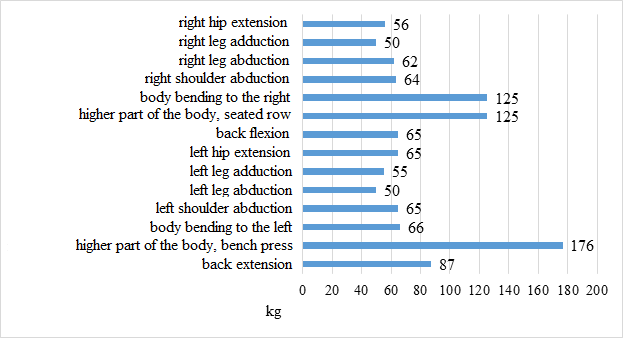
Fig. 1. Strength profile of male bodybuilders
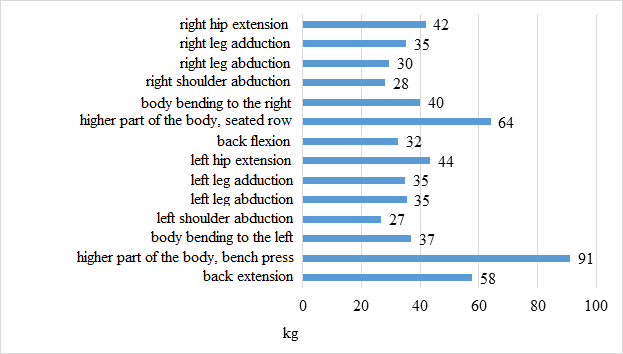
Fig. 2. Strength profile of female bodybuilders
Conclusion. The comparative analysis of strength of the various muscle groups among elite male and female bodybuilders has demonstrated statistically significant differences in all the indices. The percentage ratio comparison of female and male strength has also revealed that the upper shoulder girdle muscles lag the most, and stronger ones are the extensor back and leg muscles, and the strongest ones are the hip extensor muscles (strength amounts to 70% of male strength). The data obtained reflect a general trend of strength ratio between men and women, as well as its distribution in the separate muscles of the body. The received represents great importance for bodybuilding morphology and physiology.
The developed model characteristics and strength profiles of male and female bodybuilding athletes are recommended to assess strength capabilities at different training stages and in the sports selection system.
Conflict of interest. The authors declare no conflict of interest.
REFERENCES
- Ivanov V.D., Sukhodoev S.E. Bodybuilding and Health. Physical Culture. Sport. Tourism. Motor Recreation, 2017, vol. 2(4), pp. 96-100. (in Russ.)
- Belinskaya D.V. Sociological analysis of attitudes towards bodybuilding as a canon of masculinity. Socio-economic phenomena and processes, 2015, vol. 10, no. 3, pp. 99-107. (in Russ.)
- Dvorkin L.S., Davydov O.Yu., Dvorkin I.L. Theoretical and anthropometric aspects of bodybuilding. Proceedings of the Jubilee Scientific and Scientific-Methodological Conference of the Faculty dedicated to the 40th Anniversary of the Kuban State University of Physical Education, Sports and Tourism. 2009. pp. 269-279. (in Russ.)
- Vader D. Body building system. Moscow, 1991. 112 p. (in Russ.)
- Kochegarov N.V., Trusova V.P. Bodybuilding as one of the areas of a healthy lifestyle. Scientific Research of Modern Scientists: collection of materials of the XV International Scientific and Practical Conference. Moscow, 2016. pp. 426-427. (in Russ.)
- Zamchij T.P., Koryagina Yu.V. Morphofunctional aspects of adaptation to strength sports. Omsk: SibSUPC, 2012. 156 p. (in Russ.)
- Nopin S.V. Physiological and biomechanical characteristics of lower extremities’ muscles in female boxers during the maximum load test of Bosco repeated jumps. Modern Issues of Biomedicine, 2021, vol. 5, no. 3(16), pp. 119-129. (in Russ.)
- Nopin S.V., Koryagina Yu.V., Ter-Akopov G.N. Functional status of locomotor system of athletes engaged in cyclic and situational sports. Theory and Practice of Physical Culture, 2020, no. 4, pp. 25-27. (in Russ.)
- Koryagina Yu.V. Physiology of strength sports. Omsk: SibSUPC, 2003. 60 p. (in Russ.)
- Iordanskaya F.A. Man and woman in elite sports. Problems of sexual dimorphism. Monograph. Sovetskij Sport, 2012. 256 p. (in Russ.)
INFORMATION ABOUT THE AUTHORS:
Yulia V. Koryagina – Doctor of Biological Sciences, Professor, Head of the Center of Biomedical Technologies, North-Caucasian Federal Research-Clinical Center of Federal Medical and Biological Agency, Essentuki, e-mail:
Sergej V. Nopin – Candidate of Technical Sciences, Lead Researcher of the Center of Biomedical Technologies, North-Caucasian Federal Research-Clinical Center of Federal Medical and Biological Agency, Essentuki, e-mail:
Oksana N. Akimkina – Researcher of the Center of Biomedical Technologies, North-Caucasian Federal Research-Clinical Center of Federal Medical and Biological Agency, Essentuki, e-mail:
Aleksandr S. Nopin – North-Caucasian Federal Research-Clinical Center of Federal Medical and Biological Agency, Essentuki.
For citation: Koryagina Yu.V., Nopin S.V., Akimkina O.N., Nopin A.S. Gender characteristics of different muscle groups of elite bodybuilders. Russian Journal of Sports Science: Medicine, Physiology, Training, 2025, vol. 4, no. 3(15). DOI: 10.24412/2782-6570-2025_04_03_1