


Download the article in pdf format
Publication date: 15.09.2025
DOI: 10.24412/2782-6570-2025_04_03_7
UDC 615.8; 796.8
EFFECT OF TRANSCRANIAL ELECTRICAL STIMULATION, PNEUMO- AND HYDROTHERAPY ON RECOVERY OF BOXERS AND KICKBOXERS IN MIDDLE ALTITUDE CONDITIONS
Yu.V. Kushnareva, Yu.V. Koryagina, O.S. Zbitskaya, A.E. Starodubtseva
North-Caucasian Federal Research-Clinical Center of Federal Medical and Biological Agency, Essentuki, Russia
Abstract. Introduction. The purpose of the study – to evaluate the effect of the course of transcranial electrical stimulation, pneumo- and hydrotherapy on recovery of boxers and kickboxers during training activity in middle altitude conditions. Methods. The study included 21 athletes (boxers and kickboxers, men), age – 17 to 27 years. At the beginning and final stage, we registered waves of electroencephalogram, heart rate variability, hemodynamics, electroneuromyography, and conducted psychophysiological tests. The results of the study have shown that after the course cerebral circulation has optimized, the functional state of the central nervous system and heart functioning efficiency have improved, as well as bioelectrical activity, muscle coordination and microcirculation. Conclusion. We have proven the effectiveness of the 7-day course of procedures for recovery of the functional state of boxers and kickboxers during training in middle altitude conditions.
Keywords: transcranial electrical stimulation, pressotherapy, underwater shower massage, psychofunctional state, bioelectrical brain activity, central and peripheral hemodynamics, neuromuscular system.
Introduction. Development of methods for the recovery of the functional state of athletes during intense physical activity, including conditions of middle altitude, where fatigue develops faster than that in normal environmental conditions, remains one of the important tasks of sports medicine. The neurohumoral system plays a crucial role in fatigue processes, which is the reason why physiotherapy methods that have a positive effect on its functioning, in particular transcranial electrical stimulation (TES), have recently been widely applied [1-3]. Literature sources contain studies showing that application of TES in middle altitude conditions supports an improvement of psychofunctional state and performance, an increase of intensity of recovery processes of athletes after physical activity [4, 5]. Earlier, studies were conducted examining a comprehensive effect of physio- and balneoprocedures on the psychofunctional state and recovery processes of cyclic sports athletes in middle altitude conditions [6]. However, there are no data on a combined effect of physio- and balneoprocedures on a body of situational sports athletes.
Objective of the study: to evaluate the effect of the course including TES, pneumo- and hydrotherapy on the recovery of the functional state of boxers and kickboxers.
Methods and organization. The study was conducted at the Center for Biomedical Technologies (North-Caucasian Federal Research-Clinical Center of Federal Medical and Biological Agency) at an altitude of 1240 m (Maloe Sedlo Mountain, Kislovodsk) during training camps physically based at the Yug Sport Rehabilitation Center. It included 21 qualified male athletes specializing in boxing and kickboxing, age – 17 to 27 years, all the athletes are members of the national teams of the Russian Federation. During the study period, the athletes continued training activity (they trained 2-3 times a day).
At the beginning and final stage, the athletes were monitored, which included the analysis of wave brain activity, heart rate variability (HRV), indices of the central and peripheral hemodynamics, neuromuscular system, and psychophysiological tests. The bioelectrical brain activity was registered at rest using the Neuron-Specter 5 complex (Neurosoft, Ivanovo). The study involved athletes, who did not have any EEG-signs of paroxysmal neuron activity: spikes, sharp waves, and fast wave – slow wave complexes.
The study of HRV, central hemodynamics and blood oxygen saturation indices was conducted using the ESTECK System Complex (LD Technology, USA). The study of lower limb and brain vessel hemodynamics was carried out on the rheograph (Rheograph Valenta, Company Neo LLC, Saint Petersburg) according to the following methods: RVG (rheovasography) and REG (rheoencephalography). The stimulation electroneuromyography (ENMG) was conducted on the Neuro-MVP 4-channel complex (Neurosoft, Ivanovo). We registered motor responses (M-response) from the extensor digitorum brevis muscle innervated by n. Peroneus. The psychological tests were carried out on the “Sports psychophysiologist” complex [7].
At the next stage, the athletes were divided into two groups. The main group (MG) included 12 athletes: 7 boxers (qualification – 4 Candidates for Master of Sports, 1 Master of Sports, 2 Masters of Sports of International Class) and 5 kickboxers (qualification – 1 Candidate for Master of Sports, 2 Masters of Sports and 2 Masters of Sports of International Class). MG athletes went through the restorative course that included TES, device lymphatic drainage (pressotherapy) of the lower limbs and underwater shower massage. The control group (CG) included 9 boxers (qualification – 4 Candidates for Master of Sports, 5 Master of Sports). CG athletes received device lymphatic drainage (pressotherapy). All the athletes had no contraindications to the procedures.
We performed TES on the Transair-05 device (registration ID card No FSR 2010/07062, TES Center LLC, Saint Peterburg, Russia). Device lymphatic drainage (pressotherapy) of the lower limbs was conducted on the BTL – 6000 Lymphastim 12 device (BTL Industries Ltd., United Kingdom) in the “regeneration” mode. The underwater shower massage was performed on the BEKA hospitec UWM-100 device (Beka hospitec, Germany). Amode of actionon the lymph flow andmuscles was used –from the peripheryto the center.
Statistical data processing was performed in the Statistica 13.0 software using non-parametric Wilcoxon signed-rank test. The difference in values was considered significant at p<0.05. The data is presented as medians and quartiles (Me [Q1; Q3]).
Results and discussion. Effect of the restorative course on the functional state of the central nervous system of the athletes. It is known that EEG results can be used to assess both the functional state of the brain and signs of fatigue and overtraining [8]. Elite athletes often have a decrease in alpha activity on EEG against the background of an increase in low-frequency beta activity, in some cases – theta and delta activity.
Analysis of bioelectrical activity parameters in MG athletes did not reveal reliable changes in the alpha wave amplitude. The representation of the alpha wave in the occipital and parietal leads remained within the normal range. A significant decrease in the delta wave amplitude in the right mid-temporal lead was revealed (before: 7.50 [3.50; 10.9] µV, after: 4.50 [1.40; 13.0] µV (p<0.03)) against the background of a significant increase in the alpha/theta ratio in the right frontal lead (before: 1.38 [1.14; 1.77] c.u., after: 1.68 [1.23; 4.70] c.u. (p<0.04)). At the same time, there was a tendency of the decreasing slow-wave and fast-wave activity amplitude in almost all leads.
The CG athletes also did not have any statistically significant changes in the alpha wave amplitude. At the same time, there was a significant increase in the amplitude of the theta wave in the right anterolateral lead (before: 8,70 [2.80; 17.5] µV, after: 19.90 [7.20; 23.40] µV (p<0.01)), theta/beta ratio (before: 1,05 [0,40; 1,78] c.u., after: 1,97 [1.05; 2.94] c.u. (p<0.01)), as well as the theta+alpha amplitude (before: 22.40 [20.40; 24.50] µV, after: 24.10 [20.60; 25.50] µV (p<0.02)) against the background of the tendency of the increasing mu wave (before: 13.00 [12.40; 14.20] µV, after: 14.00 [12.90; 16.20] µV). For the remaining leads, no significant changes were found in the dynamics for the studied values of slow-wave and fast-wave activity. Thus, the course contributed to the improvement of the functional state of the athletes’ brains.
Optimal brain functioning of martial artists is the key to a successful match. The athlete’s better perception of the opponent’s distance, body position, and movement patterns makes it possible to perform the most advantageous motor actions faster in conditions of choice, when the time of making a decision is limited [9]. The study analyzed the effect of the course on simple and complex sensorimotor reactions, on mental performance, warming-up, and stability (Schulte test) of the athletes (table. 1).
The psychophysiological testing has shown that the sound reaction time significantly decreased in MG athletes after the course, a tendency of the decreasing time of sound reaction and choice reaction was revealed as well. At the same time, a significant improvement in the result for the work efficiency in the Schulte test was revealed against the background of a tendency to improve the result of the degree of warming-up and mental stability. There were no statistically significant changes in psychophysiological parameters of CG athletes, but there was a tendency of improving indices of simple sensorimotor responses and work efficiency. Consequently, the course had a positive effect on mental performance and contributed to the improvement of sensorimotor reactions.
Effect of the course on HRV and central hemodynamics of the athletes. The analysis of HRV indices in all athletes has revealed a moderate stress of regulatory systems (table 2).
Table 1
Changes in psychophysiological parameters of boxers and kickboxers before and after the course in middle altitude conditions, Me [Q1; Q3]
|
Indices |
Main group (n=12) |
P< |
Control group (n=9) |
P< |
||
|
before |
after |
before |
after |
|||
|
Light reaction time, ms |
272.2 |
270.6 |
- |
286.4 |
276.0 |
- |
|
Sound reaction time, ms |
363.5 |
336.9 |
0.01 |
396,6 |
383.3 |
- |
|
Choice reaction time, ms |
365.9 [323; 405.20] |
353,9 |
- |
379,8 |
378.2 |
- |
|
Work efficiency, s |
39.69 |
31.86 |
0.004 |
39,31 |
36.54 |
- |
|
Warming-up degree, c.u. |
1.02 |
0.98 |
- |
1,06 |
0.95 |
- |
|
Mental stability (endurance), c.u. |
1.10 |
0.98 |
- |
0,90 |
0.95 |
- |
Table 2
Dynamics of heart rate variability of boxers and kickboxers before and after the course in middle altitude conditions, Me [Q1; Q3]
|
Indices |
Norm |
Main group (n=12) |
Control group (n=9) |
||
|
before |
after |
before |
after |
||
|
HR, beats/min |
60-80 |
79.4 |
73.7 |
73.5 |
81.1 |
|
SI, c.u. |
50-200 |
118.6 |
82.3 |
102.0 |
73.3 |
|
MxDMn, ms |
150-300 |
234.5 |
257.5 [237.0; 331.0] |
238.0 |
273.0 |
|
SDNN, ms |
40-80 |
51.0 |
61.3 |
51.3 |
56.1 |
|
HF, % |
22-34 |
29.7 |
35.3 |
30,7 |
32.6 |
|
LF, % |
22-46 |
29.8 |
31.9 |
35.2 |
31.9 |
|
VLF, % |
25-50 |
33.2 |
35.5 |
31.1 |
33.9 |
|
LF/HF, c.u. |
0.5-2.0 |
1.0 |
1.0 |
0.9 |
1.0 |
Note: HR – heart rate; SI – stress index; MxDMn – variation range of cardiac intervals; SDNN – mean square deviation of cardiac intervals; HF – power of the high-frequency component of spectral frequency analysis (breathing waves): LF – power of the low-frequency component of spectral frequency analysis; VLF – power of the very-low-frequency component of spectral frequency analysis; LF/HF – autonomic balance indicator.
After the course MG athletes did not have any statistically significant changes. However, a positive trend of decreasing heart rate (HR) and stress index (SI) was identified. We have also registered a tendency towards an increase in the values of the mean square deviation of the cardio intervals and the power of high-frequency waves. The data obtained allow us to conclude that the autonomic regulation is enhanced and the effect of respiration on the heart rate of athletes is increasing. CG athletes also lacked statistically significant changes in HRV indicators. A tendency to an increase in the heart rate was revealed, while SI decreased.
The analysis of central hemodynamics and blood oxygen saturation has not reveal any statistically significant changes in all the athletes after the course. Before and after the course low values of saturation were registered, reflecting hypoxia: MG before: 95.0 [94.0; 96.0] %, after: 96.0 [95.0; 96.0] %, CG before: 95.0 [94.0; 97.0] %, after: 95.0 [94.5; 96.0] %. However, MG athletes had a tendency towards an increase of this indicator. After the course, all the athletes had a tendency towards a decrease of diastolic blood pressure (MG before: 67.5 [56.0; 71.0] mm of Hg, after: 65.5 [59.0; 70.0] mm of Hg; CG before: 71.0 [61.0; 72.5] mm of Hg, after: 65.0 [64.0; 70.0] mm of Hg) and peripheral resistance (MG before: 1113.5 [874.4; 1215,4] dyn*s/cm2, after: 983.9 [927.6; 1057.4] dyn*s/cm2; CG before: 1063.3 [1020.9; 1118.3] dyn*s/cm2, after: 966.8 [869.3; 1163.0] dyn*s/cm2. Thus, the course provided an enhancement of functional capabilities and heart functioning efficiency.
Effect of the course on the brain and lower limb vessels of the athletes. The analysis of hemodynamic parameters of carotid and vertebral artery systems in boxers and kickboxers was carried out. Significant differences were found only for the rheographic index parameters in the carotid artery system on the right in MG after the course (before: 1.37 [1.08; 1.55] c.u., after: 1.24 [0.99; 1.42] c.u. (p<0.02)) (fig.).
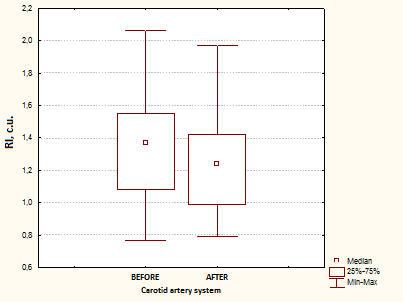
Fig. Parameters of the rheographic index (RI) in the carotid artery system on the right in athletes of the main group before and after the course in middle altitude conditions
A positive trend was found towards normalization of venous outflow parameters both in the carotid artery system (on the right before: 32.5 [28.5; 46.5] %, after: 30.0 [20.5; 46.0] %; on the left before: 30.0 [25.0; 42.5] %, after: 28,5 [19.5; 38.5] %), and in the vertebral artery system (on the right before: 36.5 [31.5; 43,5] %, after: 31.0 [27.5; 46.5] %; on the left before: 36.0 [28.0; 55.0] %, after: 32.5 [26.0; 41.5] %). Meanwhile, in the carotid artery system, there was a tendency of normalizing dicrotic (on the right before: 0,61 [0,53; 0,72] c.u., after: 0,53 [0,49; 0,69] c.u.; on the left before: 0,62 [0.53; 0.77] c.u., after: 0,58 [0,50; 0,68] c.u.) and diastolic indices (on the right before: 0.70 [0.61; 0.76] c.u., after: 0.64 [0.58; 0.79] c.u.; on the left before: 0.68 [0.63; 0.84] c.u., after: 0.66 [0.61; 0.69] c.u.), in the vertebral artery system – diastolic index on the right (before: 0.44 [0.39; 0.53] c.u., after: 0.51 [0.42; 0.66] c.u.).
The dynamics of CG athletes in the vertebral artery system showed a significant increase in the parameters of the slow vascular filling time on the left (before: 0.06 [0.06; 0.07] s, after: 0.12 [0.08; 0.17] s (p<0.02)), and elastic modulus (on the left before: 12.0 [11.0; 15.0] %, after: 24.0 [18.0; 27.0] % (p<0.01), on the right before: 12.0 [12.0; 13.0] %, after: 15.0 [13.0; 19.0] % (p<0.03)). As a result, the course contributed to normalization of cerebral artery tone and improvement of blood outflow from arteries to veins, which indicates improved blood supply to the brain.
The analysis of the lower limb vessel hemodynamics in MG athletes after the course has demonstrated no reliable differences. However, there was an increase (higher than normal values) of rheographic index and venous outflow parameters in the “foot” segment of the right leg, as well as in the “crus” segment of both legs. In addition, we have also registered a decrease in the asymmetry coefficient between the right and left legs in the “crus” segment. Higher blood supply in the studied segments may be explained by an improvement in microcirculation in tissues after the course.
Analysis of peripheral hemodynamics parameters has identified a reliably significant decrease of rheographic index parameters in the “foot” segment of the right leg (before: 1.55 [1.28; 2.04] c.u., after: 1.18 [0.90; 1.25] c.u. (p<0.02)) against the background of the increasing asymmetry in the “foot” segment between the right and left legs (before: 13.0 [8.0; 22.0] %, after: 28.0 [24.0; 41.0] % (p<0.02)). In addition, a tendency was registered towards a decrease of venous outflow to the limits of normal values in the “foot” segment of the right (before: 35.0 [32.0; 38.0] %, after: 17.0 [14.0; 31.0] %) and left (before: 41.0 [23.0; 50.0] %, after: 17.0 [12.0; 29.0] %) legs, as well as venous outflow in the “crus” segment of the right leg (before: 25.0 [16.0; 41.0] %, after: 17.0 [12.0; 29.0] %). Consequently, the course supported the improvement of microcirculation in the lower limbs of the athletes.
Effect of the course on the neuromuscular system of the athletes. The ENMG data revealed a significant increase in the parameters of the amplitude and area of the M-response against the background of a tendency towards a decrease in latency and residual latency in the right leg of MG athletes. A significant increase in the M-response amplitude was also detected in the left limb in the “popliteal fossa” stimulation point. The rest of the parameters were not significantly influenced by the course.
The dynamics of CG athletes have significantly revealed an increase in the parameters of the M-response duration in the “head of fibula” stimulation point on the left (before: 6.0 [5.3; 6.4] ms, after: 6.3 [5.7; 7.1] ms (p<0,03)). The rest M-response parameters haven’t changed much, though there was an increase in the parameters of area (before: 18.4 [17.7; 23.6] mV×ms, after: 20,5 [18.3; 26.8] mV×ms), amplitude (before: 5.8 [5.4; 8] mV, after: 7.6 [5.5; 8.3] mV) and nerve conduction velocity (before: 53.3 [52.6; 57.5] m/s, after: 55.0 [53.5; 56.5] m/s) of M-response in the “popliteal fossa” stimulation point of the right leg. Thus, the course contributed to an increase in the bioelectric activity of the muscles and improved muscle coordination.
Conclusion. Application the 7-day course aimed at restoring the functional state of athletes during intense physical activity in middle altitude conditions, combined with the effects of TES, device lymphatic drainage (pressotherapy) of the lower limbs and underwater shower massage for boxers and kickboxers had a positive effect on cerebral circulation, contributed to the improvement of the functional state of the central nervous system, manifested in optimizing the wave activity of the brain by reducing slow-wave activity, improving mental performance and sensorimotor responses. In addition, the functional capabilities and heart functioning efficiency have increased, and the autonomic regulation of heart rhythm has been enhanced. After the course, the bioelectric muscle activity, muscle coordination and microcirculation improved in the lower limbs of boxers and kickboxers.
Conflict of interest. The authors declare no conflict of interest.
REFERENCES
- Roguleva L.G. Effect of transcranial electrical stimulation on the functional state of athletes engaged in wrestling and strength sports: an author’s dissertation. Tomsk: Siberian State Medical University, 2015. 146 p. (in Russ.)
- Friehs M.A., Whelan E., Güldenpenning I., Krause D., Weigelt M. Stimulating performance: A scoping review on transcranial electrical stimulation effects on Olympic sports. Psychology of Sport and Exercise, 2022, vol. 59, pp. 102-130.
- Chinzara T.T., Buckingham G., Harris D.J. Transcranial direct current stimulation and sporting performance: A systematic review and meta-analysis of transcranial direct current stimulation effects on physical endurance, muscular strength and visuomotor skills. European Journal of Neuroscience, 2022, vol. 55, no. 2, pp. 468-486.
- Koryagina Yu.V., Roguleva L.G., Nopin S.V., Ter-Akopov G.N. Effects of application of transcranial electrical stimulation in the training process at elite athletes of various sports. Problems of Balneology, Physiotherapy and Exercise Therapy, 2020, vol. 97, no. 5, pp. 70-79. (in Russ.)
- Ter-Akopov G.N., Koryagina Yu.V., Nopin S.V. et al. The transcranial electrical stimulation course in recovery of karatekas in conditions of training in middle altitude. Modern Issues of Biomedicine, 2024, vol. 8, no. 2, pp. 259-266. (in Russ.)
- Koryagina Yu.V., Abutalimova S.M., Roguleva L.G., Nopin S.V., Kopanev A.N. To the question of developing effective restoration strategies for athletes during stay in the camp at federal bases of sports training. Modern Issues of Biomedicine, 2020, vol. 4, no. 1 (10), pp. 35-39. (in Russ.)
- Koryagina Yu.V., Nopin S.V. Hardware and software complex “Sports psychophysiologist”. Programmy dlya EVM. Bazy dannykh. Topologii integral’nykh mikrosistem, 2011, no. 1, p. 308. (in Russ.)
- Sazonova E.A. Peculiarities of bioelectrical activity of the brain of athletes in some sports. Relevant Issues of Training and Health Preservation of Athletes: Materials of the All-Russian Scientific and Practical Conference with International Participation, dedicated to the 40th Anniversary of the Department of Sports Medicine and Physical Rehabilitation (Chelyabinsk, December 20th, 2013). Bykov E.V., ed. Chelyabinsk: UralSUPC, 2013. pp. 454-456.(in Russ.)
- Cristofori I., Cohen-Zimerman S., Grafman J. Executive functions. Handbook of clinical neurology, 2019, vol. 163, pp. 197-219.
INFORMATION ABOUT THE AUTHORS:
Yulia V. Kushnareva – Candidate of Biological Sciences, Senior Researcher of the Center of Biomedical Technologies, North-Caucasian Federal Research-Clinical Center of Federal Medical and Biological Agency, Essentuki, e-mail:
Yulia V. Koryagina – Doctor of Biological Sciences, Professor, Head of the Center of Biomedical Technologies, North-Caucasian Federal Research-Clinical Center of Federal Medical and Biological Agency, Essentuki, e-mail:
Olga S. Zbitskaya – Researcher of the Center of Biomedical Technologies, North-Caucasian Federal Research-Clinical Center of Federal Medical and Biological Agency, Essentuki, e-mail:
Alla G. Starodubtseva – Junior Researcher of the Center of Biomedical Technologies, North-Caucasian Federal Research-Clinical Center of Federal Medical and Biological Agency, Essentuki, e-mail:
For citation: Kushnareva Yu.V., Koryagina Yu.V., Zbitskaya O.S., Starodubtseva A.E. Effect of transcranial electrical stimulation, pneumo- and hydrotherapy on recovery of boxers and kickboxers in middle altitude conditions. Russian Journal of Sports Science: Medicine, Physiology, Training, 2025, vol. 4, no. 3(15). DOI: 10.24412/2782-6570-2025_04_03_7