


Download the article in pdf format
Publication date: 15.09.2025
DOI: 10.24412/2782-6570-2025_04_03_3
UDC 796.015.132
EFFECT OF WORK-TO-REST RATIO IN CLUSTER SET DESIGN ON SPEED-STRENGTH INDICATORS OF GRECO-ROMAN WRESTLERS: A PILOT STUDY
A.V. Shevtsov1, A.B. Miroshnikov1, A.I. Laptev1, S.N. Manidichev2, A.V. Ermakov1
1Russian University of Sports “GTSOLIFK”, Moscow, Russia
2Institute of Traditional Health Systems, Moscow, Russia
Abstract. Introduction. Cluster sets with different work-to-rest ratios are considered an alternative to the traditional strength training aimed at reducing fatigue and increasing neuromuscular activation stability. Objective: to evaluate influence of work-to-rest ratio in construction of cluster sets on speed-strength indices of Greco-Roman wrestlers. Methods. The study involved 10 Greco-Roman wrestlers, who performed bench presses according to different methods. The evaluation was conducted using surface electromyography for the pectoralis major, anterior deltoid, triceps, and biceps muscles of the shoulder, kinematic analysis of barbell accelerations, and the Borg scale. Results. After application of the cluster method, a tendency was found to higher values of barbell acceleration and more stable muscle activation in final sets compared with the results of the traditional method in terms of lower subjective fatigue. Regression modeling of subjective perceived load showed a more uniform increase in fatigue with cluster sets. Conclusion. The cluster scheme with equal work-to-rest distribution may serve as an effective tool to optimize strength training of wrestlers, reducing subjective fatigue and maintaining high level of neuromuscular activation with a comparable amount of work.
Keywords: cluster sets, strength training, speed-strength abilities, electromyography, bench press, fatigue, Greco-Roman wrestling, movement kinematics.
Introduction. The nature of sports is that athletes usually have to perform their motor skills, including jumps, kicks, lunges and throws, as fast as possible in an adjusted movement range, supporting these movements with high velocity and strength. Different training methods, load, intensity, duration and rest intervals are the important factors in developing plans for strength training sessions [1, 2]. Depending on the manipulation of these variables, various adaptations and varying amounts of strength, power, endurance, and muscle hypertrophy may occur. According to the systematic review by Santos et al. [3], traditional resistance training (TRT) may be described as “3±1 sets of 9±6 repetitions of concentric and eccentric exercises with external load of 75±20% of one repetition maximum (1RM), performed 3±1 times a week». Intra-set rest lasts 2±1 minutes. TRT is performed continuously, without rest between repetitions [4]. According to the meta-analysis by Singer et al. [5] the highest muscle hypertrophy occurs in case of TRT with intra-set rest lasting more than 60 seconds. Despite the achieved success, a question whether this method is the most effective way to stimulate muscle fibers in comparison with alternative methods remains open for discussion and requires further study.
In the course of the last years many scientists and practicing experts strive to change TRT methods in order to minimize or alleviate negative consequences of neuromuscular fatigue and cause the most significant adaptive changes [6]. It was under the guidance of this direction that cluster training arose and is developing. Cluster sets (CS) are an alternative to TRT, which implies division of the traditional set into repetition blocks with a short intra-set rest between them [7]. Modern studies have demonstrated a positive effect of CS on the optimization of neuromuscular and sports indicators, including higher jumps and better sprinting abilities, as well as enhanced strength and mechanical power [6, 8]. Currently, five terms are identified in the cluster training theory: intra-set rest (IR), inter-repetition rest (IRR), rest-pause (RP), redistribution rest (RR) and equal work-to-rest ratios (EW:R) [4, 9]. Moreover, equal work-to-rest ratio in the CS preparation it is of the greatestinteresttophysicaltrainingcoaches.
Objective of the study: to estimate effect of work-to-rest ratio in the CS preparation on speed-strength indicators of Greco-Roman Wrestlers.
Methods and organization. On January 2025, a pedagogical experiment was conducted at the Department of Theory and Methods of Martial Arts in the Russian University of Sports “GTSOLIFK”. The study involved 10 Greco-Roman wrestlers (age – 18±2 years), who passed the preliminary testing to evaluate 1 repetition maximum (1RM) of a bench press. We examined two sequences of exercises which are aimed towards the improvement of strength indicators in a bench press, but differ in the principles of load and rest organization.
Sequence I is based on TRT: 3 sets of 8 repetitions (24 repetitions) with weights of 85% of 1RM. IRR – 60 seconds.
Sequence II is based on CS (EW:R): 24 repetitions (weights of 85% of 1RM), organized in a form of 8 mini-sets of 3 repetitions. Intra-set rest (IR) between each three repetitions was calculated according to the formula:
IR = 2 × IRR / ((N / 3) – 1), (1)
where N – total number of repetitions = 24, IRR – inter-repetition rest in TRT = 60 s.
If we put the needed values, we will get the following result:
IR = 2 × 60 / ((24 / 3) – 1) = 120 / (8 – 1) = 17.14 s
The study’s participants came in the morning and performed Sequence I followed by Sequence II, rest interval between the sequences lasted 30 minutes.
The study included three key methods of evaluating the functional state of athletes, who perform bench press: the Colibri wireless system of electrophysiological signal monitoring (Russia), inertial multisensory device and subjective evaluation of perceived load (Borg scale).
The Colibri system is based on surface electromyography (EMG). Application of wireless sensors has allowed to conduct a detailed analysis of spatial and temporal characteristics of muscle involvement, including synchronization of work of different muscle groups and fatigue dynamics. We evaluated the activity of the pectoralis major, anterior deltoid, triceps, and biceps muscles of the shoulder. The biceps muscle does not participate in horizontal adduction of the shoulder joint and extension of the elbow joint, but it plays a crucial role of stabilizing the shoulder joint, which is why we decided to analyze its activity as well. Position of electrodes during the study did not change in order to reduce inaccuracy of measurements. For the analysis, we took data of the muscle activity EMG from the last repetition of first and last sets. An area of 0.5 seconds with maximum signal amplitude was chosen on the oscillogram. Area under the curve was calculated automatically in the NeuroMD Myografy software complex developed by Neurotech Company. Then normalization of the signal and comparison of values was conducted.
At the same time with EMG monitoring, we used the inertial multisensory device equipped with accelerometer and gyroscope to register 3D kinematic parameters of the barbell’s movement. The device was applied to the barbell with a magnet adapter which provided synchronous fixation of linear velocity vectors along the X, Y, Z axes, was well as angle orientation of the barbell in space. The measurement protocol included minimization of inaccuracies connected with gravitational acceleration. Collection of the data was carried out with 200 Hz discretization frequency, which provided high temporal resolution capability to analyze phase movement characteristics. Analysis of descriptive statistics of barbell accelerations (mean, standard deviation, minimum, median, 25th percentile, 75th percentile, maximum) has allowed describing variability and movement dynamics, identifying the technique’s peculiarities and potential imbalances of bench press.
To evaluate subjective intensity of physical activity, we applied the classic 15-point Rating of perceived exertion (RPE), where the values varied from 6 (no exertion) to 20 (maximum exertion). After each set, the subjects independently recorded the level of perceived exertion. The integration of objective EMG and kinematic data with subjective RPE assessments contributes to a comprehensive understanding of the functional state of athletes and the training process optimization.
Assessment of the collected data set was based on the descriptive statistics analysis and dispersion analysis. To construct the mathematical model, we used regression modeling. All calculations were done with Python libraries in Jupyter Notebooks platform using cloud technologies of Google Colab (https://github.com/vn322/Wrestling/blob/main/weight_lift.ipynb).
Results and discussion. Comparison of the methods with the measurement of kinematic parameters of barbell movement. To conduct the initial assessment of the present datasets we have estimated descriptive statistics parameters of barbell acceleration in bench press according to the cluster scheme (table 1).
As we can see, there are insignificant differences between mean and median values, which may serve as evidence of normal distribution of the measured value and demands for further study. Moreover, we can see a slightly different approach of athletes to manage the equipment’s movement. For example, the first and the fourth athletes focus on accelerating the barbell and its smooth inhibition, the second and seventh focus on both acceleration and inhibition, the third and eighth focus on inhibition only, and the fifth and sixth athletes prefer smooth execution of the exercise with relatively small acceleration (table 1).
In order to compare data, we would like to investigate descriptive statistics of barbell acceleration in bench press according to the traditional scheme presented in table 2.
We observe a similar pattern in terms of the proximity of the mean and median values, as well as the presence of different approaches to put emphasis on acceleration and inhibition of barbell movement. Considering all the available execution styles, it can be noted that the first focus, determined by the value of the module, falls on the third, and more often the fourth movement.
Table 1
Descriptive statistics parameters of barbell acceleration in bench press according to the cluster scheme for different athletes, m/s²
|
Parameter |
Athlete |
|||||||
|
1 |
2 |
3 |
4 |
5 |
6 |
7 |
8 |
|
|
Mean |
0.965 |
0.972 |
0.983 |
0.971 |
0.946 |
0.989 |
0.996 |
0.992 |
|
Standard deviation |
0.348 |
0.351 |
0.265 |
0.269 |
0.212 |
0.267 |
0.315 |
0.276 |
|
Minimum |
-0.559 |
-0.789 |
-0.378 |
-0.362 |
-0.513 |
-0.405 |
-1.333 |
-1.052 |
|
25th percentile |
0.840 |
0.893 |
0.937 |
0.885 |
0.872 |
0.918 |
0.934 |
0.938 |
|
Median |
0.952 |
0.972 |
0.991 |
0.974 |
0.964 |
0.988 |
0.990 |
0.989 |
|
75th percentile |
1.039 |
1.023 |
1.032 |
1.023 |
1.016 |
1.016 |
1.046 |
1.024 |
|
Maximum |
4.599 |
5.041 |
3.936 |
4.719 |
2.176 |
2.809 |
4.105 |
2.846 |
Table 2
Descriptive statistics parameters of barbell acceleration in bench press according to the traditional scheme, m/s²
|
Parameter |
Athlete |
|||||||
|
1 |
2 |
3 |
4 |
5 |
6 |
7 |
8 |
|
|
Mean |
0.979 |
0.947 |
0.985 |
0.920 |
0.916 |
0.941 |
0.967 |
0.986 |
|
Standard deviation |
0.358 |
0.301 |
0.267 |
0.262 |
0.236 |
0.306 |
0.292 |
0.338 |
|
Minimum |
-0.277 |
-0.395 |
-0.420 |
-0.209 |
0.015 |
-0.655 |
-0.637 |
-0.833 |
|
25th percentile |
0.872 |
0.875 |
0.918 |
0.877 |
0.812 |
0.827 |
0.893 |
0.921 |
|
Median |
0.981 |
0.952 |
0.986 |
0.976 |
0.944 |
0.963 |
0.985 |
0.985 |
|
75th percentile |
1.070 |
1.005 |
1.033 |
1.021 |
1.012 |
1.005 |
1.044 |
1.028 |
|
Maximum |
2.502 |
2.502 |
4.333 |
2.228 |
2.485 |
2.516 |
3.664 |
4.575 |
For TRT, “smooth” performance of exercises without any pronounced emphasis may be considered as typical, there are also cases of emphasis on the last movement (table 3). A similar situation may show that in a course of first three lifts of the barbell, an athlete warms-up and adapts to the exercise, and then they may consciously emphasize specific movements. Among other things, we can see individual peculiarities of athletes, who either perform the whole sequence “smoothly”, avoiding any emphasis, or try to show maximum of their capabilities after warm-up, or “save resources” to show their maximum at the end of the exercise. Moreover, it is important to note that in most cases, higher values of acceleration are achieved in case of performing the exercise according to CS. Individual differences do not allow us to claim a single model of exercise performance inherent in all athletes, and in the future we can try to compare the results by mean and median values. It should be noted that the interval in which the acceleration values change is somewhat smaller than in CS. Among other things, according to the descriptive statistics analysis, when performing exercises according to CS, athletes achieve slightly higher acceleration values if assessed using mean and median values. To clarify the significance of these differences, a variance analysis was performed (table 3).
We used the Kruskal-Wallis H-test as less demanding to peculiarities of the examined value’s distribution. As a result, we have found that despite the tendency of increasing acceleration values according to both mean and median values of reliable differences in speed-strength fitness of athletes when applying two schemes with adjusted precision criteria (р≤0.05) no statistical significance of differences was registered.
Assessment of fatigue level of athletes under acting load using the Borg scale. In order to identify the present differences, we have proposed a theory of different fatigue models that occur in case of applying the schemes. Linear approximation of fatigue build-up rate’s mean values in application of the examined schemes is presented in figure 1.
Table 3
Dispersion analysis results of performing exercises according to the examined schemes
|
Scheme |
Mean acceleration |
Acceleration median |
Kruskal-Wallis H-test |
P< |
|
CS |
0.97675 |
0.9775 |
2.482 |
- |
|
TRT |
0.95513 |
0.9715 |
1.220 |
- |
Note: CS – cluster scheme; TRТ – traditional resistance training.
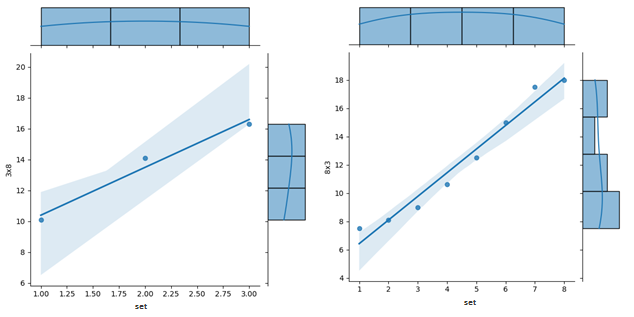
Fig. 1. Linear approximation of mean values of fatigue build-up rate in application of TRT (traditional resistance training) and CS (cluster scheme), respectively
While assessing the resulting models, we can see that the models really differ and athletes perceive most of the CS exercises as moderate when performing the same amount of work. For a more detailed study, mathematical models of performing exercises according to the examined schemes were constructed. The linear regression method was used for this purpose (table 4).
During examination of the obtained models, we can note their high productivity according to the comprehensive evaluation, which included: determination coefficient (R²), Fischer criterion (F-statistic), Akaike information criterion (AIC) and Bayesian information criterion (BIC). The models themselves demonstrate much higher fatigue build-up rate in case of CS and better fatigue management in case of TRT. We have identified three approaches to perform these exercises depending on emphasis distribution in a sequence of bench presses. We have also compared values of acceleration in the examined schemes and constructed mathematical models of fatigue build-up rate of these schemes.
Comparative analysis of the training schemes with surface EMG. EMG activity of muscles expressed in millivolts reflects the degree of motor unit recruiting and level of neuromuscular activation. Although increase of EMG amplitude may reflect a growth of neuromuscular load, this indicator is not a direct equivalent of mechanical work, but only indirectly characterizes the degree of involvement of muscle fibers. Mean values of EMG amplitude (mV), as well as relative differences between the schemes are shown in table 5. Relative change (Δ, %) was calculated according to the formula:
Δ = ((K – TR) / TR) × 100%, (2)
where K – the cluster scheme value (8×3), TR – the traditional resistance training value (3×8).
The Δ calculation was done separately for the first and last sets, showing relative dynamics of EMG between the schemes as a percentage of the traditional scheme.
Table 4
Results of regression modeling of perceived stress after performing exercises according to the examined schemes
|
Scheme |
Model equation |
R² |
F-statistic |
AIC |
BIC |
|
CS |
y = 3.10 x + 7.30 |
0.973 |
35.59 |
7.369 |
5.566 |
|
TRT |
y = 1.67 x + 4.75 |
0.967 |
176.9 |
21.12 |
21.28 |
Note: CS – cluster scheme; TRТ – traditional resistance training; R² – determination coefficient; F-statistic – Fischer criterion; AIC – Akaike information criterion; BIC – Bayesian information criterion.
To prove the hypothesis we measured 1RM of the pectoralis major muscle of one of the participants with simultaneous fixation of bioelectrical system amplitude (EMG). The repetition maximum amounted to 50 kg and the normalized value of the EMG amplitude was 4920 mV. Then we took the load of 80%, 60%, 40%, 30% and 20% of 1RM, which amounted to 40, 30, 20, 15 and 10 kg, respectively. With these weights, an exercise was performed and the amplitude of the EMG signal was recorded. The results are shown in figure 2.
Table 5
Mean values of muscle electromyography amplitude in the first and last sets, mV
|
Sets |
First |
Last |
||||||
|
Scheme / Muscle |
PM |
DEL |
TB |
BB |
PM |
DEL |
TB |
BB |
|
TRT |
1486.25 |
2260.5 |
2830.875 |
590.875 |
1754.5 |
2571.75 |
3403.375 |
720 |
|
CS |
1218.125 |
1905.75 |
2475 |
577.5 |
2013.25 |
2787.5 |
3865 |
692.5 |
|
Δ, % |
-22% |
-19% |
-14% |
-2% |
13% |
8% |
12% |
-4% |
Note: TRТ – traditional resistance training; CS – cluster scheme; PM – pectoralis major; DEL – deltoideus; TB – Triceps brachii; BB – Biceps brachii; Δ – relative changes in electromyography between schemes (%).
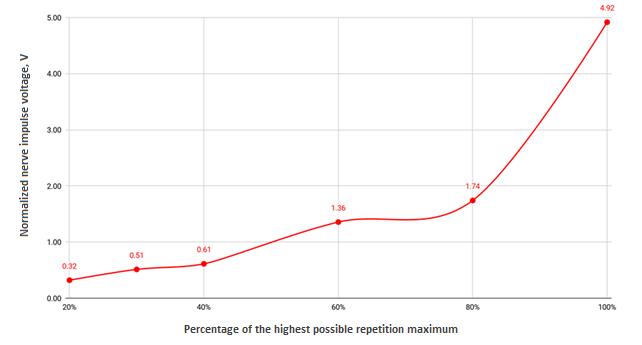
Fig. 2. Dependence of the amplitude of the biceps’ electromyography on the load level (% of 1RM), V
The analysis’s results demonstrate positive correlation between weights and EMG signal amplitude, however this dependence differs from the linear one. A number of repetitions in the first set of the traditional scheme exceeds that in the cluster scheme, which is shown in much higher EMG values. We have also noted an increase of EMG for all the muscles, except the biceps brachii that does not increases its EMG, since in this case it stabilizes the shoulder joint. Mean value of EMG at the end of the first set is lower by 14-22%. Analysis of the data from the last set shows us that with a comparable amount of work performed, the EMG values in the cluster scheme are 8-13% higher than in the traditional one, indicating more stable muscle activation with an equal amount of work. The study shows that the use of cluster training methods contributes to a higher activity of muscle fibers. This, in turn, can help increase muscle volume and strength in systematic training.
Conclusion. The conducted pilot study has allowed to comprehensively assess influence of work-to-rest ratio when using cluster sets and traditional training on speed-strength indicators of Greko-Roman wrestlers. The comparative analysis performed using kinematic characteristics of the barbell movement, EMG activity of the key muscle groups and subjective fatigue evaluation has revealed a number of significant tendencies.
- The kinematic analysis has revealed that when performing CS exercises the athletes usually achieve higher values of acceleration compared with that of TRT. However, there were no statistically significant differences at the significance level p≤0.05. We have found different individual strategies of emphasis distribution in movement, which may show features of motor control and degree of fatigue.
- The regression modelling of the Borg scale has shown that in cluster sets fatigue increases more evenly and is subjectively perceived as less stressful when performing the same amount of work. This indicates the potential effectiveness of the cluster scheme in load management and reducing the severity of fatigue in the training process.
- The EMG data demonstrate a much higher degree of muscle activation in performing exercises according to the cluster scheme, especially in final sets. The elevated bioelectric activity of the pectoralis major, anterior deltoid and triceps muscles of the shoulder in CS can contribute to a more significant training stimulus while maintaining the volume of work. Special attention should be paid to the increased role of the anterior deltoid and triceps muscles, which confirms the need to revise the emphasis in the bench press technique as an exercise.
Therefore, introduction of cluster sets with equal work-to-rest ratio may be considered as a promising alternative of the traditional method in developing speed-strength capabilities of wrestlers. Application of this scheme contributes to decreased fatigue, increased level of muscle activation and kinematic characteristics variability, which together can provide a more stable and effective adaptation to training activity. The results of this study require validation on broader samples, but already at this stage they confirm the expediency of using cluster training as a tool for individualizing and optimizing the training process in sports with a high proportion of speed and strength training.
Conflict of interest. The authors declare no conflict of interest.
REFERENCES
- Li G., Wang Z., Hao Y. et al. Consensus statement of Chinese experts on exercise prescription (2023). Sports Med Health Sci, 2024, vol. 6(2), pp. 200-203. DOI: 10.1016/j.smhs.2024.02.003.
- Mcleod J.C., Currier B.S., Lowisz C.V., Phillips S.M. The influence of resistance exercise training prescription variables on skeletal muscle mass, strength, and physical function in healthy adults: An umbrella review. J Sport Health Sci, 2024, vol. 13(1), pp. 47-60. DOI: 10.1016/j.jshs.2023.06.005.
- Santos C.S., Pinto J.R., Scoz R.D. et al. What is the traditional method of resistance training: a systematic review. J Sports Med Phys Fitness, 2022, vol. 62(9), pp. 1191-1198. DOI: 10.23736/S0022-4707.21.12112-7.
- Tufano J.J., Brown L.E., Haff G.G. Theoretical and Practical Aspects of Different Cluster Set Structures: A Systematic Review. J Strength Cond Res, 2017, vol. 31(3), pp. 848-867. DOI: 10.1519/JSC.
- Singer A., Wolf M., Generoso L. et al. Give it a rest: a systematic review with Bayesian meta-analysis on the effect of inter-set rest interval duration on muscle hypertrophy. Front Sports Act Living, 2024, vol. 6, pp. 1429789. DOI: 10.3389/fspor.1429789.
- Cui J., Yu Y., Xu Y., Wu H. Effectiveness of long-term cluster training and traditional resistance training in enhancing maximum strength in young adults: a systematic review and meta-analysis. Front Physiol, 2025, vol. 16, p. 1568247. DOI: 10.3389/fphys.1568247.
- Taber C.B., Murphy J., Shah J. et al. Changes in Bench Press Velocity and Power After 8 Weeks of High-Load Cluster or Traditional Set Structure: A Replication Study. Communications in Kinesiology, 2025, vol. 1(7). DOI: 10.51224/cik.2025.75.
- Vargas-Molina S., García-Sillero M., Maroto-Izquierdo S. et al. Cluster sets and traditional sets elicit similar muscular hypertrophy: a volume and effort-matched study in resistance-trained individuals. Eur J Appl Physiol, 2025, vol. 125, pp 1725-1734. DOI: 10.1007/s00421-025-05712-6.
- Latella C., Peddle-McIntyre C., Marcotte L. et al. Strengthening the Case for Cluster Set Resistance Training in Aged and Clinical Settings: Emerging Evidence, Proposed Benefits and Suggestions. Sports Med, 2021, vol. 51(7), pp. 1335-1351. DOI: 10.1007/s40279-021-01455-4.
INFORMATION ABOUT THE AUTHORS:
Aleksej V. Shevtsov – Candidate of Pedagogical Sciences, Professor, Professor of the Department of Theory and Methodology of Martial Arts, RUS “GTSOLIFK”, Moscow, e-mail:
Aleksandr B. Miroshnikov – Doctor of Biological Sciences, Associate Professor, Professor of the Department of Sports Medicine, RUS “GTSOLIFK”, Moscow, e-mail:
Aleksej I. Laptev – Candidate of Pedagogical Sciences, Associate Professor, Leading Researcher of the Research Institute of Sports and Sports Medicine, RUS “GTSOLIFK”, Moscow, e-mail:
Sergej N. Manidichev – Lecturer, Institute of Traditional Health Systems (ITHS), Moscow, e-mail:
Aleksej V. Ermakov – Candidate of Pedagogical Sciences, Associate Professor of the Department of Theory and Methodology of Martial Arts, RUS “GTSOLIFK”, Moscow, e-mail:
For citation: Shevtsov A.V., Miroshnikov A.B., Laptev A.I., Manidichev S.N., Ermakov A.V. Effect of work-to-rest ratio in cluster set design on speed-strength indicators of Greco-Roman wrestlers: a pilot study. Russian Journal of Sports Science: Medicine, Physiology, Training, 2025, vol. 4, no. 3(15). DOI: 10.24412/2782-6570-2025_04_03_3