


Download the article in pdf format
Publication date: 01.12.2023
DOI: 10.24412/2782-6570-2023_02_04_7
UDC 79-053.2
DEVELOPMENT OF YOUTH SPORTS IN SOCHI: CONTENT ANALYSIS OF INFORMATION SOURCES
I.K. Zabelo1, E.F. Legkaya1,2, L,S. Khodasevich1,3
1Sochi State University, Sochi, Russia
2Sochi Institute – Branch of the Peoples' Friendship University of Russia, Sochi, Russia
3Kuban State Medical University, Krasnodar, Russia
Annotation. Sochi, located on the Black Sea coast of the Krasnodar Krai, is famous not only for its natural attractions and recreational resources, but also for its sports achievements, famous coaches and outstanding athletes. Youth sports in Sochi began to develop actively in the post-war period. The XXII Olympic Winter Games 2014 in Sochi gave a powerful stimulus to its further development. More than 12 thousand children regularly play sports and every year the number of young athletes systematically engaged in physical culture is continuously growing.
Keywords: youth sports, Sochi, sports schools, physical culture and sports.
Introduction. Youth sport in our country is directed towards sports training of underage citizens in preschool educational institutions, school and student sports clubs of educational organizations, as well as in organizations providing sports training at the place of residence and work [1].
Experts in physical culture and sports agree that there is a need to follow regulations of how to organize children’s training process, consider anatomical and physiological features, as well as patterns of growth and development of children of different ages [2-4]. Unlike adults, children’s body suffer double load in sports, as it is necessary to provide adaptation to high physical activity and psycho-emotional stress, to continuously carry out the growth and development function [5-7].
Age, in which sports specialization should be started, is defined by requirements placed by a specific sport [8]. According to the reference documents, the elementary training should start from the age of 6 years in elementary sports (athletic and rhythmic gymnastics, figure skating, synchronized swimming et al); from the age of 8-9 years – in basketball, soccer, track-and-field, skating, skiing et al; from the age of 10-11 years – in cycling, rowing, equestrian sports and weightlifting. However, in some sports, young athletes start training much earlier [9]. According to N.N. Vitizej, “sport is a special type of social production, in which human self-identification recreates (models) itself in a specific form” [10].
Favorable climatic conditions of Sochi allow its residents to engage in different sports all year round not only in gyms and pools, but also on beaches, in parks, city squares and outdoor sports facilities.
The aim of the review is a content analysis of information sources on issues of youth sport development in Sochi.
Methods and organization. In the course of the study, information sources on the development of youth sports in Sochi were studied and analyzed using the content analysis method.
Results and discussion. This coastal city is a birthplace of a number of outstanding Russian athletes. A famous soccer player Slava Metreveli was born on May 30, 1936 in Sochi. He started his career in Trud Adler, then played in Torpedo Moscow and Dinamo Tbilisi, in which he became a USSR champion. He played as a winger and was one of the best players in the history of Soviet soccer [11]. A Russian tennis player Kafel’nikov, the most titled tennis player in the history of Russia, was also born and raised in Sochi. Valerij Shyshkin was his first coach. Since he was 6, Evgenij has participated in various competitions. In 1989, he became a USSR champion among the youth. Since then he played in the junior national team and managed to win the World Cup in 1990 among tennis players under 16 years of age [12]. The completionist of the Career Grand Slam, Maria Sharapova (she won in all Grand Slam tournaments) was born on April 19, 1987 in Nyagan. However, from the age of 4 years, she lived in Sochi and played tennis [13].
Youth sport in Sochi started to develop rapidly in the post-war period. The first sports school of the city was founded in 1947, which was on the site of the Festivalnyj concert hall located in the central district of Sochi. The school had a small sports hall, which included sports gymnastics and track-and-field sections. It also had a rowing canal, in which canoe paddlers practiced. At the end of the 1960s, a new sports center titled “Spartak” was built on the city stadium, into which the Sports School No 1 moved (fig. 1) [14].
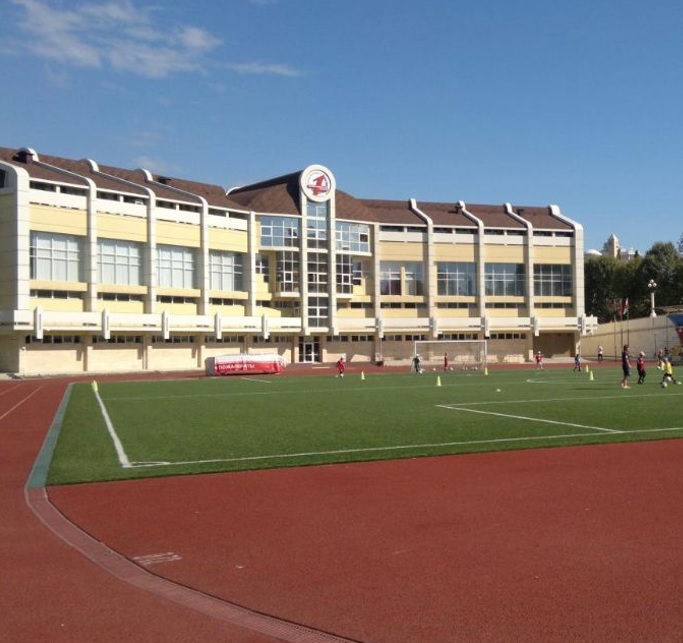
Fig. 1. Sports School No 1
In 1964, through the efforts of the city's youth, a landmark construction project was started. 2107 young men and women from 65 organizations and 200 athletes under the careful guidance of A. Khostinskij and V. Matvienko, secretaries of the Central and Khostin district committee, started a construction of a new facility. This is how the history of the stadium, later named Central Stadium, and even later named after Slava Metreveli (fig. 2) and at this moment simply labeled “Yug” began in the bed of the Bzugu River. The Construction began in early 1964 and ended in 1966. The stadium became a place for training students of children sports schools and professional athletes [15].
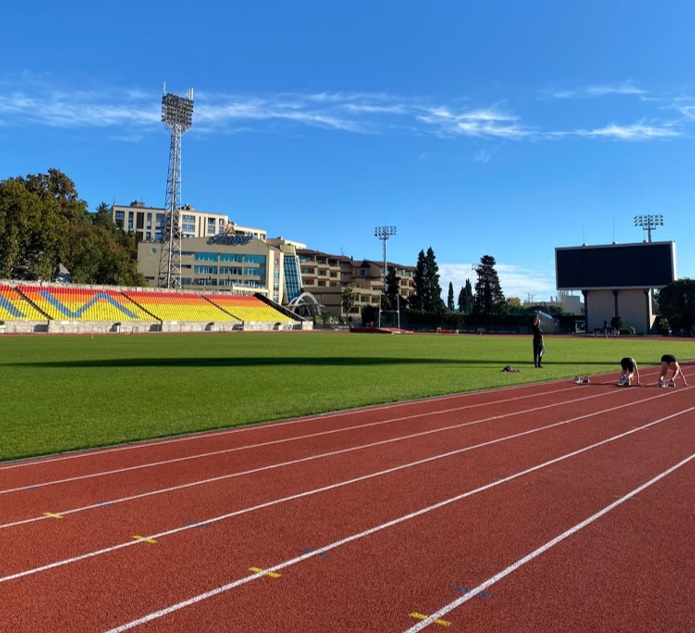
Fig. 2. Slava Metreveli Central Stadium
In 1968, the Repiblican Youth Alpine Skiing Sports School was opened in Krasnaya Polyana. Since then, Sochi started developing as a ski resort. In 1992, the Alpika-Service company built the first ski elevator in Krasnaya Polyana, which quickly gained popularity among extreme skiers. The first Winter Olympics in Russia gave a strong impetus in the settlement’s development and brought worldwide fame of an all-season mountain resort [16].
The “Spartak” Sports and Health Center is one of the oldest buildings in Sochi. It was built in 1983. It often hosted competitions of all categories, including the international ones. The Complex was opened on February 24, 1984. It included halls for gymnastics, boxing, wrestling, an arena with 300 seats, a standard soccer field with 4 500 seats, a running track (8 on the curve and 10 in a straight line) and four track-and-field sections. In 2014, a massive fire happened, but some halls survived, in which young athletes practiced after the accident [17].
In 2010, 23 Youth Sports Schools were operating (fig. 3), they were subordinate to the Department of Education and Science and the Department of Physical Culture and Sports of the City Administration, as well as two schools of the Department of Physical Culture and Sports of the Krasnodar Krai. In total, about 13 thousand students were studying in sports schools of Sochi [18].
According to the Sochi Administration [19], at the present moment, the number of sports institutions in operation is 19, with 12 000 children enrolled in municipal sports schools. In addition, the design and construction of seven sports facilities is underway. Moreover, construction of additional sports facilities is planned in Sochi within the period from 2023 to 2026 [20].
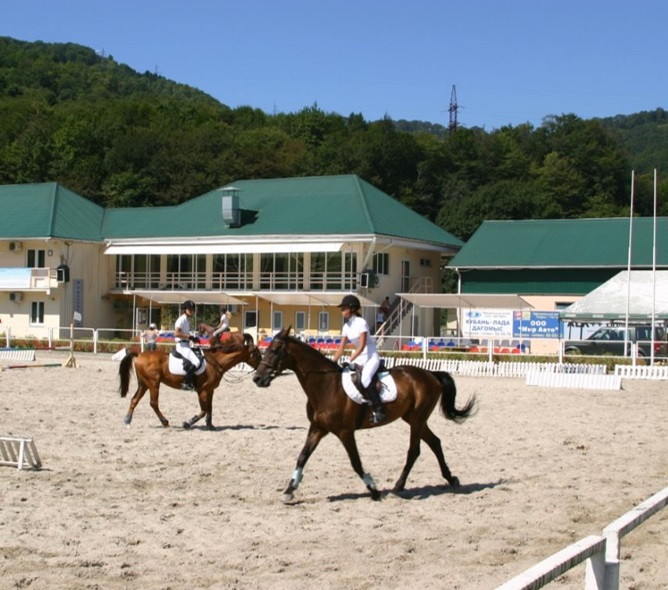
Fig. 3. Youth Sports School No 1
However, aside from municipal sports schools, Sochi has more than 30 training centers, the main objective of which is to attract children and teens to engage in physical culture regularly. Most training centers are located in sports facilities of the Olympic park. The sports heritage of the Sochi 2014 Olympics is located in two clusters: coastal and mountain. It will work for the benefit of the country for many years to come, and it is not by chance that in the post-Olympic period much attention is paid to Sochi as a national training base [21].
The coastal cluster is located in the Imereti Lowlands and includes following facilities: the Fisht Stadium (fig. 4), the Bolshoy Ice Dome, the Iceberg Skating Palace, the Adler Arena Skating Center, the Shayba Arena, the Ice Cube Curling Center. The mountain cluster is located about 40 kilometers from the Imereti Lowlands in the mountains of Krasnaya Polyana and includes following facilities: the Rosa Khutor Alpine Resort, the RusSki Gorki Jumping Center, the Sliding Center Sanki, the Rosa Khutor Extreme Park, the Laura Biathlon & Ski Complex. Some of the aforementioned facilities hold classes for sports schools, others – classes for sports clubs. By 2030, modern sports infrastructure will be created in several microdistricts of Sochi. The City Administration has allocated land plots for these purposes, which are now assigned to sports institutions [22].
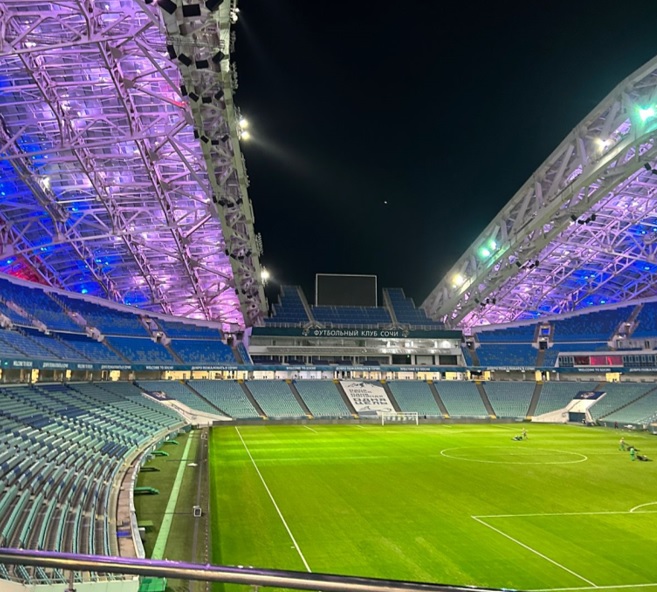
Fig. 4. Fisht Olympic Stadium
Conclusion. Therefore, the number of young athletes in Sochi is growing every year, which is due to population growth and an increase in the number of sports municipal institutions, as well as the popularization of physical culture and sports among young people.
Conflict of interest. The authors declare no conflict of interest.
REFERENCES
- On the development of children's and youth sports in the Russian Federation. Federation Available at: http://council.gov.ru/activity/documents/124561/ (accessed 19.09.2023). (in Russ.)
- Babtseva A.F., Arutyunyan K.A., Bojchenko T.E., Romantsova E.B. Anatomical and physiological features of organs and systems in children. Blagoveshchensk: Bukvitsa, 2010. 60 p. (in Russ.)
- Esakov S.A. Short course in anatomy and physiology of children and adolescents. Developmental anatomy and physiology (course of lectures). Izhevsk: Udmurt State University, 2010. 195 p. (in Russ.)
- Vasil’eva E.I. Musculoskeletal system: anatomical and physiological features, research methods and semiotics of the main lesions: a learning manual for students. Irkutsk: Irkutsk State Medical University, 2013. 24 p. (in Russ.)
- Basics of sports training: textbook of the Ministry of Education and Science of the Russian Federation. Kazan: Tatar State University of Humanities and Education, 2007. Available at: https://docs.ru/docs/view?tm=1695980779&tld=ru&lang=ru&name=osn.spor.podgot.pdf&text=подготовка%20юных%20спортсменов%20книги&url=https%3A%2F%2Fkpfu.ru% (accessed 27.09.2023). (in Russ.)
- Reshetnik L.A., Ptichkina O.I., Prokopyeva O.V., Parfenova E.O. Anatomical and physiological features of the respiratory, circulatory, hematopoietic, digestive and urinary systems: and educational and methodological manual. Irkutsk: Irkutsk State Medical University, 2017. 24 p. (in Russ.)
- Erikov V.M., Nikulin A.A., Sidorenko T.A. Anatomical and physiological features of the human body: a textbook. Moscow-Berlin: Direct-Media, 2020. 316 p. (in Russ.)
- Tudor O. Preparation of young champions. Available at: https://docs.yandex.ru/docs/view?tm=1695980103&tld=ru&lang=ru&name=bompa_tudor_-_podgotovka_yunyh_chempionov.pdf&text (accessed09.2023). (in Russ.)
- Nikitushkin V.G. Modern training of young athletes: a methodological manual. Moscow: Moskomsport, 2009. 112 p. (in Russ.)
- Dvorkin L.S. Training of a young Moscow: Sovetskij sport, 2006. 452 p. (in Russ.)
- Metreveli S.K. Biography. Available at: https://ru.wikipedia.org/wiki/%D0%9C%D0%B5%D1%82%D1%80%D0%B5%D0%B2%D0%B5%D0%BB%D0%B8,_%D0%A1%D0%BB%D0%B0%D0%B2%D0%B0_%D0%9A%D0%B0%D0%BB%D0%B8%D1%81%D1%82%D1%80%D0%B0%D1%82%D0%BE%D0%B2%D0%B8%D1%87 (accessed09. 2023). (in Russ.)
- Sports school in Sochi. Available at: http://wap.kafelnikov.borda.ru/?1-1-0-00000021-000-0-0 (accessed10.2023). (in Russ.)
- Sharapova M.Yu. Biography. Available at: https://ru.wikipedia.org/wiki/%D0%A8%D0%B0%D1%80%D0%B0%D0%BF%D0%BE%D0%B2%D0%B0,_%D0%9C%D0%B0%D1%80%D0%B8%D1%8F_%D0%AE%D1%80%D1%8C%D0%B5%D0%B2%D0%BD%D0%B0 (accessed10.2023). (in Russ.)
- Sochi Sports School No 1. Available at: http://sport1.sochi-schools.ru/sveden/istoriya / (accessed09. 2023). (in Russ.)
- Yug-Sport. Federal Sports Base of the Ministry of Sports of Russia. Available at: https://www.yug-sport.ru/news/stadion-fgbu-yug-sport-na-kotorom-igrali-metreveli-i-neymar-otmechaet-segodnya-svoye-55-letie (accessed 09/22/2023). (in Russ.)
- Ski resorts of the world. Available at: https://skiings.ru/sochi.html (accessed09.2023). (in Russ.)
- Sports and Recreation Complex “Spartak”. Available at: https://sochi.kudago.com/place/sportivnyj-kompleks-spartak/ (accessed09.2023). (in Russ.)
- News of Krasnodar, Krasnodar Krai and Available at: https://www.yuga.ru/articles/sport/amp/5976.html) (accessed 13.09.2023). (in Russ.)
- Official portal of Sochi. Available at: https://sochi.ru/gorod/sochi-v-tsifrakh/ (accessed09.2023). (in Russ.)
- GTO Sochi. Available at: URL: https://zvezdasochi.ru/tpost/79soallu11-gto-v-sochi (accessed 26.09.2023). (in Russ.)
- Romanova L.M. Serdyukova N.K. Promoting Sochi as a Tourist Destination in the Post-Olympic Period. European Journal of Physical Education and Sport, 2014, vol. 3, no. 1, pp. 68-75.
- Latest news from Russia and worldwide. Available at: https://www.kommersant.ru/doc/4594386 (accessed 25.09.2023). (in Russ.)
INFORMATION ABOUT THE AUTHORS:
Irina Konstantinovna Zabelo – 3rd year Student of the Social Pedagogical Faculty, Sochi State University, Sochi, e-mail:
Elena Fedorovna Legkaya – Candidate of Biological Sciences, Associate Professor of the Department of Physical Culture and Sports, Sochi State University; Senior Lecturer of the Department of Biomedical, Environmental and Veterinary Areas, Sochi Institute, branch of the Peoples' Friendship University of Russia, Sochi, e-mail:
Leonid Sergeevich Khodasevich – Doctor of Medical Sciences, Professor of the Department of Physical Culture and Sports, Sochi State University, Sochi; Professor of the Department of Medical Rehabilitation, Kuban State Medical University, Krasnodar, e-mail:
For citation: Zabelo I.K., Legkaya E.F., Khodasevich L.S. Development of youth sports in Sochi: content analysis of information sources. Russian Journal of Sports Science: Medicine, Physiology, Training, 2023, vol. 2, no. 4. DOI: 10.24412/2782-6570-2023_02_04_7