


Download the article in pdf format
Publication date: 15.03.2025
DOI: 10.24412/2782-6570-2025_04_01_8
UDC 796
PROBLEMS OF INTEGRALITY OF SPORTS TRAINING THEORY: BLOCK PERIODIZATION VERSUS TRADITIONAL SPORTS TRAINING THEORY
A. Petrovic, V. Koprivica
University “Union – Nikola Tesla”, Belgrade, Serbia
Abstract. The main problem of this research was to find an answer to the question whether the theoretical assumptions related to the structure of sports training (principle relationship between microcycle, mesocycle and macrocycle) in traditional sports training theory are of a subjective/mechanical or objective/integral character. The aim of this research is to show the essence of the principle relationship between microcycle, mesocycle and macrocycle in sports training. Authors of the block periodization theory of sports training vigorously opposed the traditional sports training theory and pointed out that it has no objective scientific basis. Is that a justified claim that the timely integration of the effects of the microcycle, mesocycle and macrocycle of sports training explains the sporting form? The basic assumptions of traditional sports training theory are based on objective scientific knowledge of an integral character, and not on the subjective and mechanical division of the training process.
Keywords: load, adaptation, training effects, sporting form, macrocycle, periodization.
Introduction. There are several research programs considered within the knowledge expressed by leading theorists about sports training [1-9]. All “smaller research programs” have integrated into “larger research programs,” which are denoted by the terms: traditional theory of sports training (TSTT) and block periodization theory of sports training (BPTST).
In the past 30 years, the problems of sports training theory have been increasingly discussed. The main characteristic of the discussion in the mentioned period is the beginning of the dialogue between Matveyev and Verkhoshansky on the periodization of sports training. Verkhoshansky began a dialogue with Matveyev with a fierce critique of the TSTT, and after that came Matveyev’s response him [10, 11]. This dialogue was joined by other sports training theorists who defended Verkhoshansky [4, 12-14] or Matveyev [15-17]. The dialogue on current problems of periodization of sports training has continued, and in it the authors try to point out the strengths and weaknesses of the basic assumptions of rival theories [18-20].
The problem of interpreting the theory of sports training can be seen in the latest wave of dialogue on basic theoretical assumptions. BPTST starts from the assumption that the training process is founded on a “biological background” based on the theory of human adaptation, which includes the theories: homeostatic regulation, stress adaptation and supercompensation [21]. On the other hand, there is a thesis that shows that the interpretation of periodization based on “biological background” and “stress theory” (patterned application of mechanical load causes adaptation) is outdated and that a broader context of understanding training periodization should be approached. Based on the misinterpretation of the phenomenon of stress and the “recycling of old dogma”, it was wrong to conclude that the periodization of sports training is based on old knowledge about stress [22].
It has been said and written that in TSTT, the training process is interpreted in a mechanical way, and that there is a subjective division of cycles, phases and periods. Verkhoshansky writes: Serious criticism by specialists practitioners refers to the essence of the concept of periodization of sports training – formal, mechanical fragmentation of the training process into subjective division of its parts (cycles, stages, periods) – that was the main idea and meaning of the concept of periodization of sports training [10]. In order to get a better interpretation and understanding of the problem, which is still relevant today, it is necessary to present the essence of the training structure in the macrocycle and essentially consider the objection made by Verkhoshansky.
The problem set by this research was to find an answer to the question whether the theoretical assumptions related to the structure of sports training (principle relation of microcycle, mesocycle and macrocycle) in the TSTT are of a subjective/ mechanical or objective/integral character. The main goal of this research is to present the essence of the principle relationship between the microcycle, mesocycle and macrocycle in the TSTT and to point out the correct interpretation of the basic theoretical assumptions.
Methods and organization. Analysis of domestic and foreign literature on the topic. A total of 29 sources were included.
Results and discussion. Theoretical fundamentals of the macrocycle in sports training. Every training cycle, regardless of whether it refers to a microcycle, mesocycle or macrocycle, has its own objective meaning and goal. The theoretical-methodological basis for the construction of the annual preparation is the theory of periodization, which was developed by L. P. Matveyev in his fundamental works, as well as authors such as Ozolin, Harre, Zhelyazkov, Martin, Carl and others [6]. Periodization of sports training deals with understanding the period of sports training, i.e. control of sporting form over time. Matveyev [23] was the first author to explain on a scientific level the basics of periodization of sports training and its principles, and thus set the foundation of the theory of sports training. The basic issue addressed by the periodization of sports training refers to the problem of organization and realization of training in time. In order for the training to be rationally organized and realized in the available time for preparation, with the goal of successful participation in the competition and achieving a positive sports result, the theory of periodization appeared, which divides time into periods. The aim of the periodization theory is to control the sporting form and achieve the best state of readiness and preparedness during the main competitions – achieving/demonstrating the best result [24]. Duration as a component of time is directly related to sporting form and says that sporting form lasts for a limited period of time [8, 24, 25]. The basic principle by which a sporting form can be explained, i.e., by which a sporting form is recognized, is the waves of the dynamics of its occurrence. Sporting form occurs in the form of large waves in the macrocycle. In large waves, three phases are regularly changed:
1) the phase of formation of a sporting form;
2) the phase of preserving relative stability of a sporting form;
3) the phase of temporary loss of a sporting form [8, 23, 26].
The phenomenon of changing the phases of sporting form occurs in cycles. The order of changing the phases of building a sporting form is always the same, and the number of cycles of a sporting form in one macrocycle defines the variant of periodization of sports training (monocycle, bi-cycle, tri-cycle, but there are other variants) [6, 23, 26]. The essence of the principled, phased occurrence of sporting form is not in the number of waves that occur in the macrocycle (the number of waves can be larger or smaller) but in the cyclical, principled change of the mentioned three phases which explain the dynamics of sporting form.
The main purpose of dividing the training process into periods is to acquire the conditions to build a wave of sporting form, i.e., the sporting form itself during the main competitions. Time units such as the preparation period, the competition period and the transition period are relatively independent, and at the same time inextricably linked. The essence of the division of training into periods lies in their easier integration into a whole. The greatest degree of integration is the integration of training and competition in the function of achieving results in the main competitions.
Within the period, there are stages in which the content of the training is defined. The preparation period is usually divided into the general preparation stage and the specific preparation stage. These stages of the preparation period are a precondition for the stage of integral preparation [26]. In the stages of the preparation period, through the application of exercises in training, the following are optimized:
1) the relationship of different types of preparation (physical, technical, tactical and psychological);
2) the relationship of volume and intensity;
3) the load in training.
All with the aim of acquiring conditions for the phase, which refers to the relative stabilization of sporting form.
A high degree of optimization is achieved by respecting the principles of sports training. The phase of relative stabilization of the sporting form coincides with the stage of integral preparation, i.e., with the whole competition period (if it lasts for a short time) or with the period of the most important competitions (if it lasts for a longer time). The content of the training, the optimization of the work from the aspect of the specificity of the training process, largely determines the large wave in the macrocycle. In the macrocycle, integrality and specificity of the training process are controlled sporting form.
Theoretical fundamentals of microcycles and mesocycles in sports training. The microcycle is a complete work unit of training that can be different in duration, content and structure [26]. One of the basic characteristics of the microcycle refers to the processes of fatigue and recovery, as a result of the load on individual trainings [6, 9]. This process represents the relationship between fatigue and recovery in the microcycle that occurs as a consequence of the application of load during individual trainings. Fatigue and recovery are directly related to the size and direction of the load. Applying the appropriate load in a series of training in a microcycle can cause fatigue, recovery, as well as adaptation processes in the athlete’s body. It should be remembered that the adaptation processes are directly related to the principles of sports training, which are based on biological and pedagogical principles [8, 27].
The principled change of the phase of fatigue and recovery during one-time loads causes short-term adaptation. On the other hand, by changing fatigue and recovery after a series of one-time loads, the process of long-term adaptation will gradually begin [6, 28]. Structural changes of adaptation can be achieved after a series of applied loads in which the continuity of the training process is not disturbed. Usually, microcycles last from 2-3 to 10 days, and in that short period of time it is not possible to achieve long-term adaptation in the athlete’s body. It is possible to induce or complete of adaptation processes with a series of individual trainings. The goals of the microcycle can be different and depend on the stage or period of training in which they are conducted. The basic principle of microcycle control refers to the optimal application of load, in a short period of time, which has wavy dynamics. When optimizing the load in the microcycle, a distinction should be made between the stimulating phase (in which different variants of load dynamics can be applied) and the recovery phase (which can provide supercompensation after an individual training, as well as a small wave of training effects on previously applied load).
After the applied load in the individual training (whether it is a consequence of training of minimum targeted abilities or complex training), the process of supercompensation begins. Supercompensation is a biological principle that in sports training refers to the function of energy systems, and not to the optimization of work and rest or to the generalization of this phenomenon in the preparation of athletes [29].
The basis of short-term adaptation is the theory of supercompensation and the application of one-time loads, and the basis of long-term adaptation is the application of multiple loads and control of training effects. Depending on the period and stage of training, the main purpose of the microcycle is to optimize the load and various effects of training in order to achieve optimal preparation of athletes. The correct relationship between the stimulating phase and the recovery phase ensures the optimal load that occurs in the form of small waves in the microcycle. As a consequence of the application of loads in small waves, the characteristic of microcycles – a wave of training effects – occurs.
By linking a series of microcycles to the mesocycle, the load is controlled, which results in the cumulative effect of training. The load can be different in the microcycle, mesocycle and macrocycle, and is defined in relation to their characteristics and components. The main goal of mesocycle control is that the overall/cumulative effect of training, as a consequence of a series of applied loads in microcycles, is manifested during the main competition. Unlike the short-term effects of training in the microcycle, the cumulative training effect, as a consequence of the mesocycle, is a more permanent, more stable change. Therefore, the effect of training, in relation to the applied dynamics of load in the microcycle, will be different in different periods, as well as in the stages of training.
Integrating Microcycles, Mesocycles and Macrocycles of Training. The objective dynamics of each cycle in training is that the effects of the applied load occur in waves, and that the peak of the waves of positive effects of training can be in different periods of the macrocycle, depending on the set goal. Figure below shows the principle of the integration of structural elements of sports training in a monocycle variant of periodization, with the aim of achieving the best result in the main competition. This principle is of a generalizing character and can be applied to other variants of periodization of sports training.
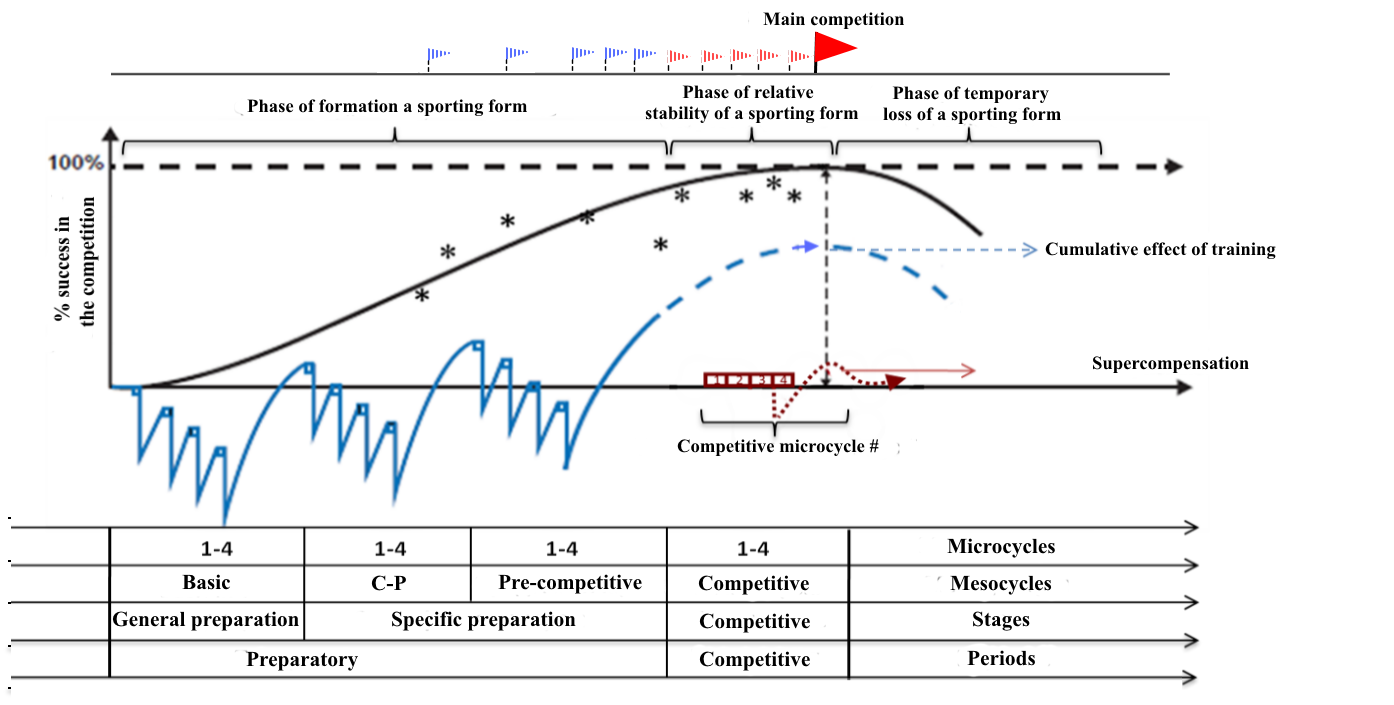
Fig. Integrating the structural elements of the training process in a monocycle variant of periodization
Note: * – result in competitions; C-P – control-preparatory microcycle. The competition microcycle is magnified to show more clearly on the chart. There can be more competitive microcycles in the competition period and stage.
A distinction should be made between the wave of the load dynamics in the microcycle, mesocycle and macrocycle and the training effects that result from the application of the load in the mentioned cycles. The smallest wave of training effects that can occur is supercompensation. This phenomenon explains the effect of individual training, i.e. the effects of the solved task or tasks on individual training by applying a one-time load. By summing several supercompensation effects, a wave of effects is achieved, which is a consequence of the dynamics of small load waves. This phenomenon is characteristic of the training microcycle. The first meaning of the microcycle lies in the integration of the peaks of the supercompensation wave with the wave of training effects as a consequence of the application of small load waves. The second meaning of the microcycle refers to the integration of the peak of the training effect wave in the microcycle with the peak of the training effect wave in the mesocycle.
The mesocycle of training connects the wave of training effects in the microcycle with the wave of training effects in the macrocycle. In the mesocycle, the wave of training effects is controlled, which has a cumulative character. The first meaning of the mesocycle lies in controlling the cumulative training effect. The second meaning is to integrate the peak of the cumulative effect of training with the peaks of the waves related to the dynamics of the effects of training in the microcycle, as well as individual training. The third meaning refers to the fact that the wave of training effects in the mesocycle is integrated with the wave of training effects in the macrocycle.
In the macrocycle lies control the large of waves that are characteristic of sporting form. The main characteristic of the big wave is load optimization and specificity control in physical, technical, tactical and psychological preparation. The essence of the control of specific work is the integration of different types of preparations, with the aim of achieving sporting form during the main competitions. First, the macrocycle integrates the effects of small and medium waves of training with the large wave of training effects, which in an integral sense represent a sporting form. The highest degree of integration of different types of preparations is achieved during the competition period by a series of competitions that precede the main competition (fig.). The result at the main competition is the basic criterion of sporting form. Secondly, it is necessary to integrate the sporting form with the period of the main competitions. With the absence of an integrated approach in sports training, the possibility of controlling the training process is practically lost.
The extent to which authors who talk about the mechanical planning of the microcycle and mesocycle within the macrocycle are not right is best seen at the time of the most important competition (fig.). Then the effects of supercompensation of the last microcycle, the cumulative effects of pre-competition mesocycle training and the state of the athlete’s sporting form must be integrated. Each of the three components must be prepared separately and integrated in a timely manner into a single unit in relation to the most important competition. If one of those three components is not at the required level at the same time – the time of the competition – the athlete cannot achieve his or her best result.
Final comment. It should be remembered that any mechanical management of sports training directly violates and crushes the principle of building a sporting form. Verkhoshansky’s thesis that the meaning of TSTT is “mechanical fragmentation of the training process” absolutely does not correspond to the basic theoretical assumptions related to the building of the training process. Such a thesis probably arose as a need to quantify training. The value of the quantitative aspects of training is of great importance, there is no doubt about that. However, the full meaning of the training process is achieved when the training is supplemented with qualitative aspects, which means an integral, unified view of all aspects of the training process. The integrality of various aspects of sports training is not based on subjective-speculative principles such as: “it can be either this or that way,” but on objective theoretical bases that have a principled character and that are practically applicable. In serious theoretical analyses that have been presented to the scientific community during the history of the development of the theory of sports training, nowhere is it written that training is partially mechanically built on the basis of a subjective division of cycles, stages and periods. The basic guideline of the whole research program, which refers to the TSTT and the Eastern European scientific school, refers to the integration of scientific knowledge in the function of achieving results in the main competitions. Without objective evidence, a critique of the TSTT has recently begun, which is being multiplied on the basis of unchecked and insufficiently strong scientific evidence.
Conclusion. There is an objective structure of sports training based on the principles of sports training. These principles do not have a fragmentary character but are interconnected and form an inseparable whole. The main purpose of studying the principles is the integration of different parts of sports training, and not arranging and stenciling its structural elements. The TSTT is scientifically based, it contains biological-pedagogical knowledge that is a consequence of many years of research work. As can be seen, the TSTT is not built on a template, mechanically or subjectively, as Verkhoshansky and his followers believe. The basic theoretical assumptions of TSTT testify to the integrality of the training process - integrating the aims of the microcycle, mesocycle and macrocycle with the aim of achieving results in the main competitions. The control of the sporting form and the training process depends on the degree of integration of the goals of the microcycle, mesocycle and macrocycle, and not on the subjective division or template arrangement of the structural elements of sports training.
In line with what has been said, it is still early to accept BPTST as a “new theory”, a “new paradigm”. It is necessary to consider more carefully the existing knowledge about sports training and to determine whether the new knowledge about sports training is incredible in the light of already existing knowledge, and then propose a new theory or theorem. Future theoretical knowledge should be supplemented by interpretations that tell what the similarities are, not just the differences between TSTT and BPTST.
Conflict of interest. The authors declare no conflict of interest.
REFERENCES
- Bompa T., Haff G.G. Periodization: theory and methodology of training. Champaign: Human Kinetics, 2009. 355 p.
- Bondarchuk A. Transfer of Training in Sports. Michigan: Ultimate Athlete Concepts, 2007. 236 p.
- Harre D. Principles of sports training: Introduction to the Theory and Methods of Training. Berlin: Sportsverlag, 1982. 334 p.
- Issurin V.B. New horizons for the methodology and physiology of training periodization. Sports medicine, 2010, vol. 40, no. 3, pp. 189–206.
- Zhelyazkov T. Condition training of top athletes: theory, methodology, practice. Belgrade: Sports Academy, 2006. (in Serbian)
- Platonov V.N. The system of training athletes in Olympic sports. The general theory and its practical applications. Kiev: Olimpijskaya literatura, 2004. 809 p. (in Russ.)
- Dick F.W. Sports Training Principles: An Introduction to Sports Science. London: Bloomsbury Publishing, 2014. 448 p.
- Matveyev L.P. General theory of sports and its applied aspects. Moscow: Soviet Sport, 2010. 339 p. (in Russ.)
- Ozolin N. Coach Handbook: The Science of Winning (Profession – Coach). Moscow: ACT, 2011. 864 p. (in Russ.)
- Verkhoshansky Yu.V. On way to scientific theory and methodology of sports training. Theory and Practice of Physical Culture, 1998, no. 2, pp. 21–41. (in Russ.)
- Matveyev L. On discussion about theory of sports training. Theory and Practice of Physical Culture, 1998, vol. , no. 7, pp. 55–61. (in Russ.)
- Issurin V.B. Block periodization versus traditional training theory: a review. The Journal of Sports Medicine and Physical Fitness, 2008, vol. 48, no. 1, pp. 65–75.
- Bleer A., Bondarchuk A.P., Pavlov S.E., Kovilin M.M., Pavlov A.S. Ways of development the theory and practice of sports. Extrem Hum Act, 2014, vol. 32, no. 3, pp. 47–52. (in Russ.)
- Issurin V., Shkliar V. Concept of block composition in elite athletes training. Theory and Practice of Physical Culture, 2002, no. 5, pp. 2–5. (in Russ.)
- Kiely J. New horizons for the methodology and physiology of training periodization: block periodization: newhorizon or a false dawn? Sports medicine, 2010, vol. 40, no. 9, pp. 803–808.
- Koprivica V. Block periodization – a breakthrough or a misconception. SportLogia, 2012, vol. 8, no. 2, pp. 93–99.
- Platonov V. About “sports training periodization's conception” and athletes training's total theory s development. Theory and Practice of Physical Culture, 1998, no. 8, pp. 23–26. (in Russ.)
- Rønnestad, B.R., Zacharoff E.E., Vikmoen O., Hansen J., Hallén J. Effects of 12 weeks of block periodization on performance and performance indices in well‐trained cyclists. Scandinavian journal of medicine & science in sports, 2014, vol. 24, no. 2, pp. 327–335.
- Rønnestad B.R., Hansen J., Ellefsen S. Block periodization of high‐intensity aerobic intervals provides superior training effects in trained cyclists. Scandinavian journal of medicine & science in sports, 2014, vol. 24, no. 1, pp. 34–42.
- Petrović A. A dialogue on the sports training theories in professional and scientific periodicals. Physical Culture, 2017, vol. 71, no. 2, pp. 172–181.
- Issurin V.B. Biological background of block periodized endurance training: a review. Sports Medicine, 2019, vol. 49, no. 1, pp. 31–39.
- Kiely J. Periodization theory: confronting an inconvenient truth. Sports Medicine, 2018. vol. 48, no. 4, pp. 753–764.
- Matveyev L.P. Problem of periodization the sport training. Moscow: Fizkultura i sport, 1964. 246 p. (in Russ.)
- Platonov V.N. Theory of periodization of elite athlete preparation in the course of the year: background, formation, criticism. Science in the Olympic Sport, 2008, no. 1, pp. 3–23. (in Russ.)
- Matveyev L. Fundamentals of sports training. Moscow: Fizkultura i sport, 1977. 280 p. (in Russ.)
- Koprivica V. Sports Training Theory. Belgrade: SIA, 2013. (in Serbian)
- Platonov V.N. Special principles in the system of athletes’ training. Science in Olympic Sport, 2014, no. 2, pp. 8–19. (in Russ.)
- Platonov V.N. Adaptation in Sports. Kiev: Zdorov'ya, 1988. 217 p. (in Russ.)
- Platonov V.N. Phenomena of supercompensation and delayed training effect and their use in development of athletic training. Science in Olympic Sport, 2010, no. 1-2, pp. 3–13. (in Russ.)
INFORMATION ABOUT THE AUTHORS:
Adam Petrovic – Doctor of Science in Sports and Physical Education, Professor of Sports Training Theory and Motor Abilities, Vice-Dean for Science, Associate Professor, Faculty of Sport, University “Union – Nikola Tesla”, Belgrade, Serbia, e-mail:
Vladimir Koprivica – Doctor of Science in Physical Culture, Professor of Sports Training Theory and Theory of Sports, Faculty of Sport, University “Union – Nikola Tesla”, Belgrade, Serbia, e-mail:
For citation: Petrovic A., Koprivica V. Problems of integrality of sports training theory: block periodization versus traditional sports training theory. Russian Journal of Sports Science: Medicine, Physiology, Training, 2025, vol. 4, no. 1(13). DOI: 10.24412/2782-6570-2025_04_01_8